
Moonshot announced Kimi K3.1 Pro on October 24, 2026, offering a one-million-token context window and immediate hosted access alongside a faster Highspeed variant. The company describes it as its most capable 3-trillion-parameter-class model and the first release in the K3.1 series. Full model weights are promised by November 4, 2026, so hosted availability and downloadable weights are separate milestones. Moonshot’s announcement
Developers face two distinct choices. The immediate one is commercial: whether Highspeed’s advertised responsiveness justifies higher token prices. The later one concerns deployment control, licensing and safety once weights become available. Moonshot says it deliberately reduced offensive cyber capability ahead of that release, publishing an internal comparison that quantifies the trade-off on one test.
What Developers Can Use Now
Moonshot says both Kimi K3.1 Pro and Kimi K3.1 Pro Highspeed are available through:
- Kimi.com, its browser-based product.
- Kimi Work, its work-oriented offering.
- Kimi Code, its coding product.
- The Kimi API, for developer integrations.
The reported API model identifiers are kimi-k3.1-pro and kimi-k3.1-pro-highspeed. Confirm the identifier and account access in the API console before integration; the launch pages are not a complete request-schema reference. The official API platform presents K3.1 Pro as the current flagship.
Hosted access lets developers begin evaluating the model without operating its inference infrastructure. It does not provide the same control as downloading weights and running them on a separately managed system.
The November 4 promise therefore matters for organizations considering self-hosting, infrastructure customization or deployments outside Moonshot’s hosted products. At announcement, the weights were not yet available, and final licensing and self-hosting requirements were not established. “Open-weight” should not be read as confirmation of an OSI-approved open-source license.
The 3-trillion-parameter-class description also supplies no hardware recipe by itself. For related infrastructure context, Zeniteq has covered how Cerebras maps a 3T Kimi model across 59 wafers; that earlier coverage is not a deployment specification for this release.
Highspeed Doubles Most Token Prices
Moonshot advertises Highspeed as delivering two to three times the speed of standard K3.1 Pro. Its API platform describes approximately threefold speed, equivalent intelligence and the same one-million-token context window. These are vendor claims, not published guarantees of application-level latency or quality parity.
The platform’s listed prices make the commercial distinction clearer:
| Specification or price | K3.1 Pro | K3.1 Pro Highspeed |
|---|---|---|
| Advertised context window | 1 million tokens | 1 million tokens |
| Advertised relative speed | Baseline | 2–3× |
| Input, per million tokens | ¥13.00 | ¥26.00 |
| Output, per million tokens | ¥68.00 | ¥136.00 |
| Cache write, per million tokens | ¥13.00 | ¥26.00 |
| Cache hit, per million tokens | ¥1.30 | ¥1.30 |
Prices are yuan-denominated rates listed on the Kimi API platform. MTok means one million tokens.
Highspeed doubles input, output and cache-write prices. Cache hits cost the same on both variants. That last detail means the premium depends on the workload’s token mix.
Consider an illustrative request billed for one million uncached input tokens and 100,000 output tokens:
- Standard: ¥13.00 input + ¥6.80 output = ¥19.80.
- Highspeed: ¥26.00 input + ¥13.60 output = ¥39.60.
Now assume the same input is billed entirely at the listed cache-hit rate:
- Standard: ¥1.30 cached input + ¥6.80 output = ¥8.10.
- Highspeed: ¥1.30 cached input + ¥13.60 output = ¥14.90.
These are calculations from published rates, not observed bills. The cached example assumes the input qualifies for cache-hit billing; it excludes any earlier cache-write charge.
The practical implication is that Highspeed’s total premium need not remain exactly twofold. Repeated, cache-heavy input reduces the relative premium, while newly processed input and generated output retain doubled rates.
I’d start with standard Pro for background jobs and evaluate Highspeed where waiting interrupts a person’s workflow. The justification is economic: the published pricing buys claimed responsiveness without a larger advertised context window. A faster model can still spend time waiting for tools, fetching documents or retrying failed steps, so a two-to-threefold model-speed claim should not be converted directly into the same reduction in total job time.
A Million Tokens Expands Scope, Not Proven Reliability
The one-million-token window gives K3.1 Pro room for large document bundles, substantial code context or lengthy agent histories. Tokens are the model’s processing units, not words, and the amount of source material that fits varies with language, code and formatting.
Capacity and usefulness remain separate questions. A context limit says how much material the model can accept. It does not show that the model will reliably retrieve every relevant fact, reconcile conflicting documents or maintain accuracy throughout a long task.
Moonshot describes K3.1 Pro as a post-trained version of Kimi K3, using substantially more post-training compute. It says the work involved joint reinforcement learning across hundreds of downstream domains, supported by changes to long-context inference, training efficiency, sandbox infrastructure and rollout scheduling. Technical announcement
For developers, the useful evaluation is whether the model correctly uses the information that matters to a task. A repository-level assistant might need to connect an API change with distant callers and tests. A financial assistant might need to reconcile figures across several filings.
My view is that the larger window is most valuable when it reduces damaging omissions. Filling it merely because it exists can add input cost without improving an answer. Retrieval, document selection and compact task state remain sensible design choices even when the ceiling is high.
Moonshot’s Benchmarks Make the Performance Case
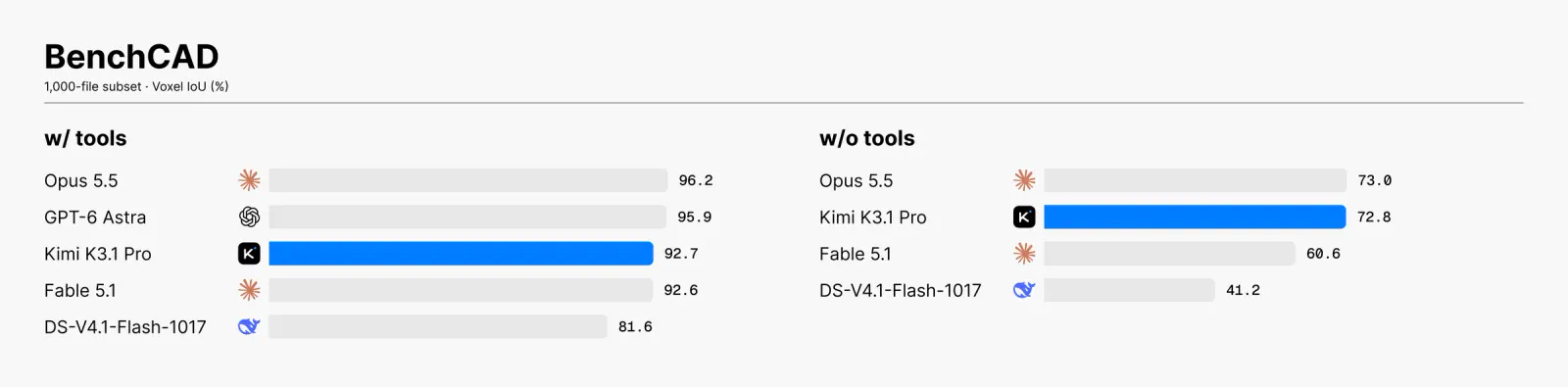
Moonshot reports improvements across coding, 3D creation and financial work. Its announcement mixes named benchmarks with internal evaluations, so the test conditions and ownership matter.
| Evaluation | Moonshot-reported result | Relevant condition or comparison |
|---|---|---|
| Terminal-Bench 4.0 | 65.7% | Resource-constrained terminal tasks; Moonshot lists GPT-6 Astra at 58.2% and Claude Opus 5.5 at 66.4% |
| Kimi Code Bench 3.0 Long-horizon | 61.2% | Internal multi-step coding benchmark; K3 scored 55.95% |
| BenchCAD | 92.7% | Tool-assisted CAD reconstruction from multi-view renderings |
All figures above come from Moonshot’s announcement. They are company-reported results, not independently reproduced measurements.
The Terminal-Bench result places K3.1 Pro between the two proprietary models in Moonshot’s published comparison. It supports a specific competitive claim on that evaluation, not a general ranking across coding work.
Frequently Asked Questions
3 questions
1Can Developers Use Kimi K3.1 Pro Now?
Yes. Moonshot announced hosted access through Kimi.com, Kimi Work, Kimi Code and the Kimi API for both standard Pro and Highspeed.