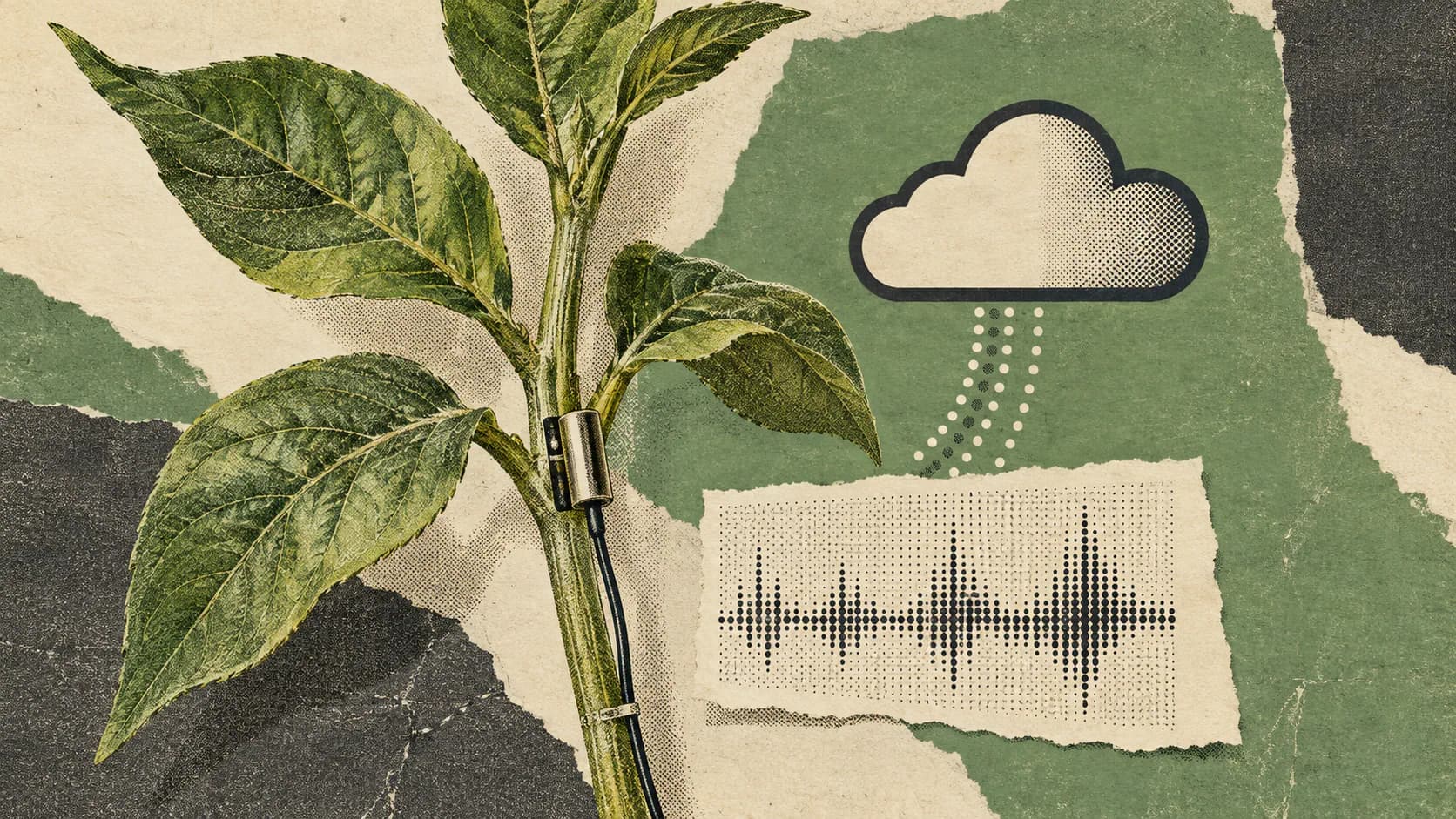
Electric Plant says its Bombadil AI model can interpret electrical signals from about 125 plant species, turning measurements from living tissue into recommendations for growers. TechCrunch’s October 20, 2026 report disclosed an $11.2 million seed round to commercialize the system.
The startup, founded by Justin Mast and neuroscientist Lee von Kraus, has spent three years collecting plant electrical data, according to the report. Its ambition is to give growers a continuous view of plant physiology that can inform watering, fertilization and other care decisions.
The important distinction is between estimating a plant’s condition and proving that acting on that estimate improves a crop. Electric Plant has described its sensing system and model-training scope. The founders’ claims about higher yields and water savings require a separate kind of evidence.
How Signals Travel From Plant Tissue to the Cloud
Electric Plant’s system starts with a physical connection to the plant. TechCrunch describes sensors attached using stainless steel screws that penetrate the cambium, the living tissue layer just beneath bark. Those contacts pick up electrical changes measured in microvolts, or millionths of a volt.
The company’s October 19 white paper describes recording plant signals through a pair of differential extracellular electrodes inserted into signal-conducting tissue. In plain terms, the equipment measures voltage differences through contacts placed in the plant.
The reported workflow has four stages:
- Collect: Attached sensors record electrical activity within plant tissue.
- Transmit: A low-power wireless network carries the measurements to a base station.
- Analyze: Bombadil processes the data in the cloud.
- Recommend: Results return to the customer, who can adjust watering or fertilizer schedules.
This is a monitoring and decision-support workflow. The report describes recommendations going back to growers; it provides no demonstration of an autonomous irrigation system.
The physical setup also matters. A cloud model still needs installed contacts, a working connection and a deployment that produces useful signals. Electric Plant’s website lists on-site installation and calibration among its offerings, making deployment part of the product rather than leaving growers with software alone.
Mast told TechCrunch that a couple of sensors per acre can deliver accurate results. That density could make large deployments less expensive, but it introduces a practical question: how well do a few instrumented plants represent the rest of a field? Differences in soil, irrigation delivery and plant condition make sensor placement consequential.
“Plant Language” Means Physiological Inference
Bombadil analyzes electrical activity associated with plant physiology. It is not translating sentences formed by plants.
Plants generate electrical signals in response to environmental stimuli, and those signals can propagate through their tissues. Electric Plant’s white paper describes several forms, including fast action potentials, slower variation potentials commonly associated with damage, and transient changes called system potentials.
The model’s job is to find useful relationships between this electrical activity and physiological state. Electric Plant says Bombadil was pretrained without labels on more than four million recording hours from 100 species across ten environments, including laboratories, greenhouses, commercial orchards and natural forests.
Label-free pretraining means the model first learns structure in recordings without requiring a human-assigned condition for every example. The company then uses those learned representations to estimate seven physiological stress indicators from electrical signals alone. The available abstract does not enumerate all seven, so they should not be treated as an established list of diagnostic capabilities.
The same white paper explains why decoding these signals is difficult:
- A recording can mix stimulus-specific information with more general responses.
- Weak electrical signals are vulnerable to noise.
- A plant’s previous stress exposure can change its response to a later stimulus.
- Signal characteristics differ between species.
Those complications matter because a waveform is not a simple dictionary entry for “needs water” or “needs fertilizer.” A useful system must handle overlapping responses and changing conditions.
Mast captured the current direction in his TechCrunch interview: “We’re listening more than we’re speaking, but listening’s the first step.”
That is a more grounded description of the product than a conversational interface with plants.
Why 125 Supported Species and 100 Training Species Differ
Electric Plant’s published material contains two prominent species counts. They measure different things.
| Figure | Source and meaning |
|---|---|
| About 125 species | The interpretation coverage reported by TechCrunch, based on company statements |
| 100 species | The unlabeled pretraining corpus described in the October 19 white paper |
| Species without training labels | A transfer capability claimed in the white paper |
The reported 125-species coverage includes varied plant forms, with ferns, redwoods, tomatoes and dahlias among Mast’s examples. The white paper’s 100-species figure describes the recordings used for pretraining. Neither number should silently replace the other.
The transfer claim needs another distinction. A species can lack labeled training examples while still appearing in an unlabeled pretraining dataset. That differs from a model handling a species it has never encountered in any form.
Electric Plant’s website makes the broader claim that Bombadil can reveal health state in species it has never seen. Its white-paper abstract describes results involving species without training labels. Those statements concern related but different tests.
The useful reading is that Electric Plant is pursuing a model reusable across species and tasks. A coverage count alone cannot show whether performance is equally strong for a tomato plant, a fern and a redwood.
The available white-paper evidence covers its abstract and introduction, without enough evaluation detail to assess per-species accuracy, error rates or the strength of those transfer tests. Broad coverage is therefore a company-reported capability, not a published guarantee of uniform reliability.
The Commercial Product Includes Hardware and Deployment
Electric Plant’s current website describes a four-part offering:
- Bud: A low-cost probe that attaches to a tree and continuously streams electrical signals.
- Bombadil: The foundation model used to infer plant health state.
- The Insight Layer: Dashboards, alerts and agents configured around a customer’s operations.
- Deployment: On-site installation and calibration with the company’s team.
Frequently Asked Questions
3 questions
1What does Bombadil measure?
Sensors record electrical activity in plant tissue. Bombadil analyzes those recordings to estimate physiological state and stress indicators.