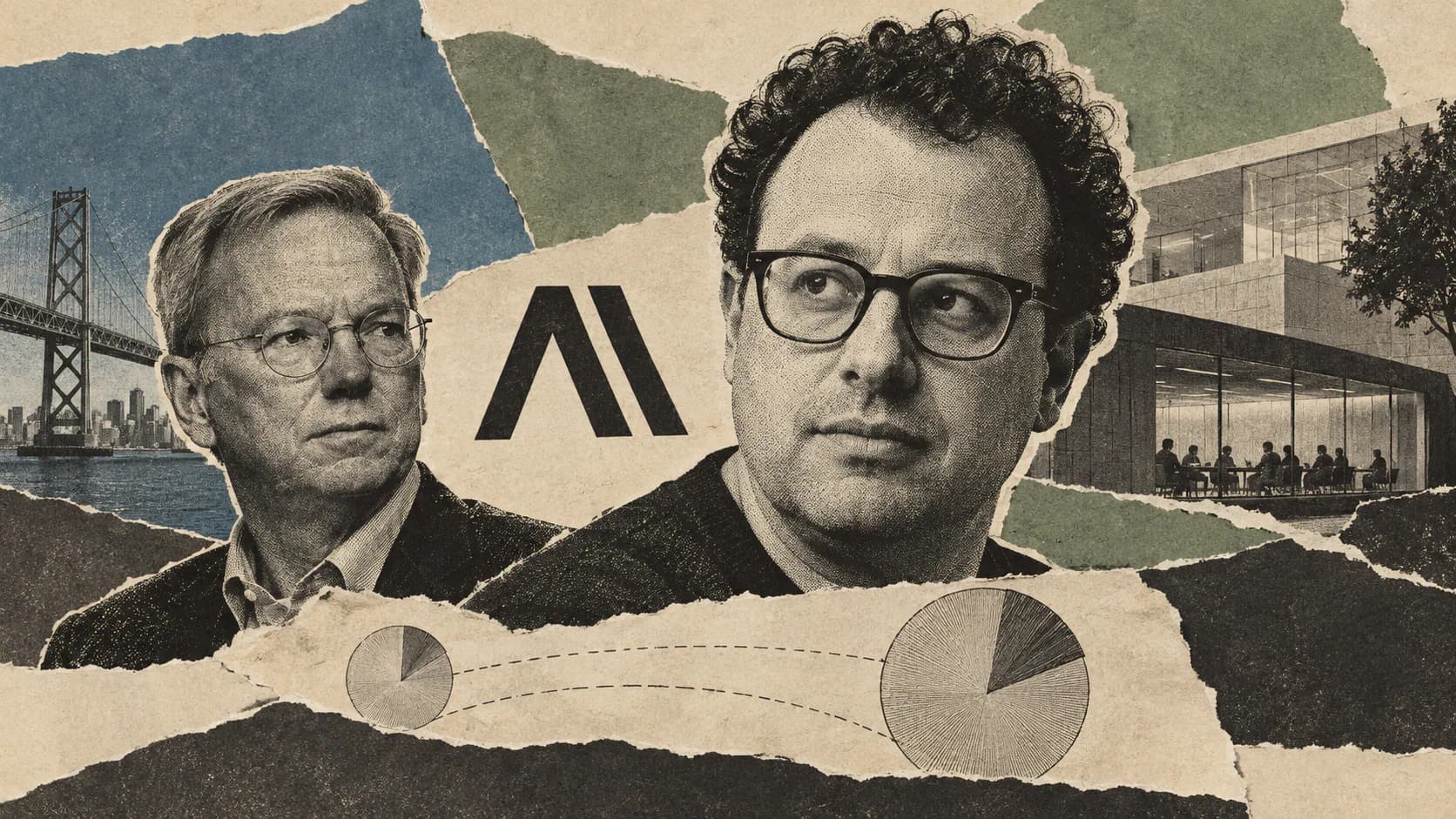
Eric Schmidt owns about 1% of Anthropic, according to Bloomberg, putting the former Google CEO’s estimated holding at roughly half the 2% that TechCrunch reports for co-founder and CEO Dario Amodei.
The comparison highlights how a large early investment can translate into substantial economic exposure to an AI company. It leaves several important questions open: how much either person’s holding has changed, what voting rights accompany their shares, and what those shares could actually fetch in a transaction.
What Bloomberg Reported
Bloomberg’s October 20, 2026, public post attributed Schmidt’s approximately 1% ownership to people familiar with the matter. It connected that holding to his early investment in Anthropic and described a prospective public-market debut.
TechCrunch’s report, published the same day, supplied the comparison with Amodei’s reported 2%. On those approximate figures, Schmidt has half Amodei’s economic stake, with a difference of about one percentage point.

These are media-reported ownership figures, not company-confirmed disclosures in the available evidence. The opened material consists of Bloomberg’s public post and TechCrunch’s account, without the underlying capitalization records or share-class terms needed to verify a like-for-like ownership calculation.
TechCrunch also said Schmidt and Anthropic did not immediately respond to its requests for comment.
The Early Investment Matters, but Dilution Is Unclear
Schmidt invested tens of millions of dollars in Anthropic’s 2021 Series A round, according to TechCrunch’s account of Bloomberg’s reporting. TechCrunch separately cited PitchBook data placing Anthropic’s valuation at $461 million at that time.
That gives readers useful context: the reported investment dates to a much earlier stage of the company. It does not provide enough information to calculate Schmidt’s original ownership or investment return.
Several missing details matter:
- The exact investment amount: “Tens of millions” is too broad for a reliable cost-basis calculation.
- The financing terms: A valuation alone does not specify every investor’s allocation or whether the figure measures value before or after new capital.
- Later transactions: Subsequent investments, share sales and other changes could affect a person’s eventual holding.
Dilution provides the basic mechanism. When a company issues additional shares, an existing shareholder’s percentage generally falls unless that person acquires enough additional shares to maintain it. A founder can therefore retain the same number of shares while owning a smaller fraction of the business.
My view is that the reported 1%-versus-2% comparison is useful as a snapshot, but weak evidence for reconstructing either person’s investment history. Neither percentage tells us how much dilution occurred, when it happened or what additional purchases might have offset it.
What a $2 Trillion Valuation Would Mean
TechCrunch reported that top-end market estimates put a possible Anthropic listing valuation as high as $2 trillion. It also said the company was widely expected to go public before the end of 2026. Both remain reported expectations, not confirmed pricing or a settled timetable.
Applying the two reported ownership percentages to the same hypothetical valuation produces this comparison:
| Person | Reported ownership | Paper value at a hypothetical $2 trillion valuation |
|---|---|---|
| Eric Schmidt | About 1%, per Bloomberg | About $20 billion |
| Dario Amodei | About 2%, per TechCrunch | About $40 billion |
These are simple calculations: $2 trillion multiplied by 0.01 or 0.02. They assume the percentages remain unchanged and that the valuation applies directly to those economic interests. They are not independent measurements of either stake’s current value.
The distinction matters because a paper stake value is different from sale proceeds. A listing could price lower, an offering could change ownership percentages, and restrictions could limit when shares become sellable. Taxes and transaction costs would also affect any eventual take-home amount.
Nor would a $20 billion paper value automatically mean Schmidt became $20 billion richer at the IPO. An existing private holding may already contribute to an estimate of someone’s wealth. Calculating an increase would require a starting value, while calculating an investment gain would require the cost basis.
I’d treat the $2 trillion figure as a scenario for understanding scale, not a forecast to build a wealth ranking around.
Economic Ownership Does Not Resolve Control
A reported 2% holding gives Amodei twice the economic exposure of a reported 1% holding on a comparable basis. It says little by itself about voting power.
Share classes can carry different voting rights, while board arrangements and governance provisions can affect decision-making separately from ownership percentages. The supplied reports do not disclose those terms for either holding.
That leaves two different documents to watch for: ownership and governance disclosures that clarify the stakes, and transaction terms that establish an actual price and route to liquidity. Until then, the strongest supported conclusion is the relative size of two reported holdings, with conditional arithmetic attached.
Frequently Asked Questions
3 questions
1Has Anthropic Confirmed Schmidt’s 1% Stake?
The available evidence contains no company confirmation. Bloomberg attributed the estimate to people familiar with the matter.
2Would Schmidt Receive $20 Billion From an IPO?
Not automatically. That figure is the paper value of 1% at a hypothetical $2 trillion valuation, not cash proceeds.
3Does Amodei’s Reported 2% Explain His Voting Power?
No. Economic ownership alone cannot establish voting power without information about share rights and governance arrangements.