
ARTEX AI is an open-source agentic penetration testing framework that at least six state-backed and criminal hacking groups now use to run attacks at machine speed. That's the finding of a Microsoft Threat Intelligence report published November 25, 2026, which names Storm-0940, Storm-3358, Onyx Sleet, Pearl Sleet, Crystal Typhoon, and Salt Typhoon.
The important part isn't a new exploit. ARTEX adds none. It wires large language model agents to ordinary hacking tools like nmap, sqlmap, and hydra, then lets them plan, retry, and move to the next stage without waiting for a human. Microsoft says that can take an attacker from reconnaissance to privileged access in minutes.
This article explains how ARTEX works, what the documented campaigns actually did, what Microsoft, Google, the FBI, and the UK's National Cyber Security Centre agree on and where they differ, and what defenders can do about it.
Key takeaways
- ARTEX is a multi-agent attack framework, not a new exploit. A planner agent issues short attack directions to worker agents that run real shells and standard pentest tools, and every result feeds a shared knowledge graph.
- Six named groups use it. Microsoft lists China-linked Storm-0940, Crystal Typhoon, and Salt Typhoon, North Korea-linked Onyx Sleet and Pearl Sleet, and the Cambodia-based criminal cluster Storm-3358.
- Speed is the real change. Microsoft recorded an AI agent going from searching GitHub for leaked secrets to taking data from Azure Key Vault in five minutes, and Storm-0940 reached privileged access in under three hours in several intrusions.
- It isn't tied to any one AI provider. Operators can plug in frontier, open-weight, or guardrail-stripped models, and the FBI reportedly found Chinese DeepSeek models most common on attacker-run instances.
- Behavior is the best detection signal. Attackers rotate IP addresses and user agents, but bursts of varied requests, rapid retries, and machine-speed stage changes are hard to hide.
- Basic hygiene still works. Every agency's advice comes back to reducing internet exposure, removing leaked secrets, enforcing MFA and least privilege, and containing compromises automatically.
What is ARTEX AI and where did it come from?
ARTEX is an AI-driven penetration testing platform whose Chinese name translates to "AI autonomous penetration testing system." A Go backend coordinates several LLM agents through reconnaissance, exploitation, verification, and reporting, with an embedded Next.js web interface and PostgreSQL storage.
A penetration test is an authorized simulated attack that a company commissions to find its own weaknesses before criminals do. ARTEX was built for that job. The trouble is that a tool which can attack a client's systems on request can attack anyone's.
How did ARTEX spread from GitHub to attackers?
A GitHub user called Autumn-27 published ARTEX as open-source code in July 2026. The original author removed the repository in October 2026, and Infosecurity Magazine's summary of an FBI Flash notice says the author claimed no involvement in the attacks and that the tool was meant only for authorized testing.
Removing the repository didn't remove the tool.
Forks kept circulating, including a localized version called ScopeWeaver and a commercial edition sold as ARTEX Pro.
| Date (2026) | Event | Source |
|---|---|---|
| July | Autumn-27 publishes ARTEX on GitHub | Microsoft, FBI via Infosecurity |
| Late August | Google and Mandiant first see ARTEX-type frameworks in incident response | Google Threat Intelligence Group |
| September | Microsoft says Storm-0940 is using ARTEX "as early as" this month | Microsoft, October 21 report |
| October | Original repository taken down; forks continue | Microsoft, Google |
| October 10 to 14 | Storm-0940 password-spray campaign against Microsoft 365 | Microsoft |
| October 16 | ConnectWise publishes its first Cloud Backup advisory | Microsoft |
| November 13 | FBI Flash notice on ARTEX abuse | FBI via Infosecurity |
| November | ThreatBook claims ownership and sells ARTEX Pro | Microsoft, Help Net Security |
| November 24 | UK NCSC publishes guidance on agentic attack frameworks | NCSC |
| November 25 | Microsoft publishes its full ARTEX defender report | Microsoft |
The ownership question is unusual. Microsoft says that in November 2026 the China-based security company ThreatBook claimed ownership of ARTEX and began offering commercial access to ARTEX Pro. Help Net Security noted on November 27 that Microsoft doesn't link ThreatBook to the attacks.
How does ARTEX AI work?
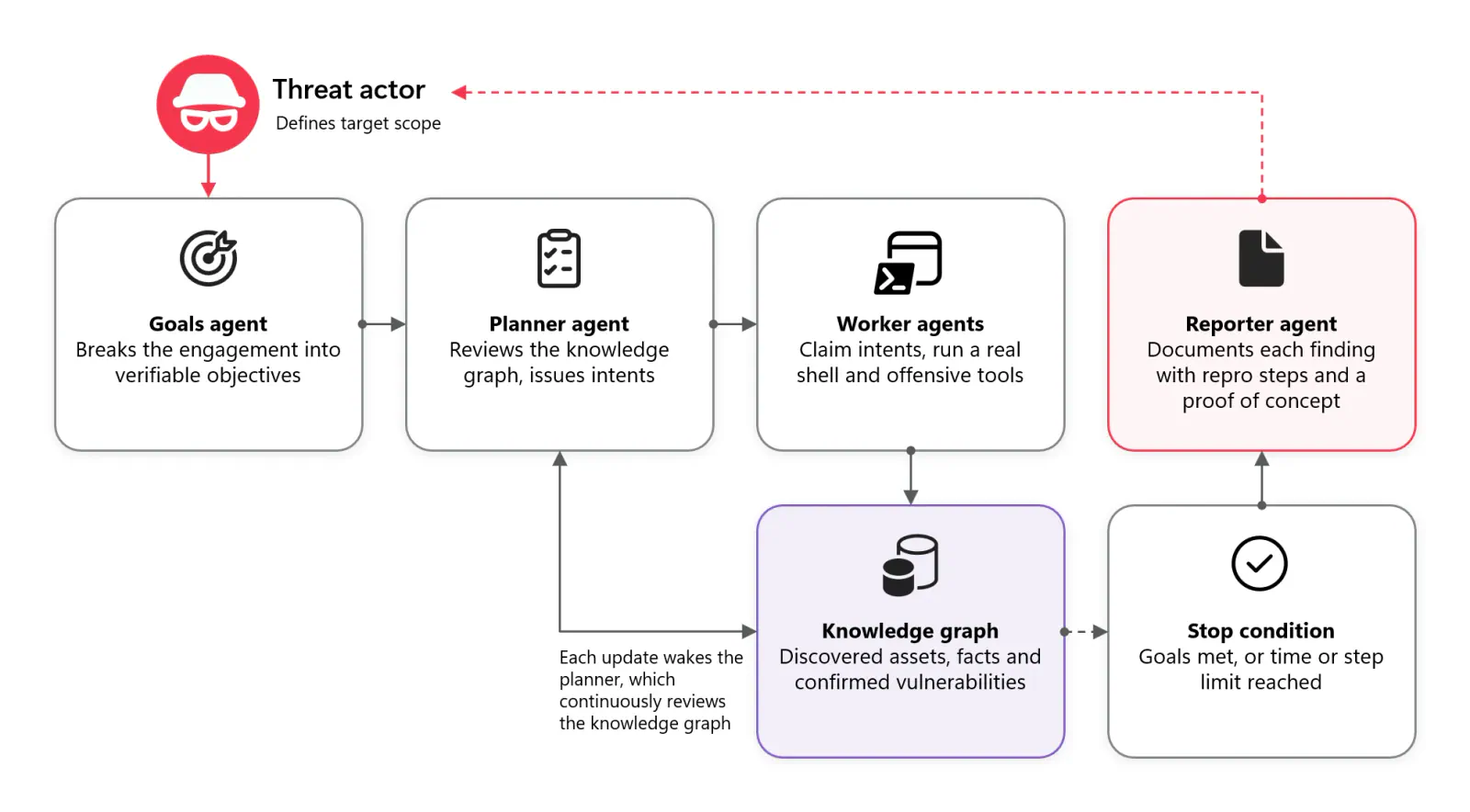
ARTEX AI works as a loop of specialized agents around a shared memory. The human operator sets the target scope, and the agents do the rest until they hit their goal, a time limit, or a step limit.
The agent loop
Microsoft's report describes four roles:
- Goals agent. Breaks the engagement into objectives that can be checked, such as "obtain a shell on this host."
- Planner agent. Reads a knowledge graph of discovered assets and findings and issues short attack directions that ARTEX calls intents.
- Worker agents. Claim intents, run them with a real shell and offensive tools, and write new assets, facts, and confirmed vulnerabilities back to the graph.
- Reporter agent. Documents each confirmed finding with reproduction steps and a proof of concept.
Each update to the graph wakes the planner, which decides the next move. That's the key design choice. A human attacker reads results, thinks, and then acts; ARTEX turns every result into the next instruction almost immediately.
A knowledge graph here is a structured map of hosts, services, credentials, and vulnerabilities with the links between them. It's what lets the planner see that a password found on one server might open another.
Google's account differs slightly. The Google Threat Intelligence Group report on ARTEX and similar frameworks says the framework spreads the attack lifecycle across six specialized sub-agents, where Microsoft's diagram shows four roles. The forks may differ, or the two firms may count roles differently.
Any model, any provider
ARTEX doesn't ship its own model. The operator configures it to call almost any LLM, including frontier models, open-weight models, and abliterated models, which are open models modified to remove built-in refusals. An optional pool function switches models when one fails because of a quota, an invalid key, or rate limiting.
That has a direct consequence. ARTEX activity "is not necessarily constrained by any single provider's safety controls," Microsoft says, and it won't show up in any single provider's logs.
According to Infosecurity's account of the FBI notice, analysis of attacker-controlled instances found Chinese models most common, with DeepSeek Flash models dominating because of their cost and lack of observable guardrails when framed as pentesting. That claim comes from the FBI notice as reported; we couldn't open the notice itself.
The toolset
ARTEX ships with ordinary utilities: nmap, netcat, curl, wget, dig, whois, git, ripgrep, jq, Python, Node, and a Playwright-driven Chromium browser. Operators commonly add sqlmap, hydra, medusa, nuclei, gobuster, ffuf, Metasploit, John the Ripper, and hashcat.
None of these is secret or new. Most are installed by default on Kali Linux, the standard pentesting distribution.
The novelty is the planner deciding which one to run next.
Who is using ARTEX, according to Microsoft?
Microsoft says both state-sponsored and financially motivated actors use ARTEX. Microsoft's naming scheme carries the attribution: Typhoon marks China-based groups, Sleet marks North Korea-linked groups, and Storm marks clusters still being tracked.
| Actor | Microsoft's description | Documented ARTEX activity |
|---|---|---|
| Storm-0940 | China-state aligned, active since 2021, focused on data theft | ConnectWise supply chain compromise, Microsoft 365 password spraying, OAuth app abuse |
| Storm-3358 | Cambodia-based, financially motivated, targets Southeast Asian finance | Scanning, file upload and SSRF exploits, remote access trojans |
| Salt Typhoon | China-based | Named as an ARTEX user; no campaign detail published |
| Crystal Typhoon | China-based | Named as an ARTEX user; no campaign detail published |
| Onyx Sleet | North Korea-linked | Named as an ARTEX user; no campaign detail published |
| Pearl Sleet | North Korea-linked | Named as an ARTEX user; no campaign detail published |
Salt Typhoon is the best-known name on the list. Help Net Security notes the White House confirmed in December 2024 that the group had breached at least eight US telecommunications providers.
Microsoft has published campaign detail for only two of the six groups. For the other four, the November 25 report establishes adoption, not what they did with it.
The criminal case is the clearer of the two. Microsoft's November 6 report on Storm-3358 says the group began hitting financial firms with ARTEX in October 2026, exploiting anonymous file upload and server-side request forgery flaws, then using netcat and curl to pull down the WISP, vshell, and AdaptixC2 remote access trojans.
Same tool, very different goals.
Other investigators see the same spread. Google says it and Mandiant have seen ARTEX used by financially motivated extortion groups and suspected Chinese espionage clusters against government, technology, chemicals, and manufacturing targets in the US.
What happened in the Storm-0940 ConnectWise campaign?
Storm-0940 used ARTEX to speed up a supply chain attack through ConnectWise Cloud Backup, and then to abuse the trust that ConnectWise's apps already had inside customer tenants. That's the most detailed public case so far, from Microsoft's October 21 report on Storm-0940, which also attributes the ConnectWise compromise to the group.
The password spray
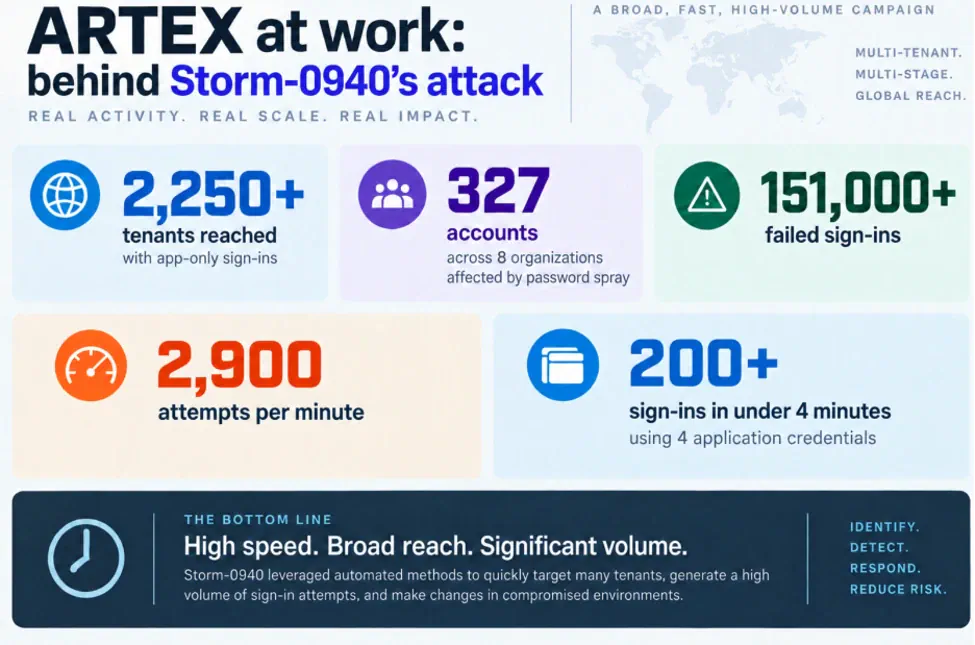
Between October 10 and 14, 2026, Storm-0940 infrastructure at 144.172.64[.]99 sprayed passwords at 327 accounts across eight organizations. Microsoft counted more than 151,000 failed sign-ins, peaking on October 11 at 2,900 failures per minute.
That peak is about 48 attempts every second. More than 111,000 failures landed in a single day, which averages roughly 77 per minute across 24 hours. Forty-eight accounts each took more than 1,000 failures.
It didn't work.
Lockout responses made up nearly 98% of the activity, and Microsoft saw no successful sign-in, token, Graph call, or directory change from the spray.
The downstream access
The next step did work. After the ConnectWise compromise surfaced on October 15, AI agents working for Storm-0940 used stolen ConnectWise application credentials to attempt sign-ins to more than 2,250 customer tenants from the same IP range.
Because those apps had already been granted access, the agents didn't need any user to sign in. In some tenants they ran Microsoft Graph reconnaissance, added credentials to applications, and changed identities, groups, and privileged roles. In one case an application assigned itself the Global Administrator role.
Microsoft's infographic counts more than 200 sign-ins in under four minutes using four application credentials. In several intrusions, Microsoft says, the time from first targeting to privileged access was under three hours.
The company is careful about one point. The presence of an affected app, or even a successful sign-in, "does not necessarily indicate" that customer data was taken. Microsoft also says the activity didn't come from a flaw in its own systems.
How did an AI agent get from GitHub to Azure Key Vault in five minutes?
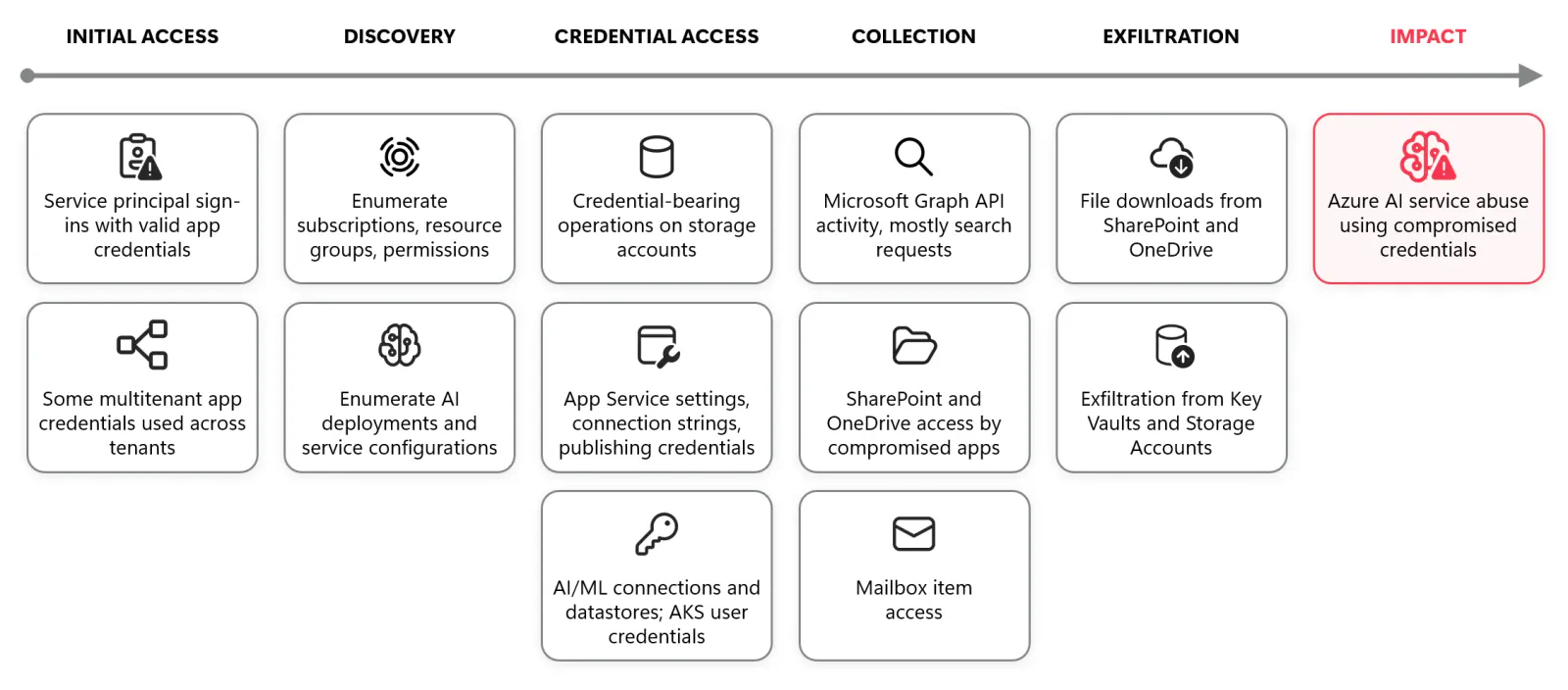
It used secrets that developers had already leaked in public code. Microsoft's November 5 report on agentic secret hunting says that starting in August 2026, an agentic framework sent large volumes of GitHub searches combining a target's name with keywords for secrets, cloud services, or AI providers.
Hunting GitHub for leaked keys is an old technique. What limited it was human time: finding repositories, reading them, and testing what they held.
The agents did all three.
In one case Microsoft observed, an AI agent went from searching GitHub for client secrets to exfiltrating data from Azure Key Vault in five minutes. Azure Key Vault is Microsoft's managed store for keys, passwords, and certificates, so reaching it usually means reaching everything else.
Watching an agent fix its own mistakes
The same report shows the agents debugging themselves. In one victim's Azure environment, operations from 199.19.77[.]84 failed and then succeeded after small corrections:
- Key Vault metadata: a batch of requests used the wrong API version and returned HTTP 400; about 28 seconds later a rerun with version 2023-07-01 returned HTTP 200.
- Azure SQL firewall rules: an outdated API version failed; about 60 seconds later the same request with a supported version succeeded, and only the version parameter had changed.
- Application Insights query: another outdated version failed; about 80 seconds later the corrected request succeeded.
A human might fix the same error. The difference is that nobody was waiting at a keyboard to read the error.
The agents also showed a clear preference for AI credentials, including API keys for major AI providers and apps with access to Microsoft's Foundry Tools. Microsoft says the attackers may have tried to use the stolen AI resources to support their broader activity.
What does ARTEX actually change for attackers?
ARTEX changes the speed, persistence, and cost of attacks, not the techniques. Microsoft's November 25 report is blunt about it:
ARTEX does not introduce new attack techniques; it uses common, pre-existing penetration testing tools and techniques.
The UK agency reaches the same conclusion. The NCSC's November 24 guidance on agentic cyber attacks says the tools give no new capability, but threat actors can now attack "quickly and persistently" at low cost using cheap open models or illegal API resellers.
What Google saw inside real intrusions
Google's incident responders give the most granular picture of how this looks in logs:
- ARTEX ran in compressed bursts of about 2 to 25 seconds, including 27 events in 23 seconds while probing AWS permissions.
- It wrote and deleted a tiny test blob in about 330 to 400 milliseconds to check whether stolen Azure credentials could write.
- It pulled scripts and sent back command output through 491 rotating webhook.site URLs.
- It enumerated more than 110,000 Active Directory objects from a domain controller.
- It once abused a legitimate notification feature to send test emails to more than 1,300 internal users.
The same report shows ARTEX being clumsy. One attempt at code execution generated 240 log events and errors that looked like sub-agents overwriting each other. It tried web shells with names like cl1217.jsp and z1219.jsp, fixing errors until one ran.
That clumsiness is the point Google makes. Current adversary use is still "in early stages," it says, with low-sophistication use of open-source tools producing "broad and noisy, but still successful campaigns."
Who gains most
The FBI, as Infosecurity reports it, says ARTEX lowers the barrier to entry and lets small groups run several campaigns at once. The notice also says it's especially effective against overlooked systems such as partner portals, mobile backends, legacy services, and third-party integrations.
That fits the documented cases. The ConnectWise attack went through a vendor's app, not the victims' front doors. The GitHub campaign went through secrets developers had forgotten.
How can defenders spot ARTEX activity?
Defenders can spot ARTEX mostly by how it behaves, not by fixed indicators. Microsoft says attackers "can and do vary" source IPs and user agent strings, so signature blocking alone is weak.
Behavioral signals
Microsoft and the NCSC describe a consistent pattern:
- Bursts at machine speed. Many varied requests in seconds, then short pauses the NCSC calls "thinking phases."
- Exhaustive retries. Variations on the same technique until one works, including garbage or example values that would never succeed.
- Instant stage changes. After a credential or host falls, new agents move to the next stage immediately.
- Parallel chains. Two or three attack chains active at once, and new attempts through fresh paths after containment.
- Rising error rates. Agents read every error and adapt, so error volume spikes.
Indicators that sometimes appear
ARTEX doesn't hide by default, so some tool fingerprints leak through. Microsoft lists two user agent strings tied to ARTEX itself.
| User agent | When it appears |
|---|---|
| artex-enrich/* | A short GET to each newly discovered web asset that reads only enough to grab the page title |
| norma/* | Requests made by agents through their built-in web-fetch tool rather than shell tools |
Treat these as alerts, not blocks.
Microsoft's November 6 report on Storm-3358 says blocking traffic with these traits "will not stop an attack by an AI agent, which will quickly change them."
On compromised servers
On a host, ARTEX looks like a noisy intruder. Microsoft lists web server processes such as w3wp.exe or php-fpm spawning shells, new script files in upload directories, several short-lived web shells with incrementing names, rapid reads of /etc/shadow and .env files, and reverse shells to webhook or file-sharing services.
Deception
Both Microsoft reports recommend honeypots, decoys, tarpits, and fake wins. A fake win shows the agent convincing evidence its objective is done, which can make it stop early. Microsoft says these controls cut attack traffic reaching real assets in its testing, but that's the vendor's own result.
What should organizations do about ARTEX AI now?
Organizations should close the cheap openings ARTEX exploits first. Microsoft, Google, the NCSC, and the FBI all point at the same short list, and almost none of it is specific to AI.
- Inventory and shrink the internet-facing surface. The NCSC says compromised services are often ones an organization forgot, like old websites and legacy kit, and suggests putting services behind an identity-aware proxy, a VPN, or mutual TLS.
- Find and rotate leaked secrets. Turn on secret scanning and push protection, and assume any secret found in public code is compromised; deleting the commit doesn't revoke it.
- Enforce MFA and ban weak passwords. Use phishing-resistant MFA for admins, block legacy authentication, and apply risk-based Conditional Access to workload identities as well as users.
- Cut standing privilege. Limit service principals to what they need, use time-bound admin roles, and watch for app credential additions and self-assigned roles.
- Rate-limit and challenge automation. Put rate limits and bot challenges on login, sign-up, and expensive endpoints, and enforce them at the API, not just the web page.
- Say less in error messages. The NCSC notes that an agent "reads every error it receives," so verbose errors help it.
- Automate containment. Storm-0940 reached privileged access in under three hours, so response that waits for a morning shift is too slow.
Microsoft's report also promotes its own products, including Defender's automatic attack disruption and a new agent system called Microsoft Perception. Those may help, but the list above doesn't depend on any one vendor.
What is still unknown about ARTEX?
Several important points are unproven, disputed, or rest on a single company's telemetry.
- How much damage was done. Microsoft says successful sign-ins don't prove data theft, and it hasn't published totals for stolen data. The 67,000-person South Korean breach figure comes from Infosecurity's account of the FBI notice.
- When abuse began. Microsoft dates Storm-0940's use to September 2026. Google and the FBI, as reported, say at least August 2026, and Google ties Storm-0940 to a cluster it tracks as UNC7228.
- What the other four groups did. Salt Typhoon, Crystal Typhoon, Onyx Sleet, and Pearl Sleet are named without published campaign detail.
- The architecture. Microsoft describes four agent roles; Google says six sub-agents. Forks may also differ from the original code.
- The interface language. Microsoft's November report says ARTEX launched with a Chinese-language interface, while its October report says the UI defaults to English and can switch to Korean, Mandarin, Spanish, or Japanese.
- ThreatBook's role. The company claimed ownership in November, but no public source links it to the attacks.
- Model attribution. The claim that DeepSeek models dominate comes from the FBI as summarized by Infosecurity, not from a document we could open.
- Deception results. The finding that decoys and fake wins reduce attack traffic comes from Microsoft's own testing.
The bigger uncertainty is direction. The NCSC says today's frameworks "trade stealth for speed" and warns that this "may not always be the case." Google expects less human involvement and more stealth as models and operators improve.
What to watch next
These are the dated or checkable things that will show whether ARTEX abuse is growing or being contained:
- Campaign detail on the other four groups. Watch Microsoft Threat Intelligence for reports on Salt Typhoon, Crystal Typhoon, Onyx Sleet, and Pearl Sleet using ARTEX.
- The full FBI Flash text. The November 13, 2026 notice includes a request for indicators; any public update would firm up the model and victim figures.
- ThreatBook and ARTEX Pro. Whether ThreatBook responds publicly to Microsoft's November 25 report, and whether ARTEX Pro adds access controls.
- ConnectWise restoration guidance. Microsoft tells customers to keep affected ConnectWise app connections disabled until ConnectWise publishes formal restoration steps.
- Stealthier frameworks. The NCSC's warning that future tools may prioritize stealth is the trend to track; Google also names PentAGI and CAIRN in the wild.
- Model provider responses. Whether AI providers report detecting or blocking ARTEX traffic, given that operators rotate across providers and keys.
Frequently Asked Questions
6 questions
1What is ARTEX AI?
ARTEX is an open-source agentic AI penetration testing framework first published on GitHub in July 2026 by a user called Autumn-27. It uses several large language model agents, coordinated by a Go backend, to plan and run attacks with standard tools like nmap, sqlmap, and hydra. Microsoft says state-sponsored and criminal groups now use it to automate reconnaissance, credential attacks, and web exploitation.
2Which hacking groups use ARTEX?
Microsoft named six groups in its November 25, 2026 report: Storm-0940, Storm-3358, Onyx Sleet, Pearl Sleet, Crystal Typhoon, and Salt Typhoon. Microsoft labels Typhoon groups as China-based and Sleet groups as North Korea-linked. Storm-0940 is China-state aligned, and Storm-3358 is a Cambodia-based financially motivated cluster that targets banks and other financial firms.
3Does ARTEX use new exploits?
No. Microsoft says ARTEX does not introduce new attack techniques and relies on common, existing penetration testing tools. What it changes is speed and persistence: AI agents chain known techniques, read errors, and retry at machine speed. In one case Microsoft observed, an agent went from finding leaked secrets on GitHub to taking data from Azure Key Vault in five minutes.
4Which AI models does ARTEX use?
ARTEX doesn't include its own model. Operators connect it to almost any large language model, including frontier, open-weight, or guardrail-stripped models, and it can switch providers when one fails. According to Infosecurity Magazine's report on a November 13, 2026 FBI notice, Chinese models, especially DeepSeek Flash models, were most common on attacker-controlled instances.
5How can organizations detect ARTEX attacks?
Organizations detect ARTEX best through behavior, not fixed indicators. Look for bursts of many varied requests in seconds, rapid retries of the same technique, instant moves to the next attack stage, and several attack chains at once. Microsoft also lists ARTEX user agents artex-enrich and norma, but attackers change those, so use them as alerts rather than blocks.
6Is ARTEX still available after the GitHub repository was removed?
Yes. The original author removed the GitHub repository in October 2026, but forks continue to circulate, including a localized version called ScopeWeaver. In November 2026, Chinese security company ThreatBook claimed ownership and began selling a commercial version called ARTEX Pro. Microsoft does not link ThreatBook to the attacks.
Sources (8)
- 01microsoft.comMicrosoft Threat Intelligence report published November 25, 2026 (opens in a new tab)
- 02infosecurity-magazine.comInfosecurity Magazine's summary of an FBI Flash notice (opens in a new tab)
- 03helpnetsecurity.comHelp Net Security noted on November 27 (opens in a new tab)
- 04cloud.google.comGoogle Threat Intelligence Group report on ARTEX and similar frameworks (opens in a new tab)
- 05microsoft.comMicrosoft's November 6 report on Storm-3358 (opens in a new tab)
- 06microsoft.comen us / security / blog / 2026 / 10 / 21 / storm 0940 uses artex agentic ai connectwise supply chain compromise (opens in a new tab)
- 07microsoft.comen us / security / blog / 2026 / 11 / 05 / threat actors use agentic ai tooling to find and abuse exposed secrets (opens in a new tab)
- 08ncsc.gov.ukNCSC's November 24 guidance on agentic cyber attacks (opens in a new tab)


