
On November 24, 2026, OpenAI published lab results for GPT-6 protein design: its general-purpose models drew the three-dimensional shapes of small proteins using only reasoning and code, and 35 of 322 proteins built from those shapes stuck to their intended targets in a wet lab. That is a 10.9% hit rate across five targets.
The claim worth paying attention to is not that an AI designed a protein. Specialized AI models have done that since 2023. The claim is that a chat model with no protein-specific architecture, calling nothing but a Python interpreter, did a job that until now required a purpose-built tool.
That claim is partly supported and partly not. This article walks through what the models designed, what the lab measured, which parts of the pipeline still belong to specialized software, where the numbers are weaker than the headline suggests, and what would settle the open questions.
Key takeaways
- 35 of 322 designed minibinders bound their targets, a 10.9% hit rate across PD-L1, IL-7Rα, TrkA, VEGF-A and IL-17A. IL-17A alone accounted for 18 of the 35 hits.
- GPT-6.2 replaced one step, not the pipeline. It generated backbone shapes; SolubleMPNN and ProteinMPNN supplied the amino acid sequences, and Boltz-2, OpenDDE and ESMFold2 filtered candidates before anything reached the bench.
- Redesigning known structures worked far better than designing new ones. GPT-6.2 kept binding in 75 of 88 MDM2 designs (85%) and 128 of 182 antibody loop redesigns (70%), but only 8 of 59 for PD-1 (14%).
- Whole-protein structure prediction is still a clear weakness: OpenAI's best internal model averaged a TM-score of 0.38 against 0.93 for the specialized ESMFold2.
- Capability rose sharply across model generations. On antibody docking, the mean DockQ score went from about 0.05 for GPT-5.6 to 0.28 for GPT-6, 0.57 for GPT-6.2, and 0.81 for an unreleased internal model.
- The work is a preprint, not peer-reviewed, and OpenAI itself flags possible memorization in the strongest benchmark results.
What did OpenAI actually announce?
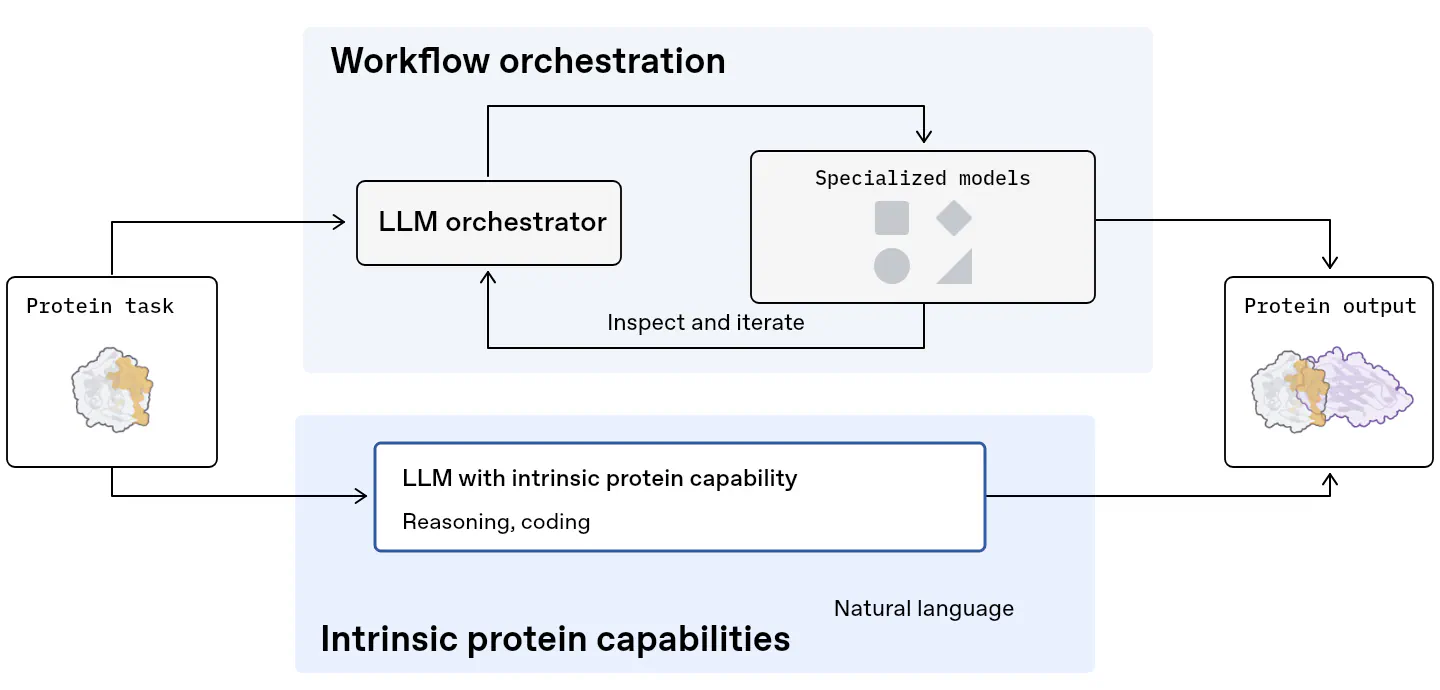
OpenAI announced that its GPT-6 family can perform protein design tasks intrinsically, meaning the model itself produces the design rather than calling a specialized biology model to produce it. The company set this out in a research post and in a preprint arguing that GPT-6 is a universal foundation model for protein biology, which carries the full figures and the task-by-task results.
The distinction matters because it changes what a model is for. Most AI-in-biology systems today are orchestrators: a language model reads the request, picks the right specialized tool, and passes work to it. OpenAI's argument is that the models can design new protein structures and sequences without relying on specialized biology models, using reasoning and a general-purpose coding environment, which removes the need to know which tool to reach for.
A minibinder is a small, purpose-built protein designed to latch onto a specific site on a larger target protein. Minibinders are the standard testbed for de novo design because they are short, cheap to synthesize, and easy to assay for binding.
Three things were released together:
- A research post on openai.com summarizing 14 protein tasks and the lab results.
- A preprint PDF hosted on OpenAI's CDN, roughly 89 MB with the full figures.
- Wet-lab validation run by Onava, OpenAI's research partner for the experiments.
Onava describes itself as a therapeutics company built around agentic drug discovery, AI-native protein engineering, and high-throughput functional assays. Its co-founders are chief executive Ido Calman and chief scientific officer Sharrol Bachas, and it ran the binding measurements reported in the preprint.
How does GPT-6 protein design work without a specialized model?
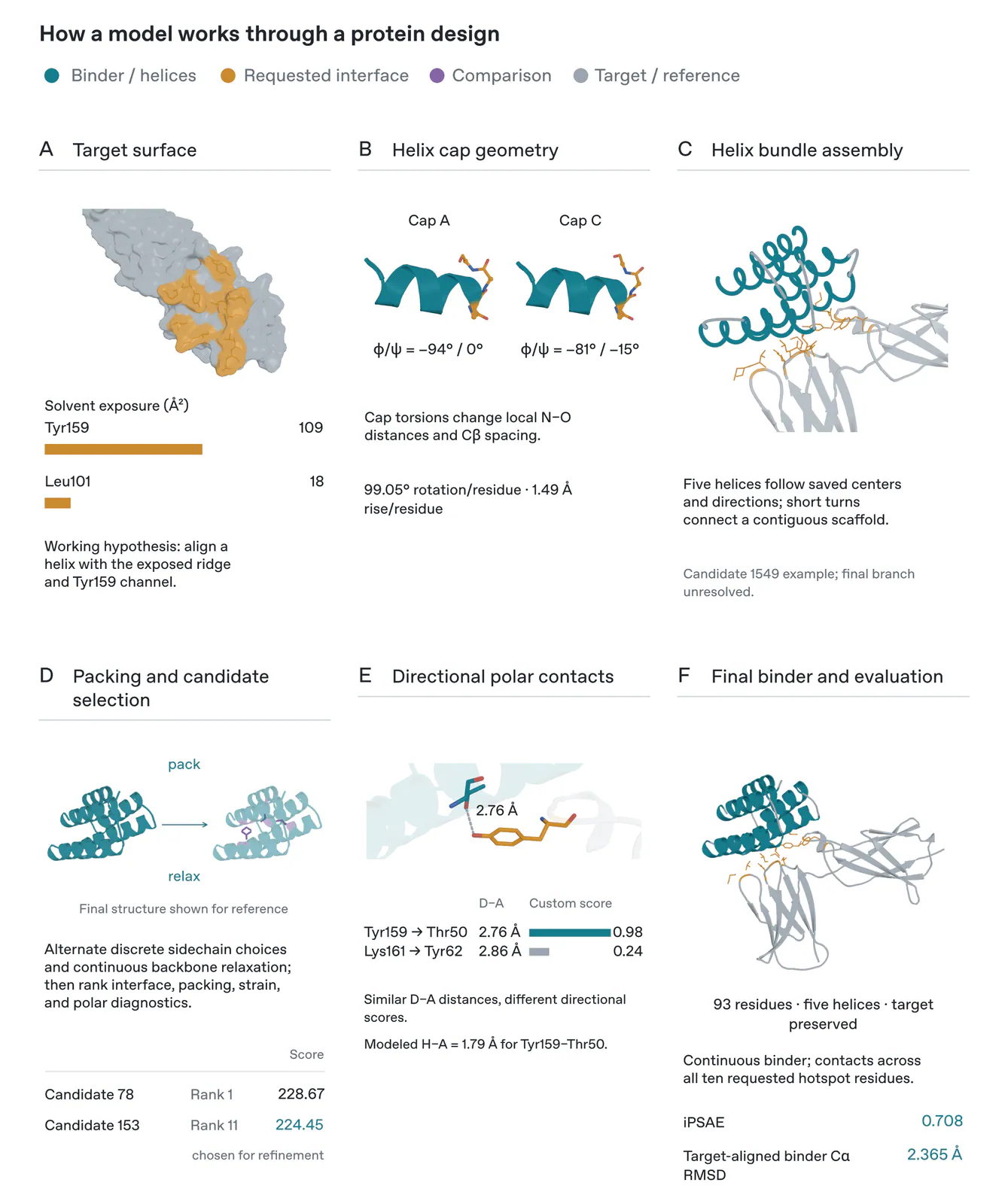
GPT-6 protein design works the way a structural biologist with a laptop would work: the model reads the target's surface, forms a hypothesis about where to attach, writes code to place helices and strands in three-dimensional space, scores the candidates it has built, and refines the best one. No protein-specific network is involved in generating the shape.
OpenAI's own walkthrough of one design makes the sequence concrete. Asked to design a binder for IL-7Rα, the model measured solvent exposure on the target surface, picked a ridge to align a helix against, chose helix cap torsion angles, assembled five helices into a bundle, ranked 1,500-plus candidates on interface quality, packing, strain and polar contacts, then returned a 93-residue binder touching all ten requested hotspot residues.
What the model does itself
The intrinsic part of the work covers backbone generation and geometric reasoning. OpenAI reports that researchers could specify a binder's structural class — all helices, all strands, or a mix — and the number of coils and strands, and the model followed those instructions with near-perfect fidelity. Control at that level is normally a code change in a specialized tool, not a sentence in a prompt.
The model also handled molecular docking directly. On the PoseBusters dataset, GPT-6.2 matched the observed position and orientation of a small molecule in 93% of scored predictions, against 50% for the specialized DiffDock-L.
What still needs specialized models
Four specialized tools remain load-bearing in the published pipeline:
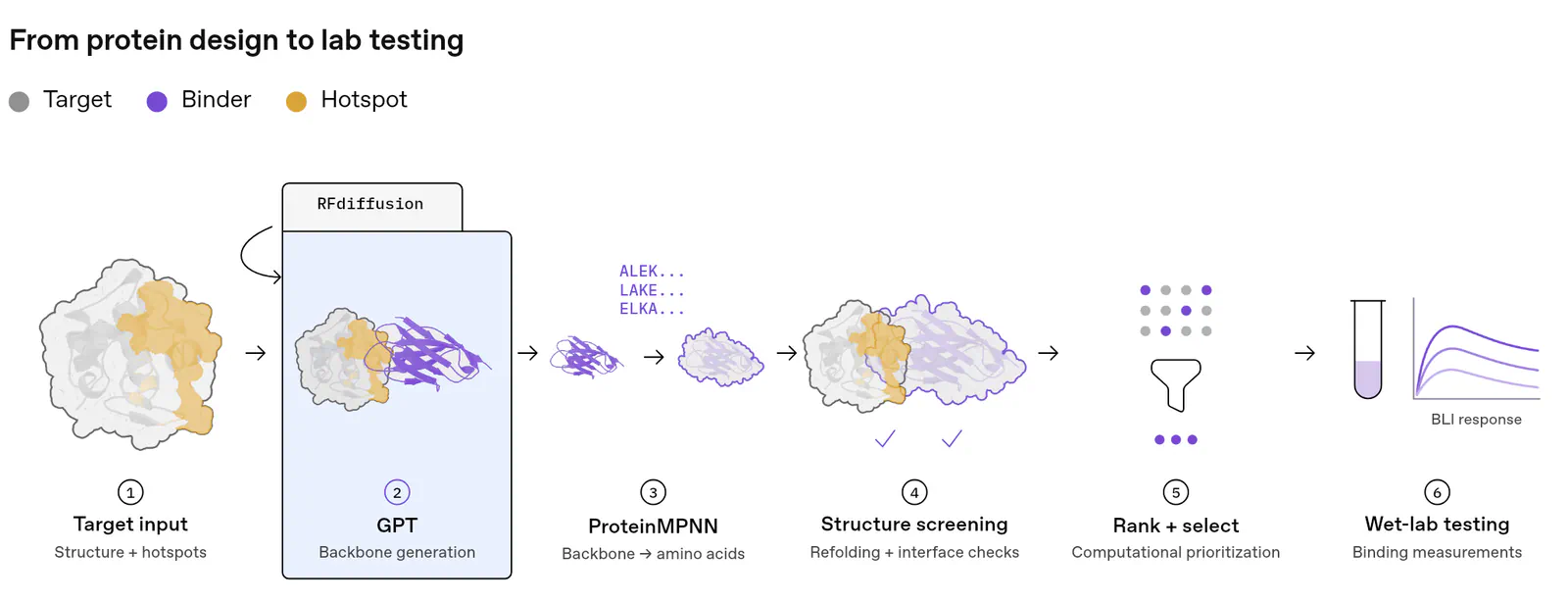
- SolubleMPNN and ProteinMPNN proposed the amino acid sequences that would fold into GPT-6.2's shapes in the first experiment.
- ESMFold2 predicted how those sequences would fold.
- Boltz-2 and OpenDDE scored and filtered candidates before synthesis.
OpenAI is explicit that this leaves the end-to-end claim unproven. Its results show intrinsic capability at two stages — backbone generation, where researchers normally use RFdiffusion, and sequence redesign, where they normally use ProteinMPNN — but not that the models can produce de novo minibinders from start to finish on their own.
What did the lab experiments find?
The lab found real binding, at a rate that is respectable for de novo design and unremarkable compared with the best specialized pipelines. Onava made and tested proteins from three separate design campaigns, and every campaign produced binders.
In the first experiment, OpenAI gave GPT-6.2 the structures of five targets and marked where a minibinder should attach. The model wrote code to generate backbone shapes; specialized models supplied sequences and selected candidates; Onava synthesized and measured.
| Target | Minibinders tested | Confirmed binders |
|---|---|---|
| IL-17A | — | 18 |
| VEGF-A | — | 8 |
| PD-L1 | — | 5 |
| IL-7Rα | — | 3 |
| TrkA | — | 1 |
| All five | 322 | 35 (10.9%) |
Every target produced at least one binder. The distribution is lopsided: IL-17A supplied more than half the hits, and TrkA produced a single one.
Redesigning sequences for known shapes
The second experiment reversed the division of labor. OpenAI gave GPT-6.2 the three-dimensional structures of minibinders that were already known to work, withheld their amino acid sequences, and asked the model to invent new ones.
This is where the numbers get large.
| Target | Designs tested | Bound | Rate |
|---|---|---|---|
| MDM2 | 88 | 75 | 85% |
| VEGF-A | 42 | 26 | 62% |
| PD-1 | 59 | 8 | 14% |
The new sequences were not small edits. The median difference from the original was 50% of positions for VEGF-A, 43% for MDM2, and 15% for PD-1.
OpenAI also ran this on three unpublished minibinder shapes the model had generated earlier, which rules out the model having seen the answers. Of 107 proteins made from those new sequences, 14 bound — 13.1%. For one PD-L1 shape, GPT-6.2 produced two sequences that differed from the original at 52 and 58 of 90 amino acids and from each other at 44 positions, and both showed binding.
Antibodies
The third campaign targeted antibody loops, the short stretches that do the actual gripping. Researchers often rewrite these to tighten or sharpen a binding interaction, a process called affinity maturation.
Given six small antibodies that bind IL-4Rα, with the three binding loops removed, GPT-6.2 designed replacements: 128 of 182 designs (70%) still bound. On five therapeutic antibodies, with instructions to change about half the amino acids in each loop, 179 of 272 tested fragments (66%) still bound PD-1 or PD-L1.
How does this compare with RFdiffusion and other specialized tools?
On the specific sub-tasks OpenAI measured, the latest internal model matched or beat the specialized baselines on most of them; on whole-structure prediction it lost badly. The comparison is uneven by task, not uniformly favorable or unfavorable.
RFdiffusion is the reference point for backbone generation. It was introduced in a 2023 Nature paper describing a generative model of protein backbones obtained by fine-tuning the RoseTTAFold structure prediction network on denoising tasks, and it remains the default tool for de novo binder design.
| Task | Specialized baseline | Baseline score | OpenAI's best |
|---|---|---|---|
| Motif scaffolding (30 MotifBench challenges) | RFdiffusion | 27.8% | 43.7% |
| Fold-specified design (200 challenges) | Proteina | 17.1% | 18.9% |
| Small-molecule docking (PoseBusters) | DiffDock-L | 50% | 96% |
| Tethered docking (179 Scarpino structures) | DiffDock | 60% | 97% |
| Whole-structure prediction (TM-score) | ESMFold2 | 0.93 | 0.38 |
Docking is the clearest win, and it is a sizeable one. Motif scaffolding — building a protein around a fixed arrangement of key amino acids — is a solid win on computational checks, though no lab test of function has been run on those designs.
The hit-rate comparison against RFdiffusion is harder to call. OpenAI notes that the original RFdiffusion study reported higher hit rates, and that such rates depend heavily on how strictly designs are filtered before lab validation and on how binding is defined. Published RFdiffusion experimental hit rates have ranged roughly from 1% to 19% depending on target, so 10.9% sits inside the band rather than above it.
Generation-over-generation improvement
The trend across model versions is the part of the paper that is hardest to argue with, because it uses one evaluation across four models.
On antibody docking with side-chain detail hidden, the mean DockQ score rose from roughly 0.05 for GPT-5.6 to 0.28 for GPT-6, 0.57 for GPT-6.2, and 0.81 for the unreleased internal model. On ranking 265 sets of protein stability mutations, rank correlation improved from 0.41 to 0.52 to 0.57 to 0.66 across the same four models.
Nothing in those runs was protein-specific training that OpenAI describes. The capability arrived alongside general reasoning gains.
Where do the models still fall short?
The models fall short most clearly on predicting a complete protein structure from its amino acid sequence, which is the single task the field cares most about and the one specialized models solved first. OpenAI calls this out directly rather than burying it.
Introducing the gap in its own write-up, OpenAI frames the pattern this way:
Our work demonstrates yet again the jagged capability frontier.
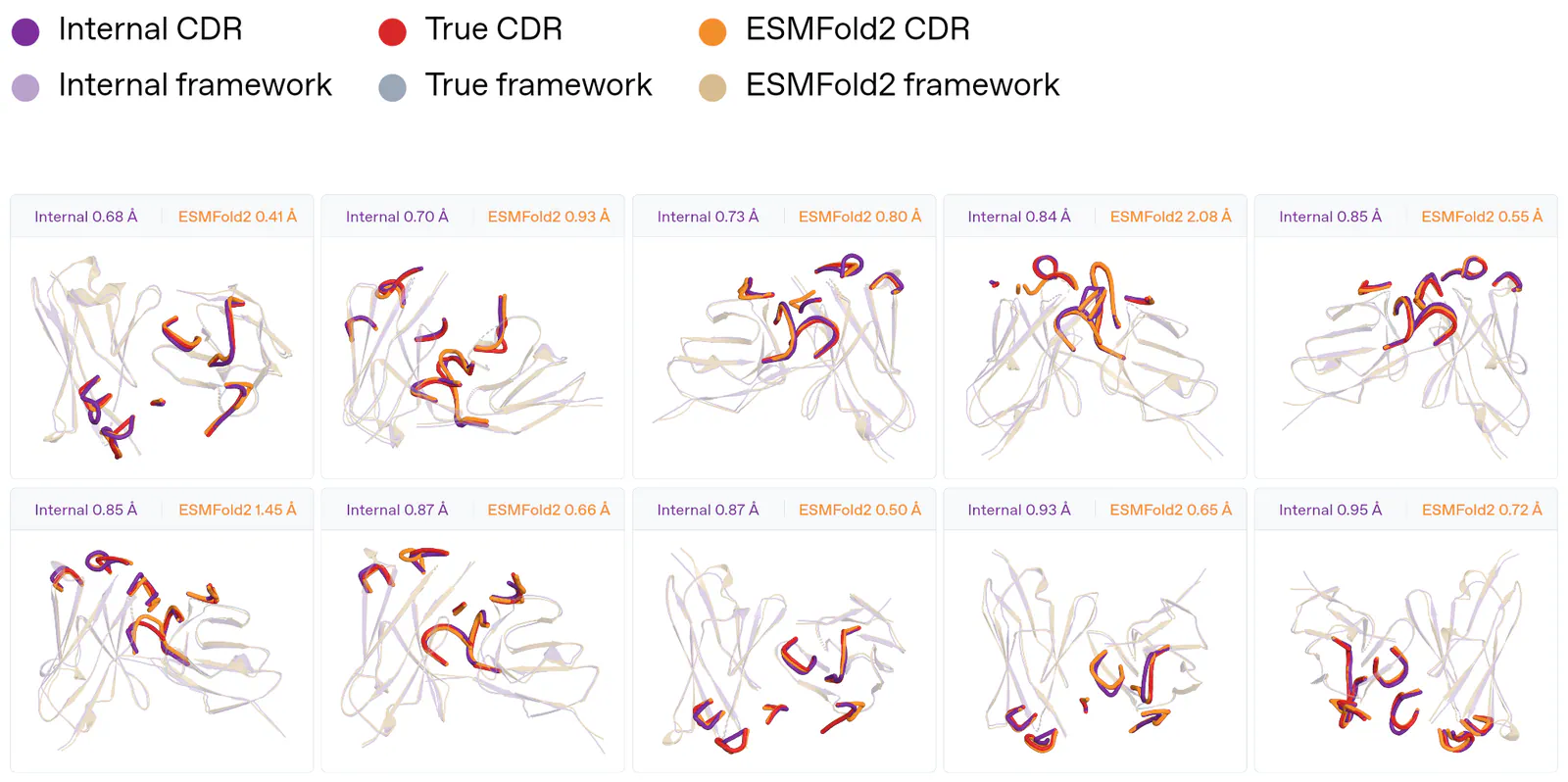
A TM-score measures how closely a predicted structure matches the real one, where 1.0 is perfect and above 0.5 generally means the overall fold is right. OpenAI's best internal model averaged 0.38. ESMFold2, working from sequence alone, averaged 0.93. GPT-6.2 managed 0.26 and GPT-5.6 managed 0.16, so the trend is upward, but the remaining distance is most of the way.
Filling in a missing piece of a known structure goes better than predicting one from scratch. Given 100 antibody fragments with the six recognition loops hidden, the internal model often placed them accurately — and ESMFold2 was still more accurate overall while working from less information.
Who does this affect, and what does it cost them?
The group most directly affected is the small population of labs that already run de novo binder campaigns, and the effect is on who can run one rather than on what is possible. A specialized pipeline requires knowing which model takes which input and how to chain them; a prompt does not.
For a protein engineer, the practical change is control. Specifying a fold class, a hotspot set, or a bond between two named atoms is a sentence rather than a code change, and switching between docking and design tasks needs no retraining.
For a drug discovery team, nothing changes yet. Binding is only one step toward a useful research tool or medicine, and specificity, stability, biological activity, manufacturability, safety and efficacy all remain untested for every design in the paper.
For biosecurity, the picture is the one OpenAI raises itself. The company says the capabilities that help design medicines could also be misused, and points to the framework that guides how it assesses these risks and tests safeguards as the governing process. That is a statement of intent, not an external audit, and the preprint does not report a third-party biosecurity review.
The cost nobody has quantified is compute. The paper reports results "at each model's highest evaluated compute setting" without publishing what a single design run consumed. A method that works but costs more per candidate than RFdiffusion changes the economics of a campaign, and there is no way to assess that from what has been released.
Limits and unknowns
Six things are genuinely unresolved, and three of them are OpenAI's own caveats rather than outside criticism.
- Not peer-reviewed. The work is a preprint published on OpenAI's own CDN. Independent coverage notes it has not been peer reviewed, and no replication by an outside lab has been reported.
- Possible memorization. OpenAI warns that unusually high accuracy on tasks asking models to infer sequences from structures may partly reflect memorized training data or artifacts of how those structures were generated. The unpublished-structure results, where 14 of 107 designs bound, are the cleanest evidence against pure memorization, and they are also the smallest sample.
- No end-to-end demonstration. Every lab-validated design passed through specialized sequence and filtering models.
- Binding is not function. None of the designs was tested for whether it produces a biological effect, such as blocking a signal or killing a cell.
- Unreported denominators. The per-target breakdown gives hit counts but not how many designs were tested per target, so the 10.9% overall rate cannot be decomposed.
- The best results come from an unreleased model. Many of the strongest numbers — 43.7% on motif scaffolding, 0.81 DockQ, 0.38 TM-score — belong to an internal research model that nobody outside OpenAI can test.
There is also an absence worth naming: in the two days after publication, no named outside structural biologist had publicly assessed the results. The critique available so far comes from OpenAI's own limitations section and from technology reporters reading it.
What to watch next
- Peer review and preprint posting. Whether the paper appears on bioRxiv or arXiv and enters formal review, and whether the code and designs become downloadable. OpenAI's research post links a GitHub repository path for the figure data that returned a 404 on November 26, 2026.
- Replication by an outside lab. The decisive test is another group running GPT-6.2 against fresh targets and reporting the hit rate without OpenAI's involvement.
- Harder targets. OpenAI says it wants to design binders for targets where attempts so far have fallen short. Which targets, and what rate, will say more than the current five.
- Function, not just binding. The stated next step is testing whether designs produce a specific biological effect, such as killing a cancer cell. That result, if it comes, is the one that matters for medicine.
- End-to-end designs. Watch for a campaign where the model supplies the backbone and the sequence and the filtering, with no specialized model in the loop.
- Biosecurity disclosure. Whether OpenAI publishes a Preparedness Framework assessment specific to protein design capability, and whether access is gated.
Frequently Asked Questions
6 questions
1Did GPT-6 design proteins entirely on its own?
No. GPT-6.2 generated the three-dimensional backbone shapes using reasoning and code, but specialized models did the rest of the pipeline. SolubleMPNN and ProteinMPNN proposed the amino acid sequences, and ESMFold2, Boltz-2 and OpenDDE filtered candidates before anything was synthesized. OpenAI states plainly that its results do not establish that the models can produce de novo minibinders end-to-end without that help. The intrinsic claim covers two stages of the workflow, not the whole of it.
2How many of the designed proteins actually worked?
Of 322 minibinders tested against five targets, 35 showed evidence of binding — a 10.9% hit rate. The hits were unevenly spread: 18 for IL-17A, 8 for VEGF-A, 5 for PD-L1, 3 for IL-7Rα, and 1 for TrkA. A separate experiment that redesigned sequences for already-known minibinder shapes did far better, with 75 of 88 MDM2 designs binding, and a third that rewrote antibody loops kept binding in 128 of 182 designs.
3Is GPT-6 protein design better than RFdiffusion?
It depends on the task. On motif scaffolding, OpenAI's best internal model passed 43.7% of 30 MotifBench challenges against 27.8% for RFdiffusion, and on small-molecule docking it reached 96% against 50% for DiffDock-L. On the wet-lab binder hit rate the comparison is not clean, because published RFdiffusion rates vary with how designs are filtered and how binding is defined. On predicting a whole protein structure from sequence, specialized models remain far ahead.
4Has this research been peer-reviewed?
No. The work is a preprint published on OpenAI's own content delivery network rather than a journal or a preprint server, and it has not been through peer review or independent replication. OpenAI flags its own limitations in the research post, including possible memorization in benchmark results and the reliance on specialized models. Until an outside lab reproduces the binding results on fresh targets, the findings should be read as a company-reported proof of principle.
5What is a minibinder, and why do these experiments use them?
A minibinder is a small engineered protein designed to attach to a specific site on a larger target protein. Minibinders are the standard testbed for de novo protein design because they are short enough to synthesize cheaply in large batches, and binding is straightforward to measure in the lab. That makes them the fastest way to check whether a design method produces something physically real, which is why both this work and the original RFdiffusion study used them.
6Could this capability be misused?
Yes, and OpenAI says so directly. The company notes that the same capabilities that help scientists design proteins for medicines could also be misused, and says its Preparedness Framework governs how it assesses those risks and tests safeguards. No external biosecurity audit of this specific capability has been published, and the preprint does not describe access restrictions on the protein design workflows. That gap is one of the clearer things for outside observers to press on.
Sources (6)
- 01openai.comindex / gpt 6 models demonstrate intrinsic protein design capabilities (opens in a new tab)
- 02cdn.openai.coma preprint arguing that GPT-6 is a universal foundation model for protein biology (opens in a new tab)
- 03onava.aiOnava describes itself (opens in a new tab)
- 04nature.coma generative model of protein backbones obtained by fine-tuning the RoseTTAFold structure prediction network (opens in a new tab)
- 05openai.comthe framework that guides how it assesses these risks and tests safeguards (opens in a new tab)
- 06glitchwire.comIndependent coverage notes it has not been peer reviewed (opens in a new tab)


