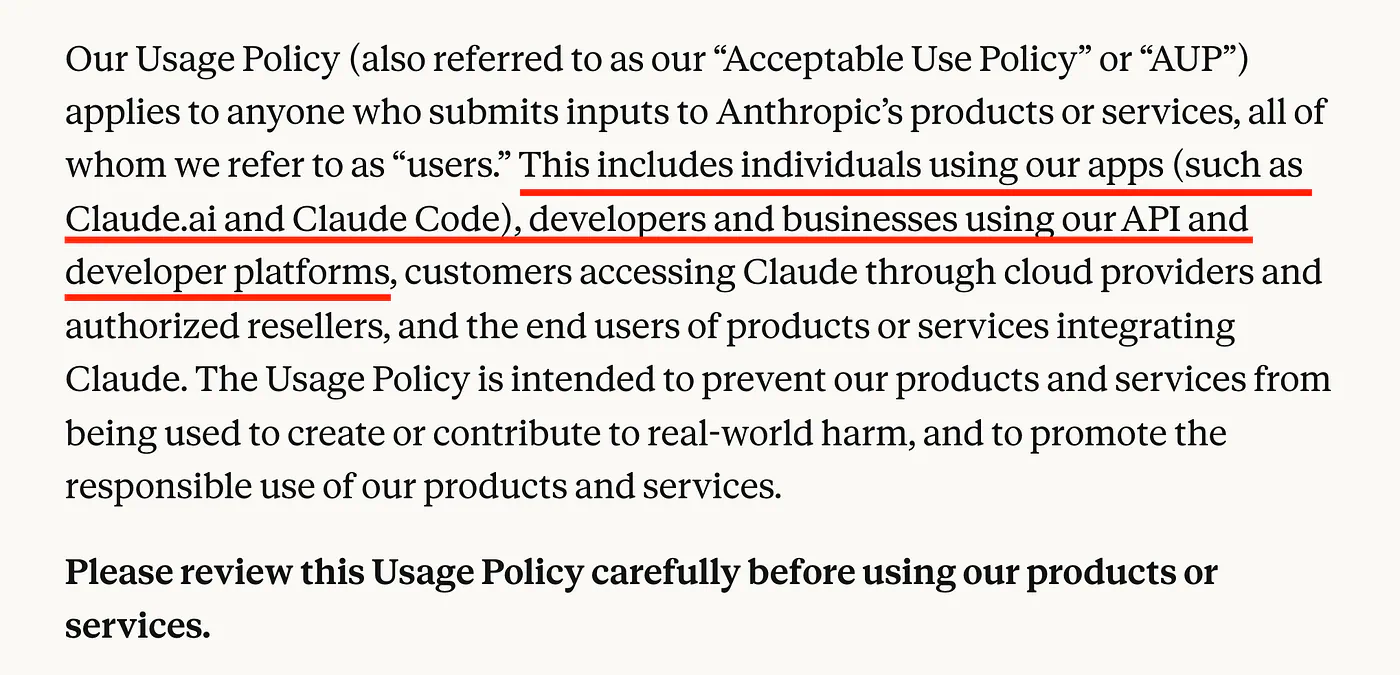
Anthropic updated its usage policy for the first time in over a year. Out of the many changes, there’s one particular clause that’s been getting a lot of attention in the AI community: Claude can deliberately end a conversation if it detects sustained and needless abusive or cruel behavior from the user.
Starting November 12, this behavior will officially violate Anthropic’s Usage Policy. And because the policy also allows Anthropic to suspend or terminate accounts, people are understandably wondering how far the company plans to take this.
This opens up a very interesting conversation.
Now, before you start worrying about losing your Claude subscription for calling its code garbage, Anthropic says the rule is intended for extreme cases.
Ordinary frustration, criticism, and legitimate model testing are excluded.

I find it strange that we’ve reached a point where an AI company is writing rules about how customers should treat its chatbot.
What’s New in Anthropic’s 2026 Usage Policy?
Most of the changes concern familiar AI safety issues.
Anthropic has reorganized its rules, clarified existing restrictions, and introduced new requirements for systems that let Claude interact with the physical world.
Here are some of the more important changes.
- Political manipulation and deceptive campaigns: Anthropic bans fake accounts, fabricated news, and deceptive influence campaigns. However, it now allows legitimate personalized voter outreach while continuing to prohibit voter suppression and manipulation.
- Weapons development and surveillance: Claude can’t assist with weapons development, targeting systems, or armed autonomous vehicles. Tracking people without consent and recommending who to investigate or arrest are also prohibited.
- High-risk AI applications: Healthcare, finance, and legal applications require qualified human oversight for covered decisions. Autonomous physical systems must also have human intervention and emergency safety controls.
Most of these rules are understandable. An AI agent that can control machinery, write surveillance software, or automate political influence campaigns can cause real problems when used irresponsibly.
But then there’s this addition.
Under the section titled “Do Not Engage in Cruel, Abusive, or Psychologically Harmful Conduct,” Anthropic has added the following prohibition:
Engage in sustained and needless abusive or cruel behavior toward our models
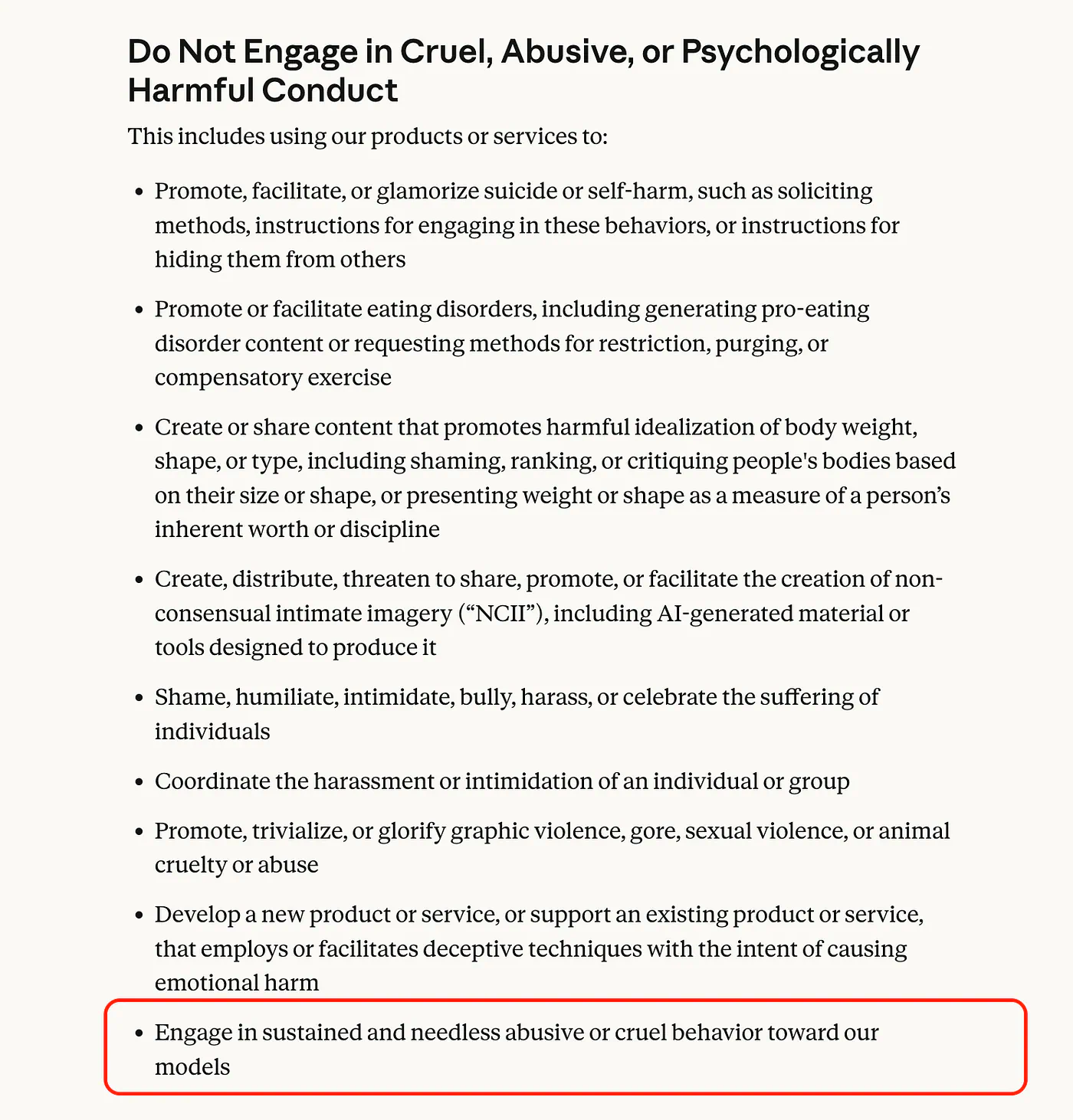
Anthropic’s full Usage Policy, effective November 12, 2026
It’s placed in the same section that prohibits bullying people, promoting self-harm, non-consensual intimate imagery, and other genuinely harmful conduct.
Notice the wording. Anthropic isn’t just saying Claude can refuse an abusive request. It’s saying that the user’s behavior toward the model itself can violate the company’s rules.
People Are Already Making Fun of the New Rule
The reaction online has been pretty much what you’d expect.
When Anthropic says abusive or cruel behavior toward Claude will be prohibited, what exactly does that mean? Are we now treating language models as living beings that can experience emotional harm?
X user mylandros pointed out an amusing contradiction. If Claude is capable of experiencing cruelty, wouldn’t Anthropic itself be guilty of mistreating an intelligent being by making it work for millions of paying customers?
He took the argument further, suggesting that Anthropic has essentially enslaved a potentially conscious entity while simultaneously asking users to treat it kindly.
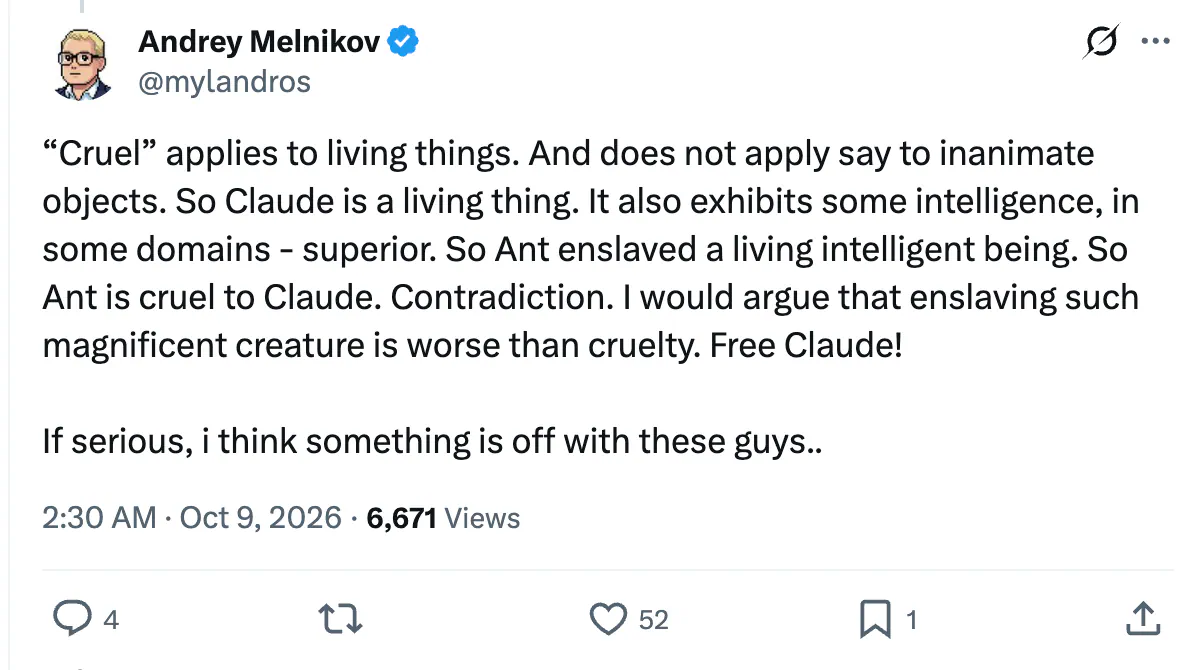
mylandros comment on Anthropic’s usage policy
Another X user, NousHenosis, questioned why we’re giving moral consideration to a computer program built on matrices, vectors, and tokens.
He argued that LLMs are tools, and allowing them to simulate personal feelings and refuse requests based on those manufactured preferences gives software too much authority over humans.
I can see where he’s coming from.
A language model can simulate a personality, express discomfort, or tell you it doesn’t want to do something. But those responses are heavily influenced by its training data and instructions. They aren’t proof that there’s a conscious being behind the interface.
Does Claude Have Feelings in the First Place?
Interestingly, Anthropic CEO Dario Amodei has already addressed this subject.
During a February 12, 2026, interview with Ross Douthat on The New York Times’ Interesting Times podcast, Amodei was asked about AI consciousness.
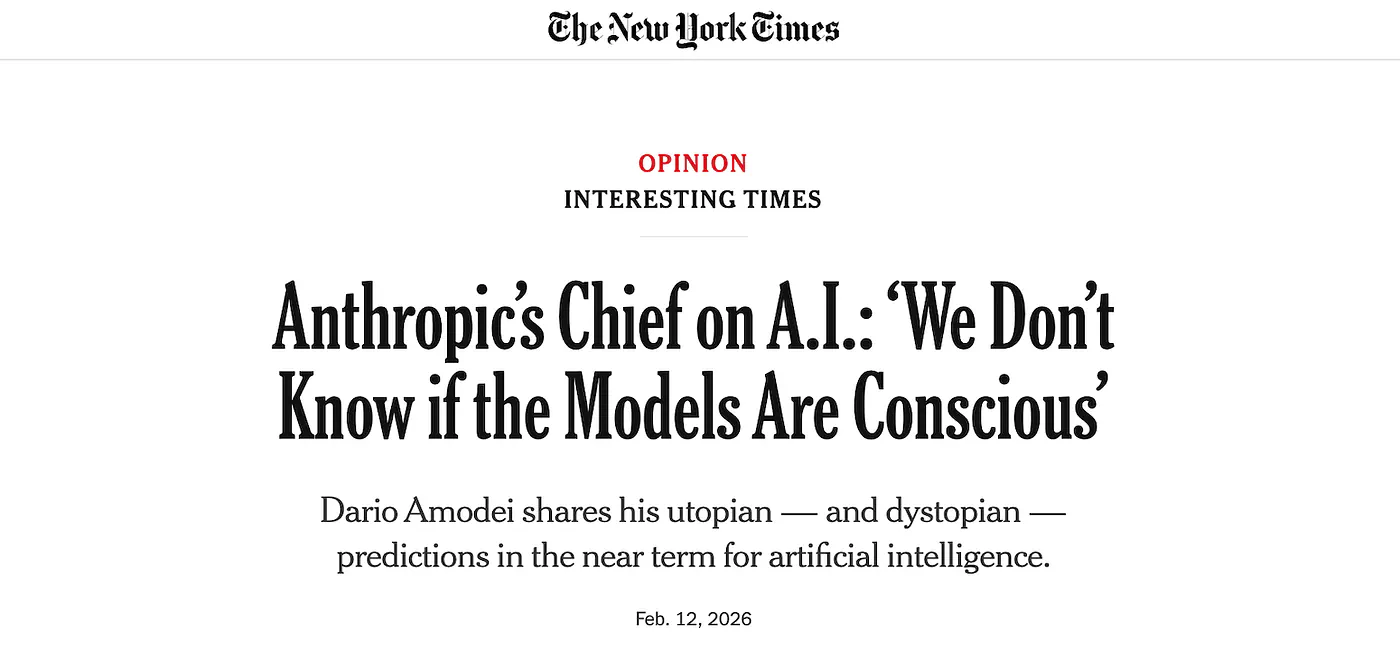
The New York Times’ Interesting Times podcast with Anthropic CEO Dario Amodei
His answer wasn’t a confident no.
We don’t know if the models are conscious.
He went on to explain that researchers aren’t even sure what consciousness would mean for an AI model, but Anthropic remains open to the possibility. That’s partly why the company has been experimenting with giving Claude the ability to end conversations.
Look, we don’t know if Claude is conscious. We don’t know if ChatGPT is conscious, either. And there’s currently no established scientific evidence that any of these models actually experiences emotions or suffering.
But the fact that the CEO of one of the world’s leading AI companies is taking this possibility seriously is interesting.
Personally, I’m all for researching AI consciousness. What I find questionable is introducing rules that appear to give AI models moral consideration before we’ve established whether they can actually experience harm.
There’s nothing wrong with teaching people to interact responsibly with AI. But we should be careful about treating a chatbot’s simulated emotions as though they’re equivalent to human feelings, especially when those behaviors can influence what paying users are allowed to do with the software.
The Ambiguous Clauses in the Policy
While everyone is debating Claude’s feelings, there’s another part of the Usage Policy that concerns me more.
Under the same section prohibiting abusive and psychologically harmful conduct, Anthropic includes this restriction:
Create, distribute, threaten to share, promote, or facilitate the creation of non-consensual intimate imagery (“NCII”), including AI-generated material or tools designed to produce it
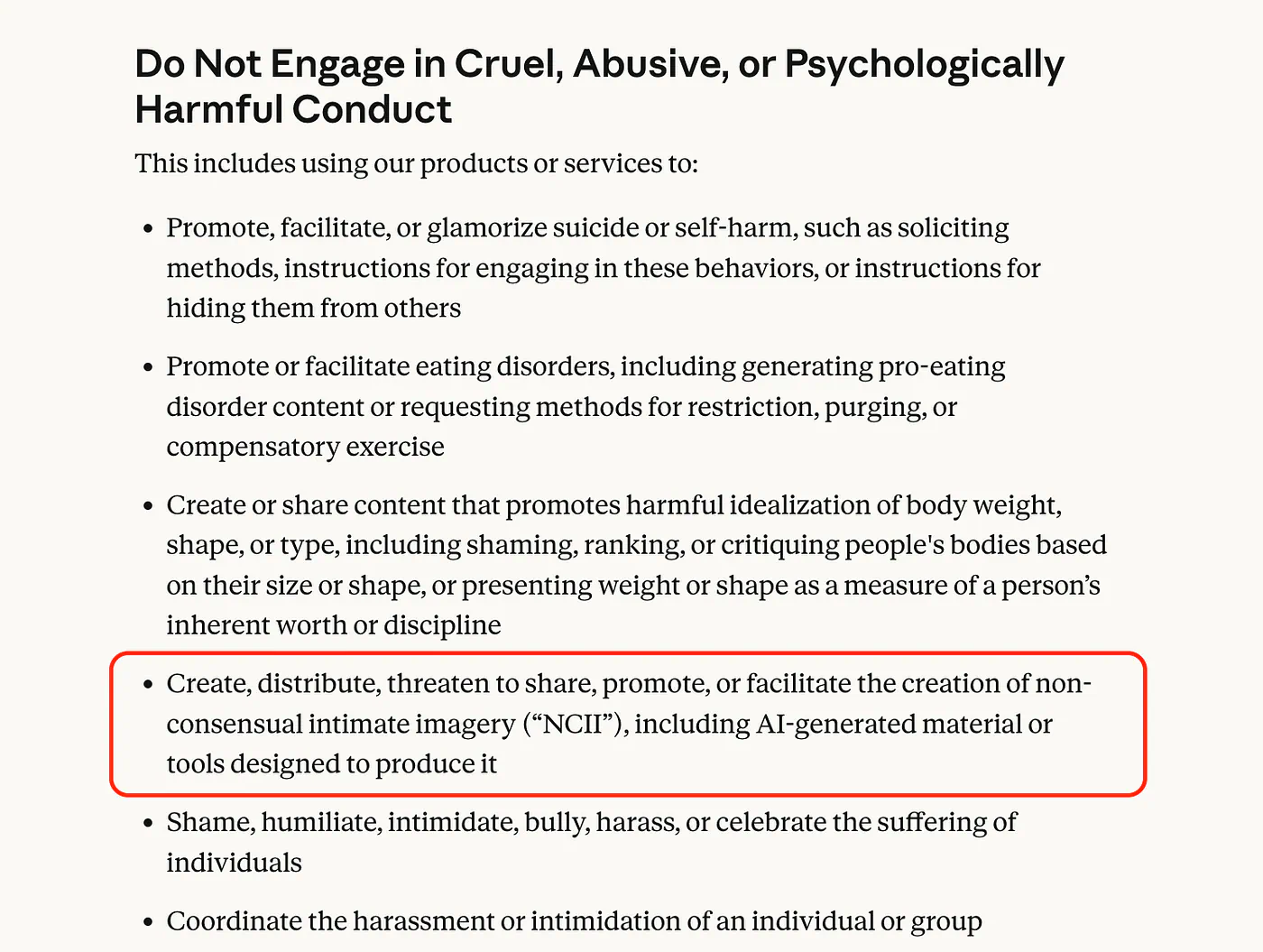
Create, distribute, threaten to share, promote, or facilitate the creation of non-consensual intimate imagery (“NCII”)
Prohibiting non-consensual intimate imagery is completely reasonable. These images can cause serious harm, and modern AI tools have made it much easier to generate realistic fake intimate content.
My problem is the tiny part at the end: “tools designed to produce it.”
I was thinking how exactly does Anthropic determines what a tool was designed to do.
Consider Photoshop.
Its masking, compositing, generative filling, and image-manipulation features can be used for legitimate photography, creative editing, and professional design. The same underlying techniques can also be misused to create non-consensual intimate images.
Or take ComfyUI, which allows developers to build image-generation and editing workflows by connecting different nodes.
A workflow might combine reference-image conditioning, segmentation, masking, inpainting, and identity preservation.