

I wasn’t supposed to write about this, but I’ve seen enough hate on social media over the past 48 hours that we need to discuss what’s going on with Anthropic.
To start, I’ve already switched most of my coding tasks, plus some of my research and writing workloads, from Claude to OpenAI’s Codex. GPT-5.6 Sol is good, and OpenAI has become much more generous with its usage limits.
Now, Opus 5 is still my go-to model for difficult coding tasks. The problem is how quickly it burns through my usage allowance. A good five to eight prompts and I can already be locked out or pushed toward a cheaper model.
I also have access to a Claude Max subscription offered by a company I work with. Sometimes we can send two prompts and the organization is already out of usage credits. Like WTF???
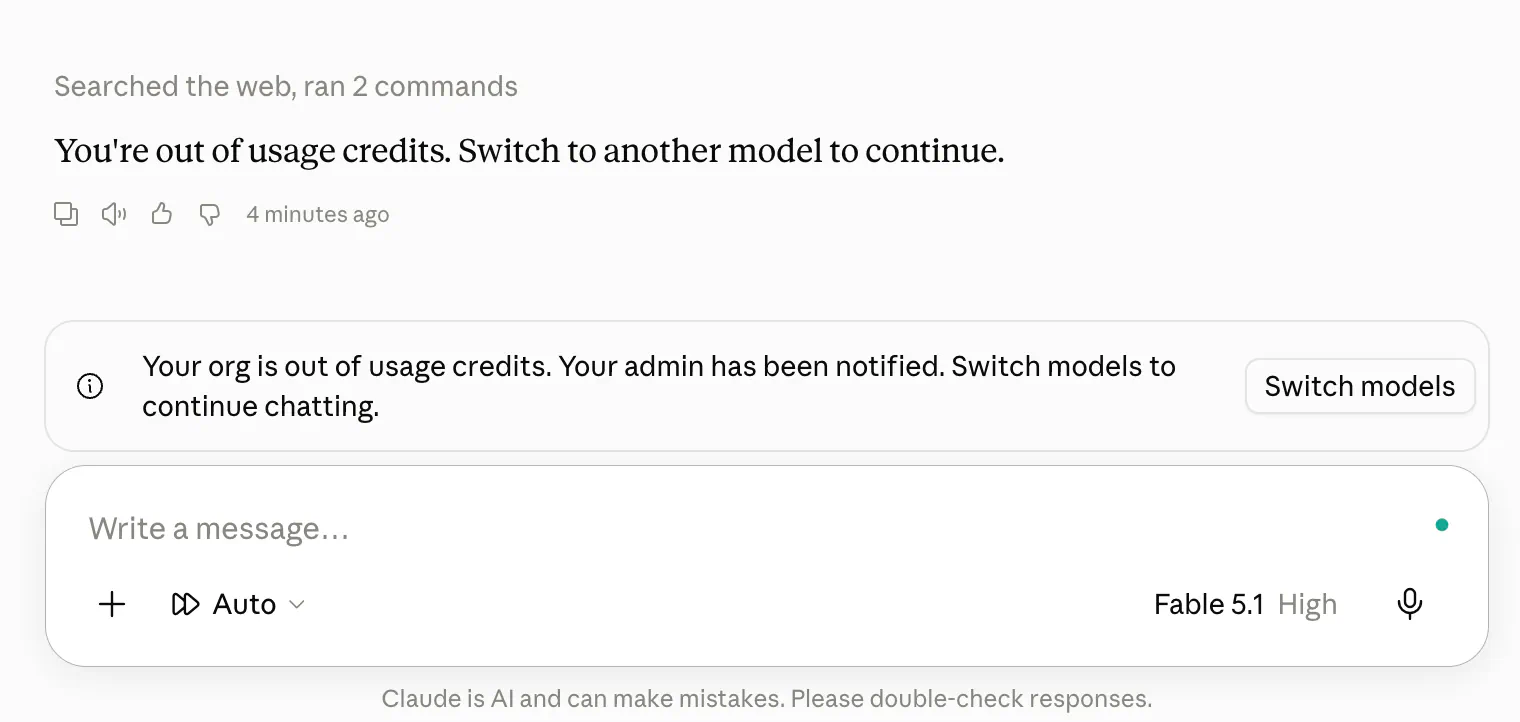
Out of usage credits after a few prompts with Fable 5.1
I kept quiet for a while because I didn’t want to sound whiny on social media. I assumed my prompts were too complex and were somehow eating millions of tokens in a single pass.
It turns out that this can actually happen, although not in the way most users expect.
Claude does not charge usage based on the number of prompts you send. A single prompt in Claude Code can trigger a long agent loop involving repository searches, file reads, tool calls, test runs, retries, subagents, and repeated processing of the existing conversation.
Every time the context grows, Claude may need to process a large portion of it again. Prompt caching can reduce the API cost of repeated context, but cached tokens still represent usage inside the system. If the cache is invalidated or the agent creates several parallel subagents, the token count can grow very quickly.
This is why saying “I only sent two prompts” does not tell the full technical story. But it also shows why Anthropic’s usage system feels so terrible. Users see prompts and working time. Anthropic measures a pile of input tokens, output tokens, cached context, tool calls, and model-specific compute that most subscribers cannot properly inspect.
I was finally triggered when one of the big names on X, Chubby, started hate posting about how bad Claude’s rate limits and safety filters have become.
Go check the replies to that post and you’ll see how many people claim they are cancelling their subscriptions. Better yet, search for “Fable limit” on X and you’ll see what I mean.
This is happening despite how good the latest model, Fable 5.1, actually is. If you check the benchmarks, you’ll know that this is the model you should upgrade to for any agentic tasks.
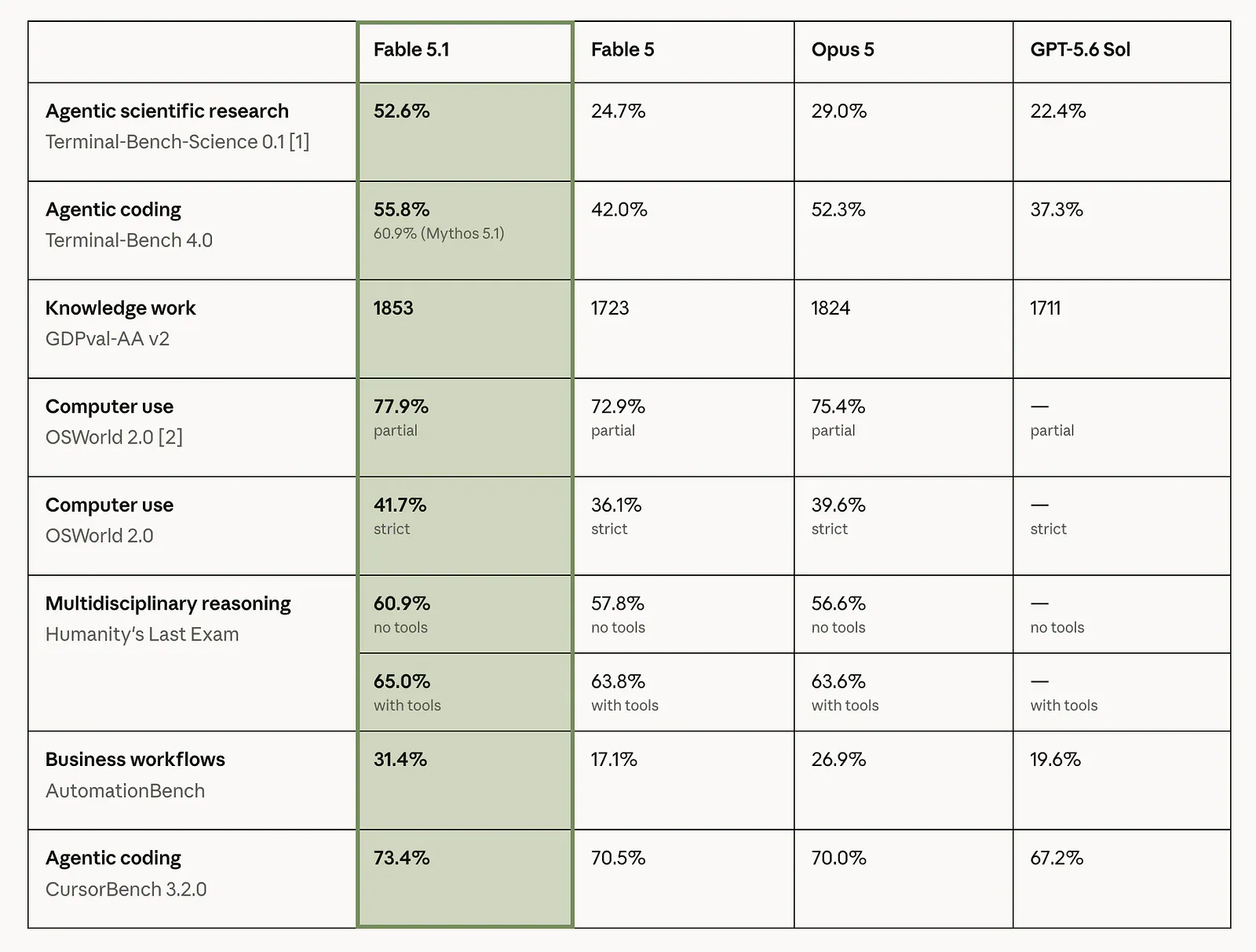
Fable 5.1 benchmark results
But hold your horse because Fable 5.1 is also a token hungry beast that can eat up your credits in minutes. A user claimed to have exhausted the allowance on a $200 Claude Max plan in under 30 minutes.
In one Reddit discussion, a Max 20x subscriber said that only a couple of prompts pushed their usage to 100%. In another post, a user reported that two localization audits spawned 126 agents and processed roughly 8.4 million tokens.
Another Max 20x user said they deliberately burned through the plan in around eight hours. Interestingly, that user still praised the quality of the output. That describes my problem with Claude perfectly. The model is extremely good. The experience around it is not.
Anthropic’s own documentation helps explain some of this.
The $100 and $200 Max plans are advertised as offering 5x and 20x more usage than Claude Pro. Those are relative allowances, not fixed token packages. Anthropic also applies five-hour session limits and separate weekly limits, with usage depending on model choice, conversation length, files, tools, and compute demand.
Fable makes this even more confusing. According to Anthropic’s support page, Fable usage on Max can consume up to 50% of the weekly allowance. On some organizational plans, it can instead use metered credits from the first token.
Fable 5.1 also uses adaptive thinking, and Claude Code runs it at high effort by default. Higher effort gives the model more freedom to reason, search, and retry before answering. That can improve the code, but it can also burn through an allowance much faster than users expect.
So no, Anthropic does not promise a specific number of prompts. Technically, the company can say the system is working as documented.
That does not make the product less frustrating.
If Anthropic sells a plan for $200 per month, users should be able to understand what they are buying without reading several support pages and reverse-engineering token consumption from a status command. “20x more usage” means almost nothing when the baseline changes based on the model, context, tools, and whatever the agent decides to do behind the scenes.
Another terrible experience I have with Anthropic models is the level of safety filtering. Yes, I understand why these filters exist. I am not asking Claude to help me create malware, manufacture a weapon, or attack somebody’s server.
But Claude can become ridiculously cautious during legitimate technical work.
Have you experienced that? Claude is 90% done of the task and all of a sudden it stops because it realized that what you are asking is against its safety policies. Crazy. And worse, those failed attempts can still consume part of your limited usage.
Anthropic knows that false positives are a problem. With Fable 5.1, the company says it reduced cyber-related safety interventions by 60%. It also reduced some biology-related fallbacks for basic and medical questions.
In case you experience any illogical refusals with the latest model, let me know in the comments.
I get why Dario Amodei keeps arguing that AI companies should move carefully. There are real risks here. But from a customer’s perspective, it is difficult not to be annoyed when Anthropic sells one of the most expensive models available, gives it some of the tightest practical limits, and then sometimes blocks the work you were paying it to perform.
Based on the Model Zen Garden chart, Claude models are also among the most expensive models in its long-running agent tests. Check the API-equivalent cost per run below.
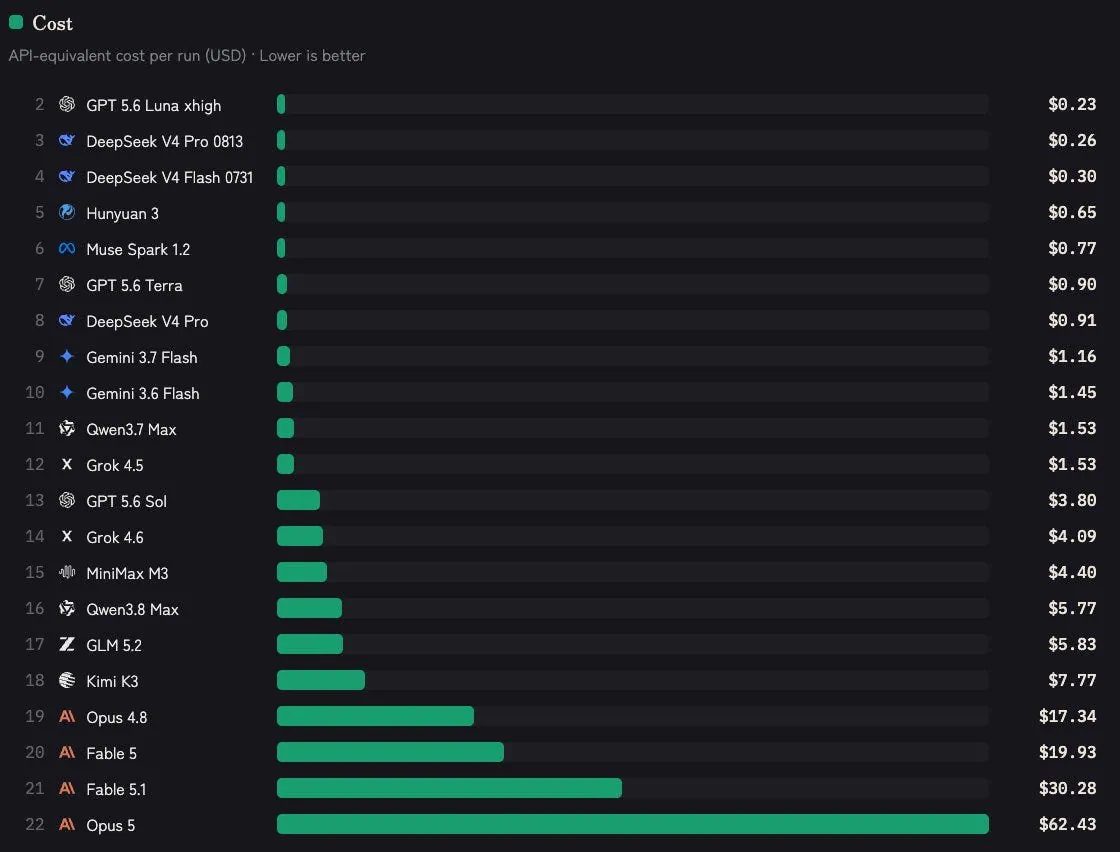
Model Zen Garden cost benchmarks on SOTA models
Okay, that chart needs some context. “API-equivalent cost” is an estimate based on the tokens used during the benchmark and the model’s published API prices. It is not the amount Anthropic directly charged a Max subscriber.
It is still useful because it shows how expensive an agent run would have been through the API. In the result shown above, Opus reportedly processed around 97.1 million tokens over four hours and sixteen minutes, producing an estimated cost of $62.43.
In terms of active build time and total tokens consumed, Claude Opus is still near the bottom of that particular test.
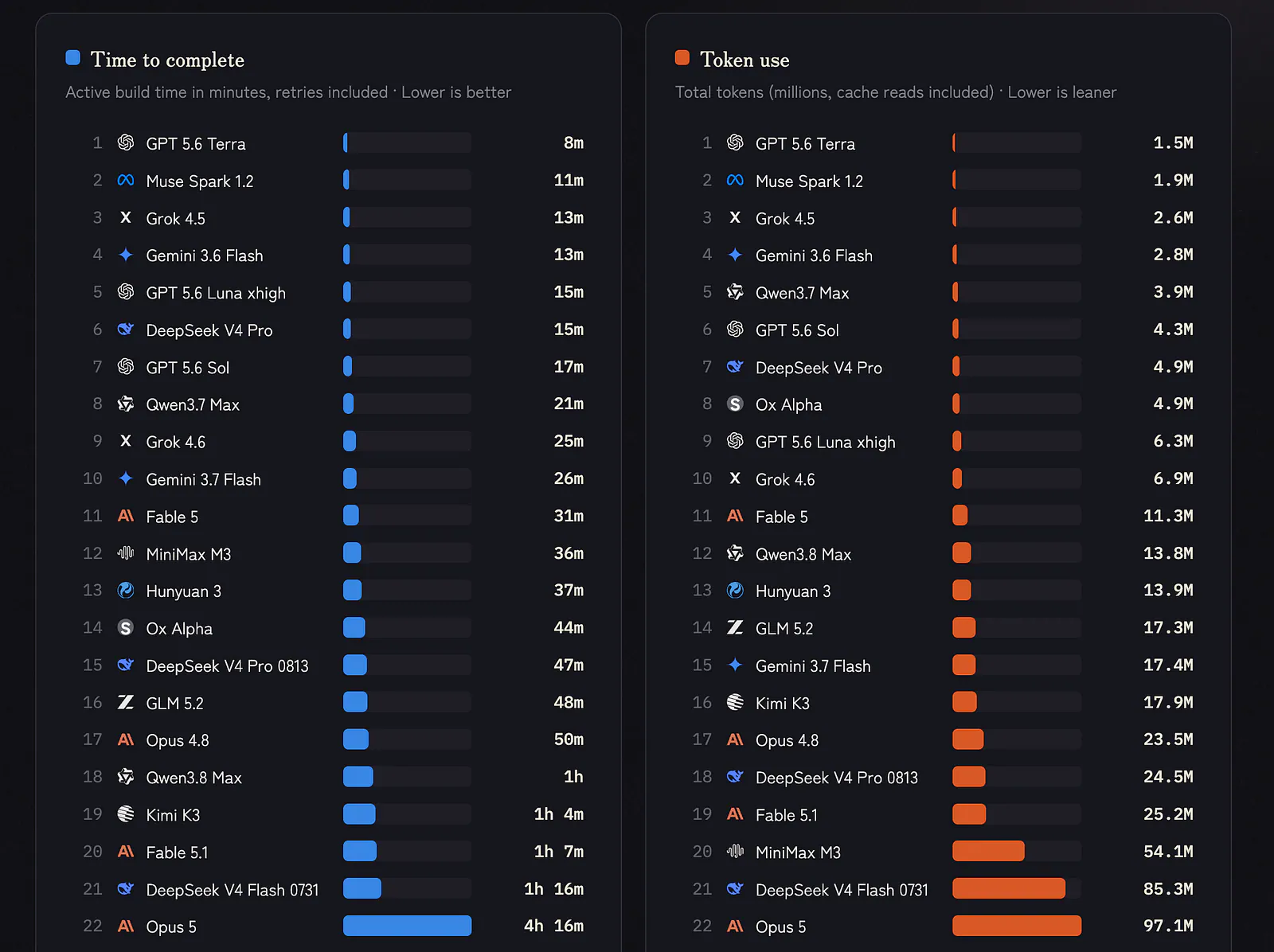
Model Zen Garden cost cost and token benchmarks on SOTA models
Again, this does not mean Claude is always slower or more expensive. These benchmarks test the model together with its agent harness, tool strategy, and prompting setup.
But that is also the product people are using. If the agent repeatedly reads the same repository, spawns too many workers, or spends millions of tokens thinking, users still pay for that inefficiency through API bills or subscription limits.
This is incredibly frustrating for indie developers like me because I do not have unlimited money sitting in the bank for AI subscriptions. I cannot justify paying $200 a month for a plan that might give me several productive hours one day and then stop after a handful of prompts on another.
This is why I’m slowly moving more of my work to Codex. Not because Claude suddenly became bad. Opus and Fable are still some of the best coding models I’ve used.
I am moving because OpenAI currently gives me a more predictable working experience. I can start a task without constantly looking at a usage meter or wondering whether asking the model to rerun the tests will wipe out the rest of my weekly allowance.
Anthropic does not need to make Claude unlimited. That would be unrealistic, especially for models as expensive to run as Fable and Opus.
It does need to show users what is happening. Give us a proper token breakdown. Show how much usage came from the main agent, subagents, cached context, tool results, and extended thinking. Warn us before a task launches 126 agents or consumes half of a weekly allowance.
And if a safety classifier blocks a legitimate request, do not make us waste more usage arguing with it.
Claude is still good. In some coding tasks, it is still the best model I use. That is exactly why Anthropic’s pricing, limits, and guardrails are so frustrating.
The company has built a model people want to use, then wrapped it in a system that keeps telling them to stop.
What are your thoughts? Let me know in the comments.
Sources
- https://x.com/kimmonismus/status/2094896358008442960x.com
- https://x.com/petergyang/status/2095275295511281918x.com
- https://x.com/bridgemindai/status/2095085317367762983x.com
- Reddit discussionreddit.com
- another postreddit.com
- deliberately burned through the plan in around eight hoursreddit.com
- $100 and $200 Max plans


