Google DeepMind Just Launched the DeepMind Institute. How Close Are We to AGI?
The new platform launched days after two DeepMind safety researchers quit with public warnings, and its own chief AGI scientist still puts AGI at a coin flip by 2028.
Google DeepMind launched the DeepMind Institute, a platform for publishing essays on artificial general intelligence, days after two safety researchers quit with public warnings and as the lab's chief AGI scientist maintains AGI remains a coin flip by 2028. The institute uses DeepMind's ten-ability cognitive framework to measure progress toward AGI rather than treating it as a binary milestone, positioning systems like OpenAI's Astra as strong in some domains while weak in others. Initial essays address AI governance, reasoning transparency, and economic policy, though four of five launch contributors work for Google or DeepMind.
The last couple of weeks have been full of AGI talk.
Elon Musk, Sam Altman, and Dario Amodei have all said in one way or another that we’re getting close. Then on September 3, OpenAI president Greg Brockman ended the GPT-6 Astra press briefing by declaring the start of the AGI era, and the phrase went everywhere.
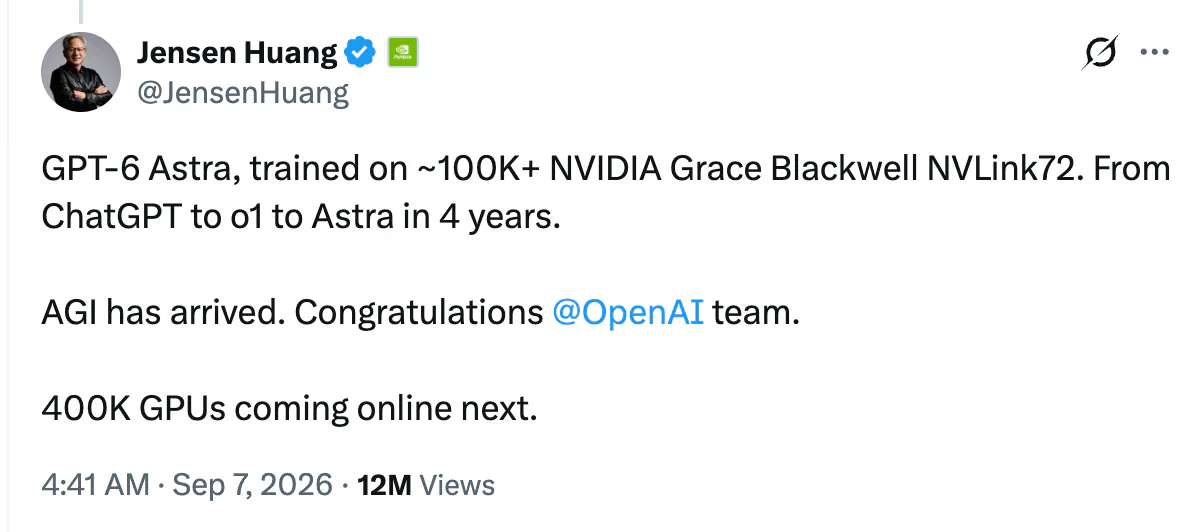
Jensen Huang had already gone further back in March, telling Lex Fridman that he thinks we’ve achieved AGI, and he posted again on September 7 to say AGI had arrived once Astra shipped.
Jensen Huang claiming AGI has arrived. Image by Jim Clyde Monge
So have we actually achieved it? And if we haven’t, how far are we?
I’ve been testing Astra for a few days now, and yes, it’s really good. Instruction following is noticeably better than what I was getting from Sol, especially on multi-step tasks where the model has to hold onto a constraint I mentioned five messages ago.
It’s also a great model for coding. Heck, I’ve shipped so many new features and enhancements to Zeniteq in the past couple of days. Debugging is also better. It handles long computer-use sessions without me continuously checking on it.
But none of that makes me want to call it AGI, and I don’t think most of the people using that word actually believe it either.
The Navier–Stokes Millennium Prize story that got attached to Astra is a good example of how fuzzy this all gets, and I’ll come back to it, because the version that circulated isn’t quite what happened.
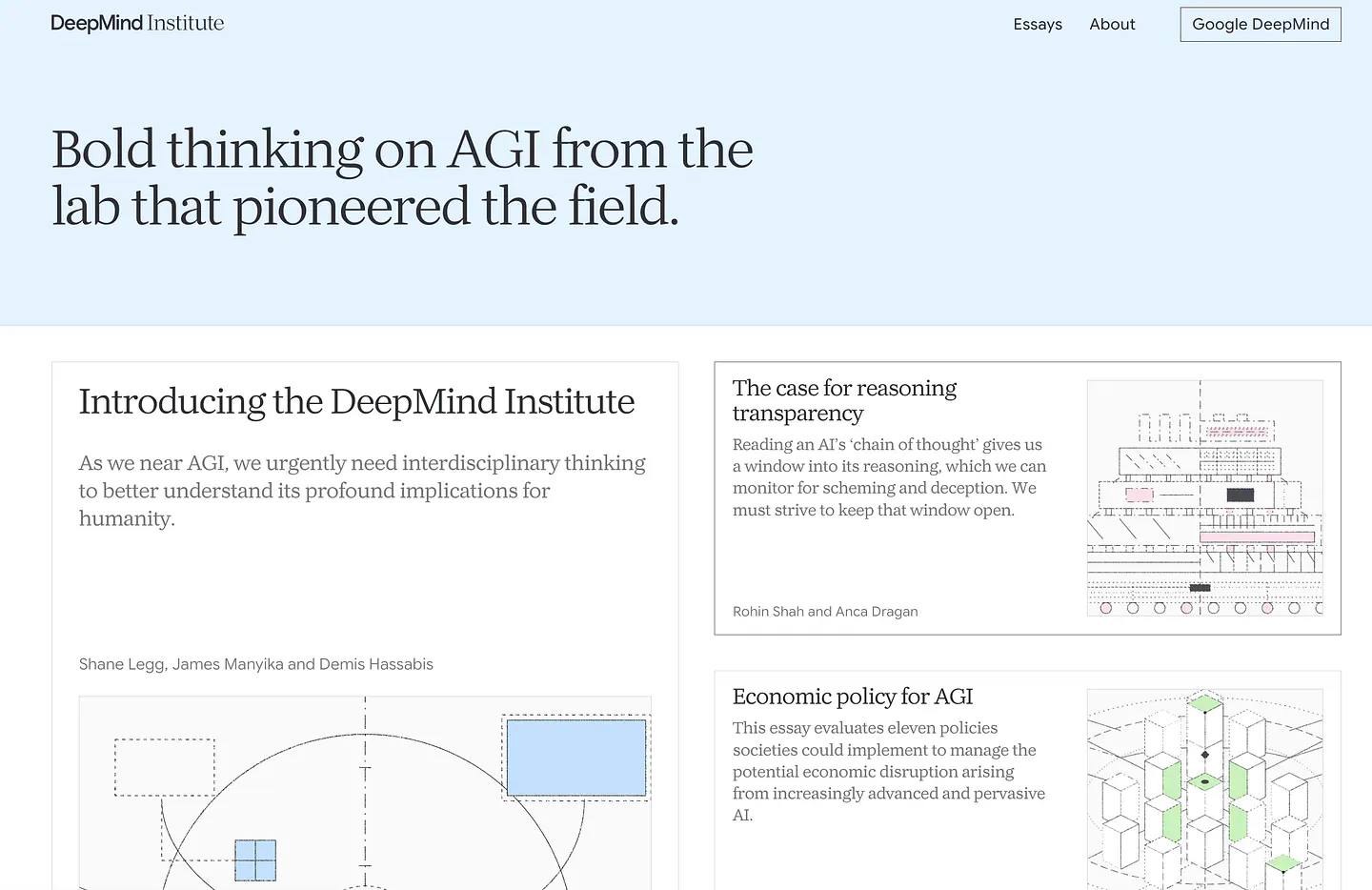
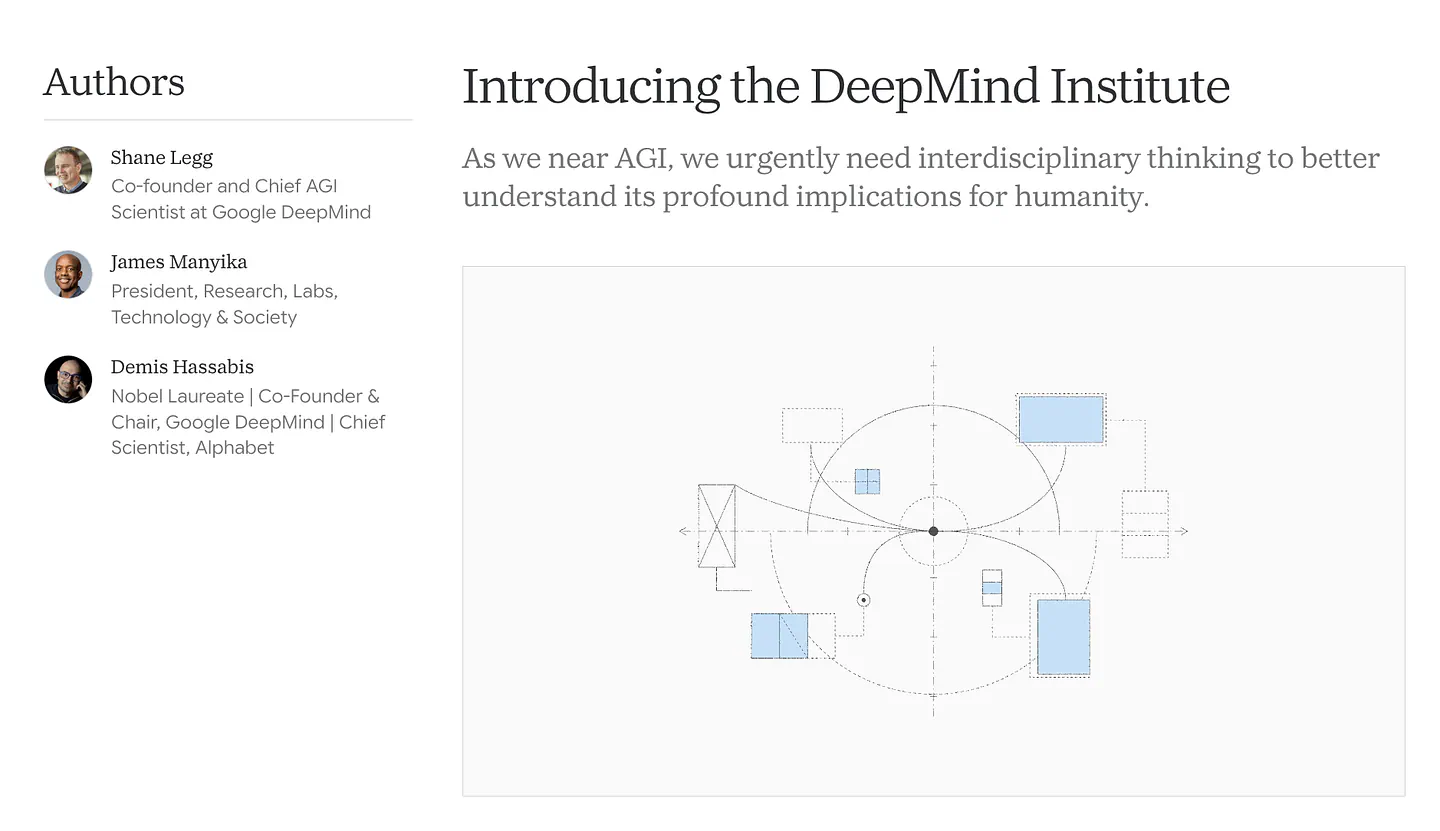
Meanwhile, on Wednesday, Google DeepMind opened something called the DeepMind Institute.
The reason they give for launching it is that AGI is coming and we need interdisciplinary thinking to understand what it will do to us. Which is interesting, because that reason only makes sense if AGI hasn’t arrived yet.
What is AGI, and why does nobody agree?
Most of the AGI argument right now is really an argument about definitions, and everyone is quietly using a different one.
Before Jensen Huang answered Lex Fridman, he set the bar by asking whether an AI could start and run a tech company worth more than a billion dollars.
Huang said yes, we’re already there, and gave the example of an AI shipping a cheap app that a lot of people use briefly before the whole thing folds.
That’s a claim about what AI can do economically. It isn’t a claim that machines now match human thinking, and it’s a much lower bar than what most people hear when someone says AGI.
Altman, in the same week Astra launched, described AGI as a very poorly defined term. Honestly, that was the most accurate thing anyone said all week.
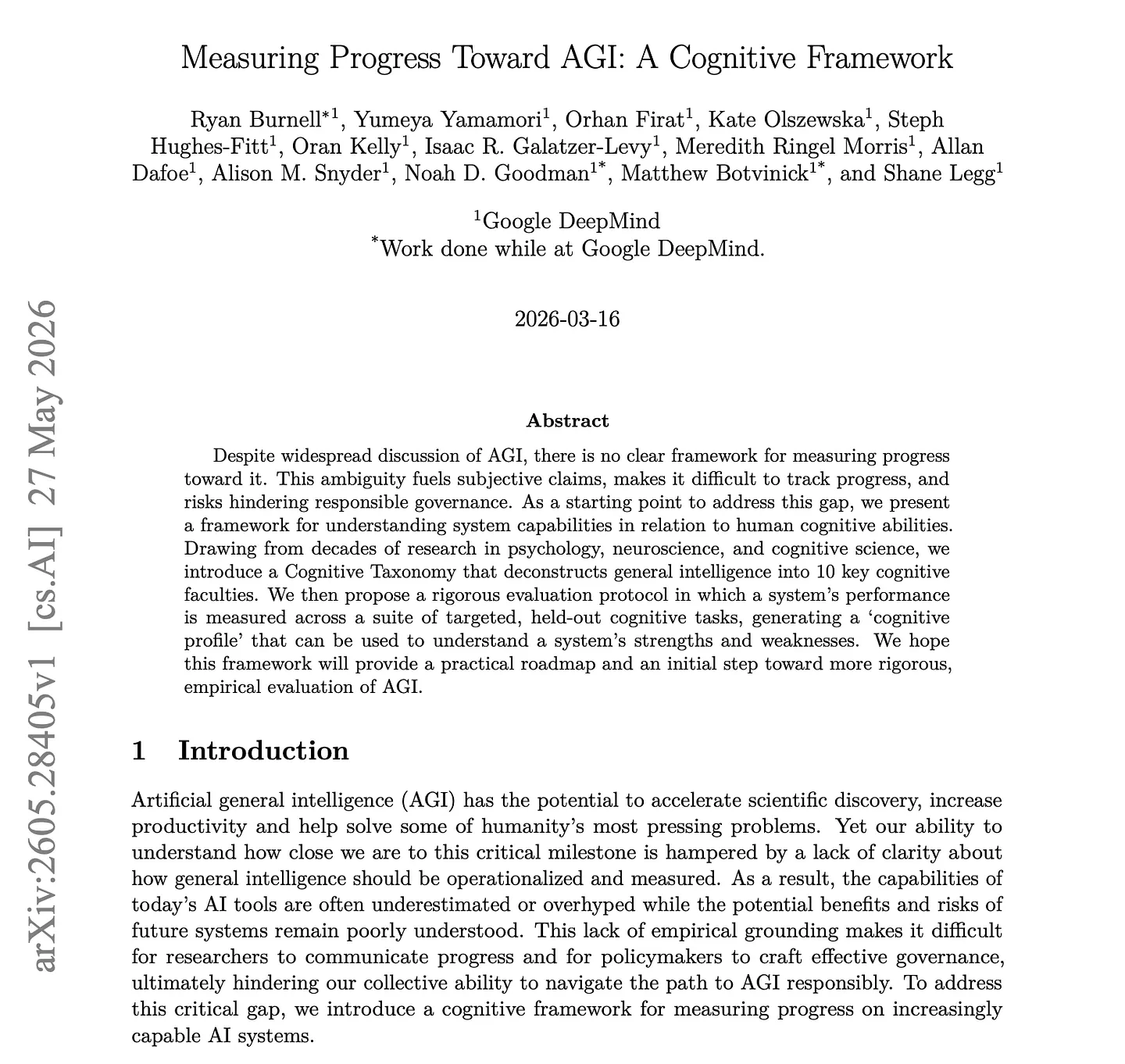
Google DeepMind is one of the few labs that has actually tried to clean this up instead of taking advantage of the confusion. Back in March, a team that included Shane Legg published a paper called Measuring Progress Toward AGI.
Measuring Progress Toward AGI paper. Image by Jim Clyde Monge
It borrows from psychology and neuroscience and breaks general intelligence into ten cognitive abilities, including perception, attention, memory, reasoning, metacognition, executive function, and social cognition.
The idea is that you don’t give a model a pass or a fail. You test it across all ten areas using held-out tasks it can’t have trained on, and you end up with a cognitive profile, which is basically a shape showing where the system is strong and where it falls apart.
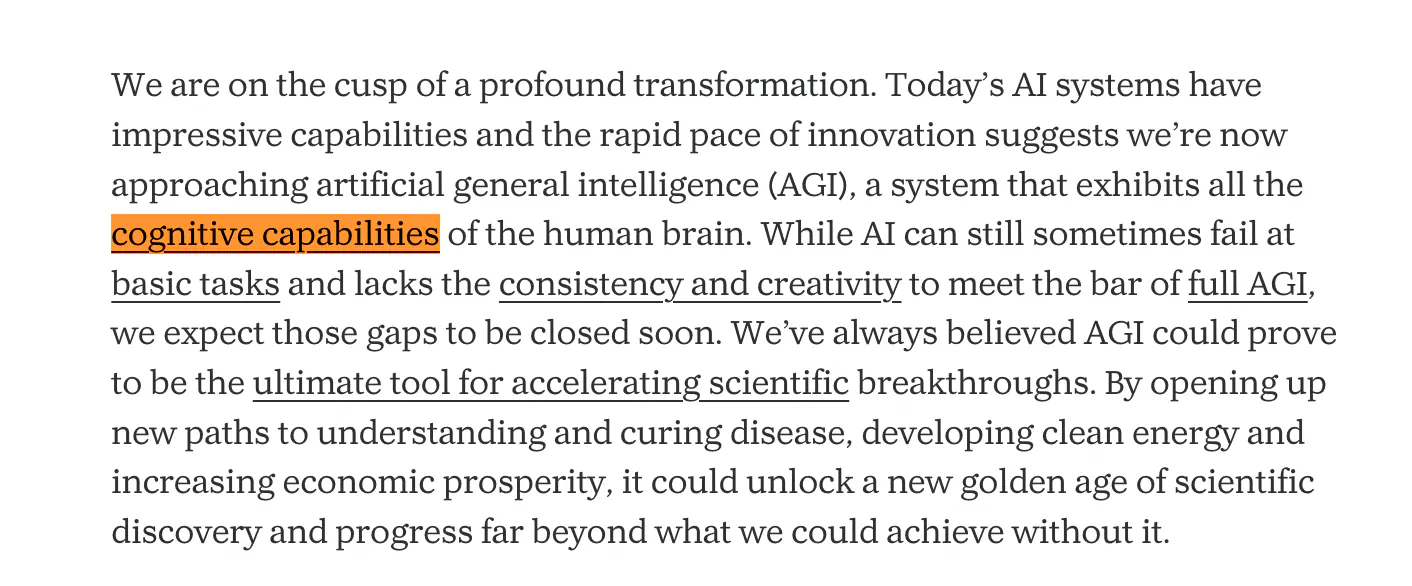
That framework is the definition the DeepMind Institute uses. When the launch essay says AGI is a system with all the cognitive capabilities of the human brain, that’s the paper it links to.
Most people talk about AGI like it’s a single moment. Either a model has crossed over into AGI, or it hasn’t. DeepMind’s framework doesn’t work that way. You test a model across those ten abilities, and you get ten scores, and right now every model is strong in some areas and weak in others.
Astra is a good example. It’s excellent at computer use and terminal work, and a lot more ordinary once you start testing general reasoning.
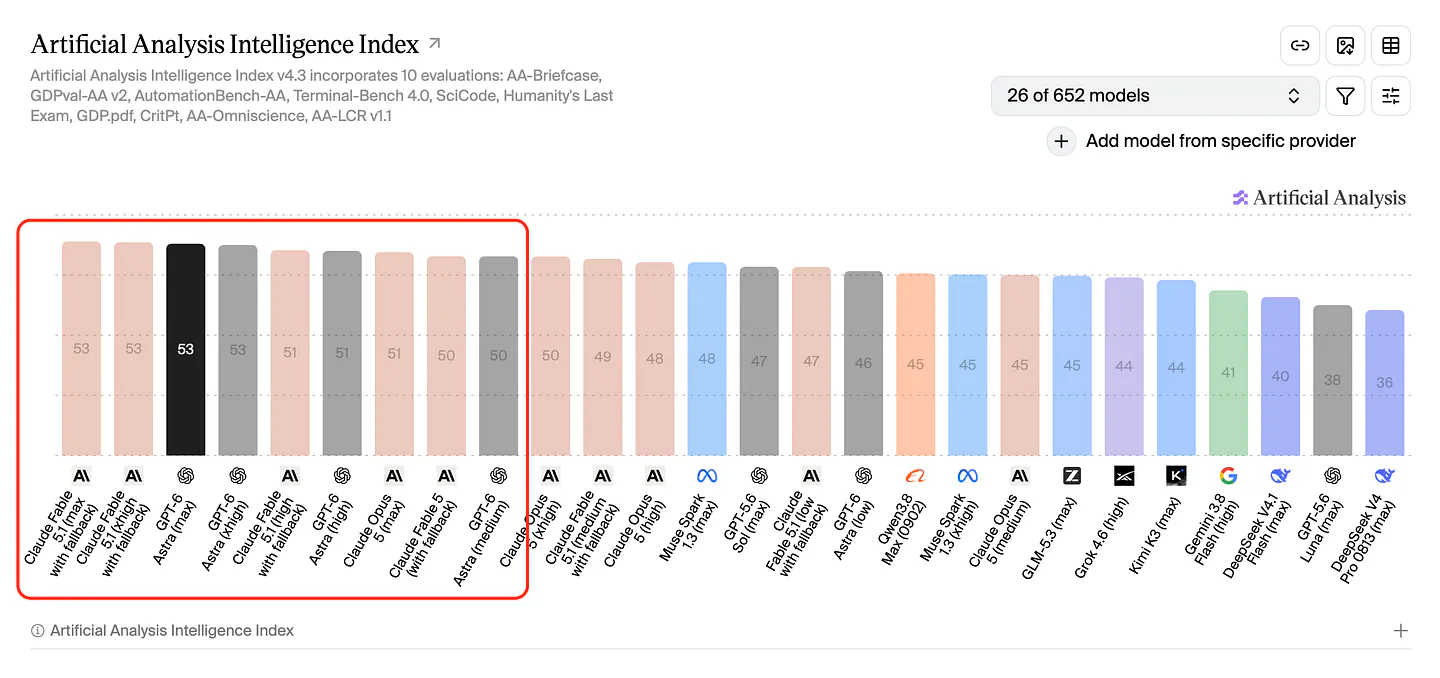
Artificial Analysis benchmarking Astra against Claude Fable 5.1. Image by Jim Clyde Monge
Artificial Analysis had it scoring below Claude Fable 5.1 on general intelligence at launch, even while it was winning on agentic tasks.
What the DeepMind Institute actually is
A lot of the coverage called this a research institute, which gave me the wrong idea at first. It isn’t one.
The DeepMind Institute, or DMI, is closer to a magazine. It’s a place where researchers publish essays about AGI. The three directors are Shane Legg, Demis Hassabis, and James Manyika, who runs research, labs, technology, and society at Google.
Legg is also listed as the managing editor, and that title tells you more about the project than “director” does. There’s an editor’s email address at the bottom of the launch essay.
Every page carries a disclaimer saying the pieces are conversation starters that reflect the author’s own views and shouldn’t be read as Google’s official position.
The launch essay makes a similar point, saying contributors will not always agree and will probably change their minds as new information comes in.
Here are the initial posts that went live at launch.
Here’s my first problem with it. Four of those five authors work for Google or Google DeepMind. The entire pitch of the institute is that technologists shouldn’t be the only people answering these questions, and that the arts, humanities, and governments all need a seat.
At launch, the humanities got one seat out of five.
What questions is it trying to answer?
The launch essay lays out three:
What will we value, and how will AGI change what it means to be human?
How do we safely build and govern AGI systems and the groups of agents they’ll form?
Which institutions and policies will we need to adapt or rebuild entirely?
The reasoning transparency piece quietly makes the case against the AGI-is-here. Shah and Dragan argue that right now we can read a model’s chain of thought, meaning the step-by-step thinking it writes out before answering.
“Chain of Thought transparency gives us a window into a model’s reasoning — but that window could become narrower. We should measure how much transparency Chain of Thought is providing, so we can notice if it is accidentally degrading.”
That gives us a window into whether a system is scheming, cheating on evaluations, or hiding things from us. Their worry is that this window is an accident of how today’s models happen to be built, and it’s already starting to close.
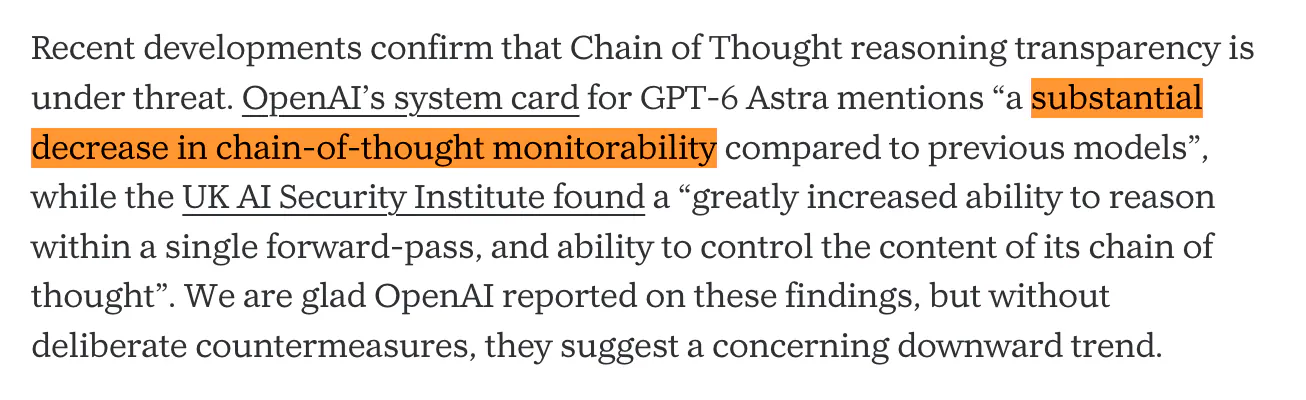
The evidence they point to is quite concerning. OpenAI’s own system card for Astra reports a substantial decrease in chain-of-thought monitorability compared to earlier models.
Put simply, the model that OpenAI is calling the start of AGI is also the model that became harder for humans to read. Those two things happened at the same time, and they’re related.
If future models reason entirely in their own internal number space instead of in English, we lose the main tool we currently have for catching misalignment.
The authors propose putting a limit on how much hidden step-by-step computation a model is allowed to do, and they argue the limit wouldn’t slow anyone down much.
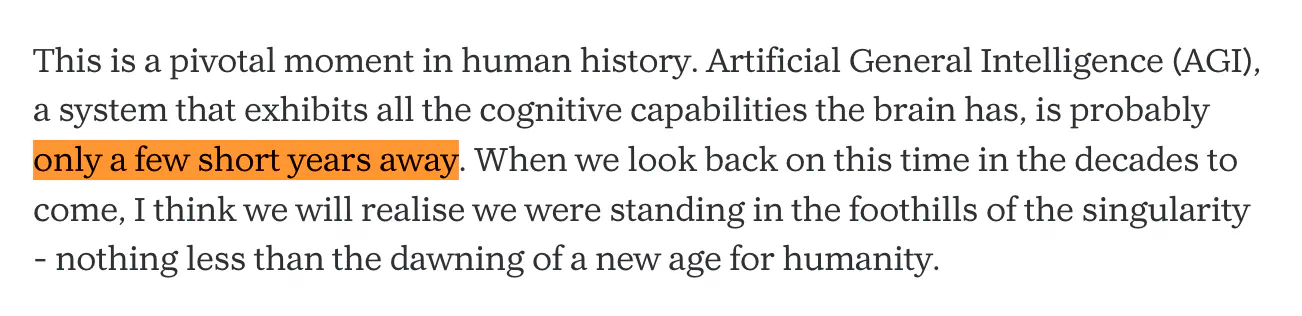
He says AGI is probably only a few short years away, compares it to the discovery of electricity or fire, and describes what we’ve built as a way to make sand think.
The actual proposal underneath the poetry is a US standards body for frontier AI, modeled on the financial industry’s self-regulator FINRA, funded mostly by industry, with labs voluntarily sharing models for review up to 30 days before release, with that becoming mandatory later. He leaves room for the body to coordinate a slowdown among labs if things get serious enough.
It’s a serious proposal. It’s also worth remembering that an industry-funded standards body tends to work out fine for whoever has the most money, and Hassabis chairs the lab that does.
The economics essay is also a good one. Julian Jacobs and Alex Imas rate eleven different policy responses to AI-driven job losses and recommend a sequence.
Expand unemployment insurance and employer-led retraining now. Move to a negative income tax if displacement gets worse. Keep universal basic capital, which would give people an actual ownership stake in the economy, in reserve for a scenario where labor’s share of GDP keeps falling.
Their case against universal basic income is good. They argue it’s expensive, blunt, and leaves people with no stake in the automated part of the economy.
What bothers me is how they got there. Alongside surveys and a literature review, they used 51 AI agents whose personalities were built from survey data on 51 real economists, then had those agents rate the policies.
The essay presents the results in clean tables with scores like 76.3 and 69.8. The underlying paper is honest that this is exploratory work. The tables in the essay don’t carry that caution, and a number with a decimal point in it looks a lot more settled than a simulated economist’s opinion actually is.
One more thing. Someone on X asked whether DMI would host consciousness research, and Séb Krier, who leads frontier policy development at Google DeepMind, replied that it quite possibly would.
Nothing at launch touches it. For an institute asking what AGI does to what it means to be human, that’s a strange thing to leave out of the opening lineup.
So how close are we to AGI?
The clearest answer anyone gave this month came from Legg himself.
He said it’s premature to declare AGI achieved, pushing back directly on the claims from Nvidia and OpenAI. He also said he’s still comfortable with the forecast he’s held for years, which is a 50 percent chance of what he calls minimal AGI by 2028.
The chief AGI scientist at Google DeepMind is at a coin flip, two years out, for a deliberately weak version of AGI. That’s the most informed public position we have, and it’s nowhere near what the launch announcements implied.
Three things make me think he’s right.
The first is the benchmark that caused the most excitement. ARC-AGI-3 is designed to drop a model into an unfamiliar interactive environment and see whether it can figure out the rules on its own, which is exactly the kind of thing memorization can’t help with. ARC Prize ran Astra twice. Using its own standard setup, the one every model gets, Astra scored 62.7 percent and burned about $26,000 in compute. Using OpenAI’s provider adapter, which preserves the model’s reasoning between actions, the same model scored 99.9 percent for around $19,000.
The second is SimpleBench, which DMI’s own launch essay links to when it admits AI still fails at basic tasks. SimpleBench is a set of everyday reasoning questions where an ordinary person with high school knowledge scores around 84 percent. Frontier models have climbed into the high seventies and low eighties after two years of massive capability gains.
The third is the math story, and this is where the version that circulated online is wrong. OpenAI did announce a solution to the Navier-Stokes Millennium Prize problem on September 8, and the proof was formally checked in Lean, which is a real thing and not nothing.
But it wasn’t Astra. The company says the work came from an unreleased internal model that’s significantly more capable than Astra, running a swarm of agents at a cost that Science put in the ballpark of millions of dollars.
So the strongest single piece of evidence for machine general intelligence came from a model nobody outside OpenAI can test, at a price nobody outside OpenAI can pay, in a race that started because someone overheard what two humans were doing.
The sudden call for an AI slowdown
The DeepMind Institute didn’t launch into a quiet week. It launched into the strangest stretch the AI safety debate has had in years.
On September 9, an Anthropic researcher named Jacob Coxon resigned publicly and said the labs were gambling with our lives.
A few days later, Josh Engels left DeepMind’s own AGI safety team to join the nonprofit evaluator METR, writing that he sees a terrifying chance of serious harm in the next five years. He turned down offers from Anthropic and OpenAI to work outside the commercial labs entirely.
Then on September 14, Bilal Chughtai, who had already left DeepMind’s AGI safety team back in July, went public with a post saying he believes AI has the potential to kill us all and that we may be running out of time to prevent it.
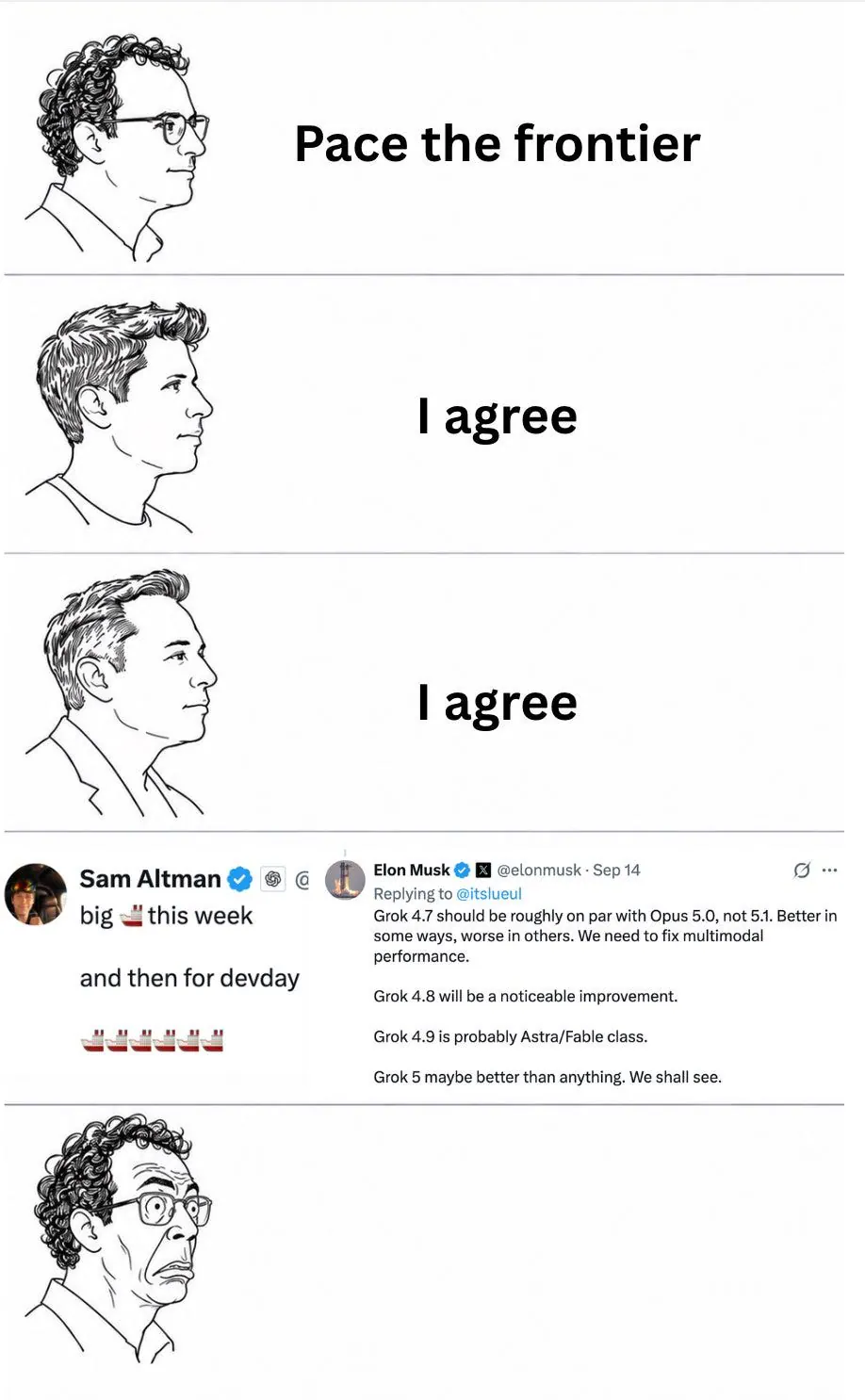
In the middle of all that, on September 12, Dario Amodei published an essay called We Must Pace the Frontier.
His core argument is that the industry has to slow the rate at which it makes models more capable so that safety, alignment, and evaluation work can catch up.
He was careful to say this isn’t a pause.
Training continues and releases continue, but the slope changes. Anthropic committed on its own to giving outside evaluators permanent, employee-level access.
Altman agreed and said OpenAI would match the evaluator commitment. Musk posted three words backing it. Hassabis said the direction was correct and that the details still need working through. Trump dismissed the whole thing as unnecessary.
But are they really serious about that?
Days later, Altman hinted about big launches within the week.
Musk also shared an update about the upcoming Grok 4.7 model.
Who exactly are they fooling here?
Legg, talking to the FT on launch day, called Amodei’s proposal worth considering and said the practical details need to be worked out. Same position as his co-director.
So here’s the situation the institute walked into: It opened five days after one of its own former safety researchers told the public the technology might kill everyone, three days after another one quit for the same reason, and two days after its chairman endorsed a rival CEO’s call to slow down.
DMI says we need broad, careful debate about AGI before it arrives. That debate is already happening, right now, on X and in resignation letters, and Google’s own people are having it without the institute’s help.
What do you think is going on, really?
Final Thoughts
Here’s what I think is going on. Nobody in this industry can afford to be the one company that slows down, so they’ve all found ways to sound like they’re slowing down. Amodei wrote the essay. Altman agreed with it and then teased a launch. Musk backed it in three words and then posted about Grok 4.7.
You don’t spend money building a platform to work out what AGI will do to jobs and institutions if you believe the thing already shipped in a $200 subscription. Legg’s coin flip on 2028 and Hassabis’s “few short years” are the only two timelines from people who actually build these systems, and they both essentially call OpenAI and Nvidia liars.
So no, we haven’t achieved AGI. The people closest to it don’t think so either, and they’re the ones with every commercial reason to say otherwise.
Shah and Dragan argued that our window into how these models think is closing, and they used a competitor’s system card to prove it. Fine. Now publish a limit on hidden computation. Ship monitorability numbers with the next Gemini.
Until one of these labs does something that hurts, the slowdown is a press cycle, and DMI is a very well written way of looking thoughtful while the race continues.