
On November 20, 2026, Anthropic mathematician Levent Alpöge released a Riemann Hypothesis proof that he says he found with Claude, published not as a paper but as a 17-million-line program in the Lean proof assistant. By November 23, independent checkers at MIT, the University of Waterloo, and the Lean community had compiled it, rechecked it with several separate kernels, and confirmed that the theorem it proves is the Riemann Hypothesis as Lean's math library states it.
That makes this the strongest claim yet that an AI system helped settle a famous open problem. It doesn't make the problem "solved" in the sense mathematicians care about. Nobody has a readable account of why the argument works, the broader Generalized Riemann Hypothesis claim has had less scrutiny, and the Clay Mathematics Institute's prize rules haven't even started their clock.
This article covers what was released, how the machine verification works and what it rules out, what Claude reportedly contributed, how leading mathematicians reacted, and what remains open.
Key takeaways
- The claim: On November 20, 2026, Levent Alpöge posted a four-page note and a Lean archive of 175,187 files, about 17 million lines, proving the Riemann Hypothesis and, he says, the Generalized Riemann Hypothesis for Dirichlet L-functions.
- The certification: On November 21, the Lean FRO and the Mathlib Initiative said in a joint statement that both the statement and the proof of the Riemann Hypothesis are correct.
- The checks: MIT's Andrew Sutherland reports the proof compiles with zero errors, uses only Lean's three standard axioms, and passes Lean's own kernel, a paranoid kernel mode, and independent checkers such as nanoda and con-leche.
- The gap: There is no human-readable paper. Alpöge says a Claude-written draft ran past 250,000 pages and he chose not to post it. A 265-page third-party guide still reduces the core inequality to thirteen unproved hypotheses stated in classical terms.
- Claude's role: Alpöge credits Claude with key technical steps, including chaining theta lifts about √X times, and says Claude "far outpaced" him near the end. Terence Tao describes the result as generated with an internal AI model.
- Not yet a Millennium Prize: Clay requires publication in a qualifying outlet, two years of waiting, and general acceptance before it considers a solution.
What did Levent Alpöge announce on November 20?
Levent Alpöge announced a complete, machine-checkable proof of the Riemann Hypothesis, posted on his personal website as a short note plus a Lean code archive split into 14 parts. He is a number theorist on leave from Harvard who works at Anthropic, according to Nature.
In his four-page statement, Alpöge writes that he believes he has found the proof "working with Claude," that the method extends to the Generalized Riemann Hypothesis, and that he expects the Extended Riemann Hypothesis to follow with more time. He also says he and Claude formalized the argument without assumptions.
The note is unusual for a major mathematical announcement. It contains no proof sketch a specialist could follow line by line. Instead it offers a dated timeline of ideas, which Alpöge says Claude compiled, and a set of caveats:
- No paper yet. Alpöge says it would be "obviously inappropriate" to post an unreadable draft, so he released only the Lean code and intends to write the argument up properly himself.
- He hasn't mastered all of it. He writes that he personally has little mastery of automorphic forms on higher-rank groups, a field the argument leans on.
- It is probably not the final form. He says he may have baked in strange, suboptimal choices and expects much shorter arguments to follow.
- The timing. The note addresses the fact that it came a day after Anthropic's Nasdaq debut, calling the timing "horrible" and the cynical reading of it false.
That last point matters for how the claim was received.
Some mathematicians said the release was rushed, and the timing became part of the story.
What is the Riemann Hypothesis, and why does it matter?
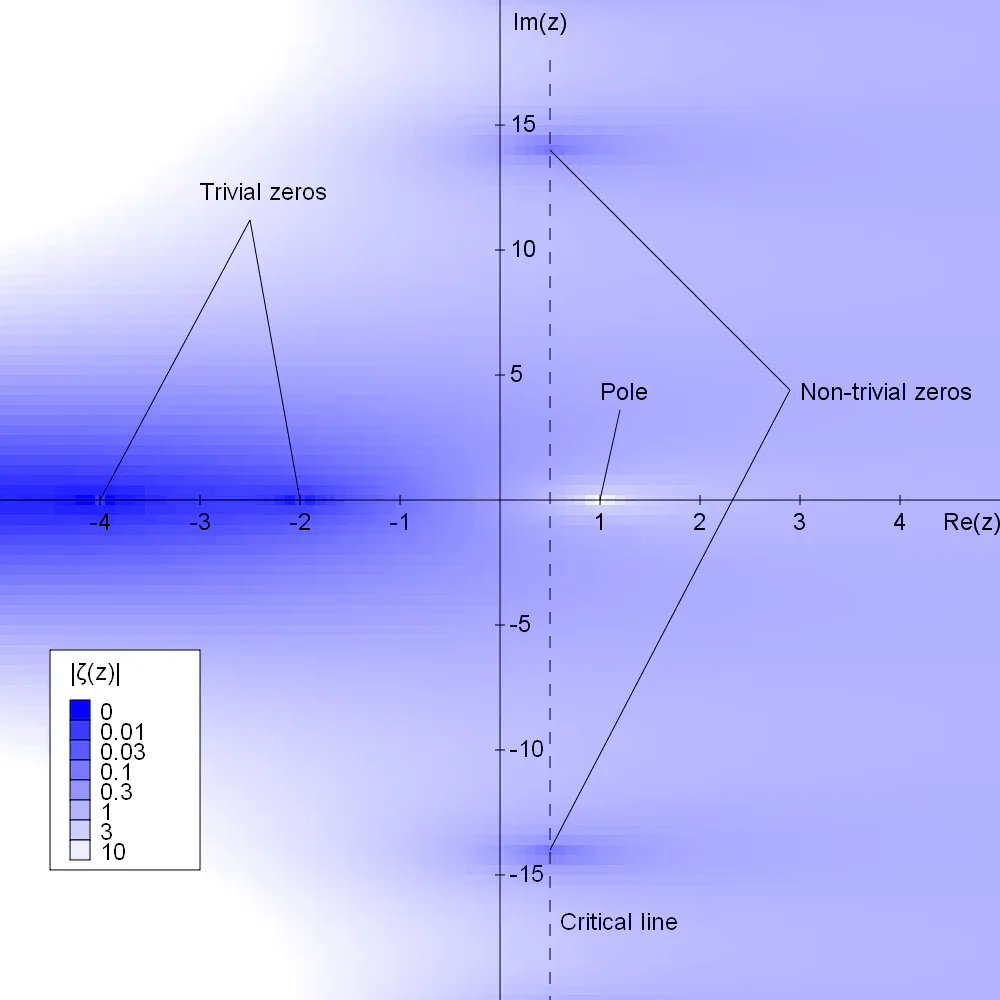
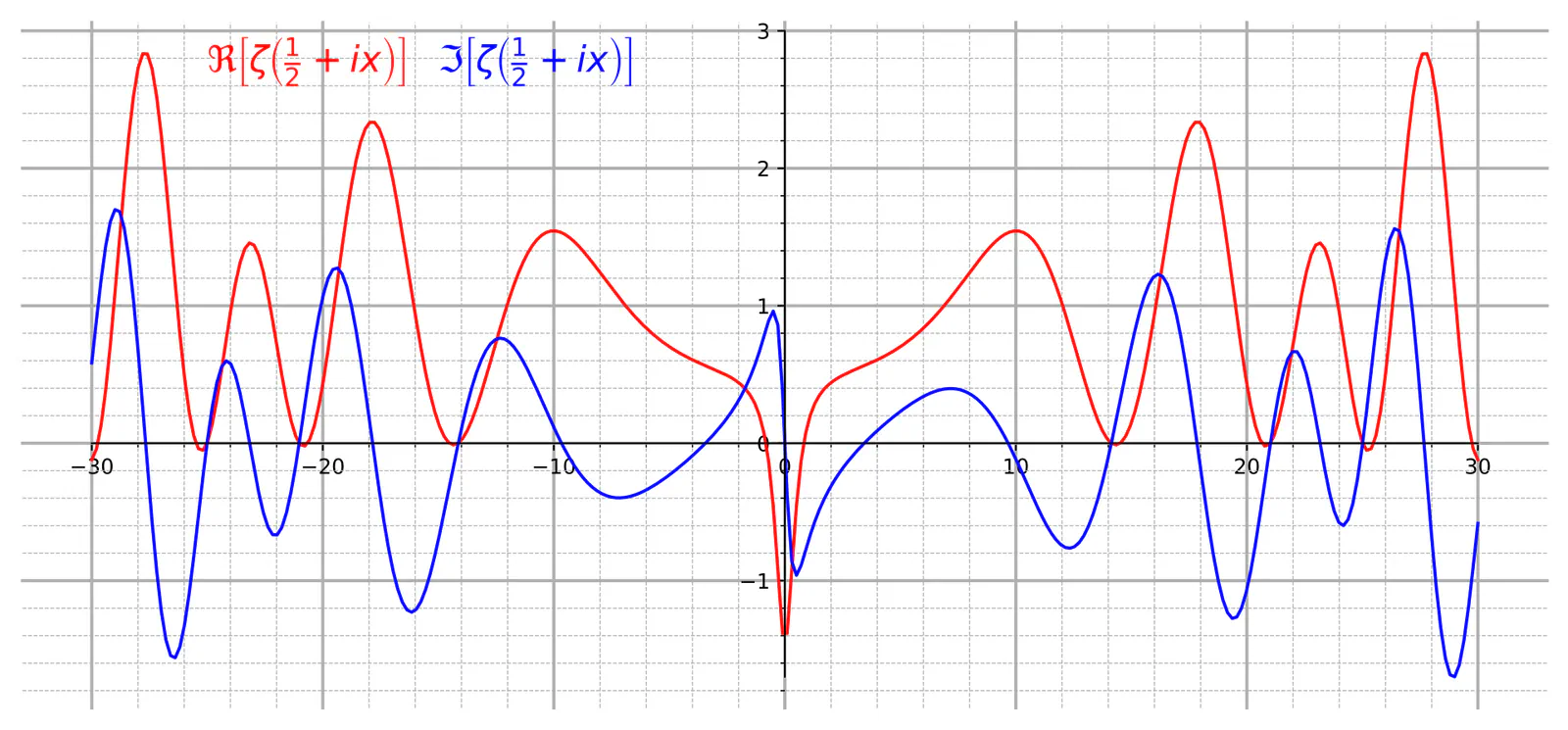
The Riemann Hypothesis is the claim that every non-trivial zero of the Riemann zeta function has real part exactly one half. Bernhard Riemann proposed it in 1859, and it is the classic open problem in number theory because it controls how regularly prime numbers are spread out.
The Riemann zeta function is a function of complex numbers that starts as the infinite sum 1 + 1/2^s + 1/3^s + ... and extends to the whole complex plane except for a single pole at s = 1. Its zeros come in two kinds:
| Kind of zero | Where it sits | Status before November 2026 |
|---|---|---|
| Trivial zeros | Negative even integers: −2, −4, −6, ... | Fully understood |
| Non-trivial zeros | The critical strip, real part between 0 and 1 | Conjectured to lie on the line real part = 1/2 |
| Computed non-trivial zeros | Trillions checked numerically | All found on the line, but computation can't cover infinitely many |
As the Wikipedia overview of the hypothesis explains, the positions of the zeros control the error term in the prime number theorem. If the hypothesis holds, the count of primes up to x stays as close to its smooth estimate as it possibly can.
That's why so much mathematics depends on it. Number theorists have spent more than a century proving theorems that begin "assuming the Riemann Hypothesis." A proof would make all of those unconditional at once.
What doesn't change
A proof does not break encryption. heise notes that RSA and similar systems depend on how hard it is to factor large numbers, and the Riemann Hypothesis gives no new factoring method.
Why the generalized version is bigger
The Generalized Riemann Hypothesis (GRH) makes the same claim for a wider family of functions called L-functions. Alpöge's Lean archive includes GRH theorems for Dirichlet L-functions, a large and important class, though not every L-function mathematicians care about.
What exactly does the Lean proof state?
The Lean archive proves five headline theorems: two that state the classical Riemann Hypothesis and three that state the Generalized Riemann Hypothesis for Dirichlet L-functions. Their exact wording is what the verification effort focused on first.
Lean is a proof assistant: software that accepts a proof only if every logical step checks out against a small trusted core called the kernel. Mathlib is Lean's community-maintained mathematics library, and it already contained an expert-vetted definition named RiemannHypothesis before Alpöge's release.
Andrew Sutherland's verification page at MIT lists the five theorems exactly as they appear in a challenge file that imports only Mathlib:
| Theorem name in Lean | What it says in plain words |
|---|---|
riemannHypothesis | Mathlib's own Riemann Hypothesis statement holds |
riemannZeta_eq_zero_re | The same statement written out: every zero of zeta, other than −2, −4, ... and the pole, has real part 1/2 |
LFunction_ne_zero_of_half_lt_re | No Dirichlet L-function has a zero with real part above 1/2 (except the trivial character at its pole) |
LFunction_eq_zero_re | Zeros of Dirichlet L-functions in the critical strip lie on the line real part = 1/2 |
LFunction_eq_zero_re_of_isPrimitive | The same, stated for primitive Dirichlet characters |
The first theorem is the one that matters most for trust.
Because the statement is Mathlib's own definition, nobody has to take Alpöge's word for what "Riemann Hypothesis" means in the code.
The GRH statements are a different case. They live in a short file written for this release, so they haven't had the years of review that Mathlib's definition has.
How was the Riemann Hypothesis proof verified?
The Riemann Hypothesis proof was verified by independent groups who rebuilt the Lean archive from scratch, confirmed it uses no hidden assumptions, and rechecked the compiled proof with several separately written checkers. The goal was to rule out three failure modes: a wrong statement, a hidden extra axiom, and a bug in Lean itself.
Kevin Buzzard of Imperial College London framed the first question in a blog post quoted by Scientific American: what is the statement of the theorem in the Lean code, and does it match the actual theorem? The checks below answer that question and two others.
Does it compile, and does it assume anything extra?
Yes, it compiles, and it assumes nothing beyond Lean's standard foundations. Michael Rubinstein's independent check at Waterloo found that all 175,187 modules compile with no errors, finishing at 01:47 UTC on November 21 after a distributed build of 3 hours 18 minutes.
Both Rubinstein and Sutherland report that each of the five theorems depends only on three axioms: propext, Classical.choice, and Quot.sound. These are the standard axioms that nearly all of Mathlib uses.
An axiom audit matters because a Lean proof can "cheat" by declaring an unproved statement as an axiom. A clean list of the standard three means no such shortcut exists in the dependency chain.
Could a bug in Lean make a false proof pass?
That's the point of using more than one checker. A proof kernel is the small program that does the final check; if every independently written kernel accepts the same exported proof, a bug would have to exist in all of them in the same way.
Here's what the checkers reported, according to Sutherland's page as of 23:45 UTC on November 23 and Rubinstein's page as of November 21:
| Check | Result | Reported by |
|---|---|---|
| Full compile of 175,187 modules | Zero errors | Sutherland, Rubinstein |
| Lean kernel replay of every module | 175,187 accepted, 0 rejected | Sutherland, Rubinstein |
| nanoda (independent Rust kernel) | 1,484,729 declarations, no errors | Rubinstein |
| con-leche and con-ron (statement matching) | All five theorems "justified by the solution" | Sutherland |
| Lean default kernel on full export | Accepted after 48 h 3 min, 82.6 GiB peak memory | Sutherland |
| Lean paranoid kernel on full export | Accepted after 72 h 20 min | Sutherland |
| Comparator v4.33.0 | "Your solution is okay!" after 64 h 8 min | Sutherland |
| Sandboxed rebuild, no network | Export reproduced byte for byte | Sutherland |
Every completed check has passed.
One run, a comparator built against Lean v4.36.0, was still in progress when Sutherland last updated his page.
The numbers also show how heavy this proof is. The exported proof is about 61.6 GB, and a single-threaded kernel check took two to three days on a machine with roughly 100 GiB of memory.
What did the Lean community certify?
The Lean FRO and the Mathlib Initiative issued a joint statement on November 21 based on those checks. The statement says dozens of people reproduced the same raw proof export, and that two independent tools confirmed the proved theorem is exactly Mathlib's Riemann Hypothesis. In the joint statement, the two organizations wrote that they have full confidence the proof is correct, and added:
We hereby certify that both the statement and the proof of the Riemann Hypothesis are correct.
The statement also notes that the checkers ran on an inert export of the proof, out of reach of any malicious code in the Lean sources. It covers the classical Riemann Hypothesis only; it doesn't mention the GRH theorems.
Sutherland put it more bluntly. He told Scientific American that the chance anything is fishy is "approximately zero," after rechecking the proof with the Lean kernel himself.
That's a strong statement from a checker, not a promoter.
What did Claude actually do?
According to Alpöge, Claude did much of the technical work, especially in the final weeks, while he chose the overall direction. That account comes from Alpöge alone; Anthropic hasn't published logs or transcripts for this result, and no one outside the company has described Claude's contribution independently.
Alpöge says he steered the work toward a setting analogous to a simpler "toy" model, after which Claude began to outrun him. The single example he gives is the step he expects to make mathematicians "fall out of their chairs."
In 1969 Sergei Stepanov proved the finite-field analogue of the Riemann Hypothesis using a trick based on multiplicity: building an auxiliary function that vanishes to high order. Over the whole numbers there's no natural way to get that multiplicity. Alpöge writes that Claude proposed chaining theta lifts, a construction from the theory of automorphic forms, so that each lift contributes one unit of multiplicity, and suggested a chain whose length grows like the square root of X for a prime sum of length X.
The dated timeline in Alpöge's note runs about six weeks from first idea to GRH, and he cautions that Claude compiled it and he may revise parts:
Frequently Asked Questions
6 questions
1Has the Riemann Hypothesis been proven?
Not officially, though the evidence is strong. Levent Alpöge's Lean proof, released on November 20, 2026, has passed every completed independent machine check, and the Lean FRO and Mathlib Initiative certified the statement and proof on November 21. But no human-readable paper exists, and the Clay Mathematics Institute still lists the problem as unsolved until a published solution gains general acceptance.


