The usual advice about data licensing is to get permission before training. That's necessary, but incomplete. A signed agreement won't protect an AI team if the supplier can't show where the records came from, which rights it acquired, or whether those rights extend to the product the team plans to sell. Treat the license as a claim that needs evidence, not a clearance label.
What Data Licensing Means for AI Teams
Access to data isn't permission to train on it. A library card lets you read a book, but it doesn't authorize you to photocopy it and sell the copies. A paid subscription, downloadable archive, or accessible website creates the same distinction: obtaining material and reproducing it for a new purpose are different questions.
The UK government's report on copyright and artificial intelligence explains that copying protected works during AI development generally requires permission unless a specific exception applies, including reproductions made while extracting information for text and data mining. Teams must check the applicable exception, its conditions, and any relevant reservation of rights rather than assuming lawful access settles the issue.
The library analogy makes that boundary easier to recognize.

Permission needs a defined scope
A data license should specify which acts the buyer may perform: copying, transforming, training, evaluating, deploying, and commercializing. It should also identify the covered dataset, purposes, territories, recipients, and duration.
Licensing is already a commercial category. Grand View Research valued the global AI datasets and licensing market for academic research and publishing at USD 381.8 million in 2024. Within that market, Grand View Research's custom and enterprise licensing analysis put global custom and enterprise AI-data licensing revenue at USD 52.6 million in 2024.
Those figures describe a specific market, not the entire AI-data economy. For an individual buyer, the useful question remains narrower: what rights does this transaction deliver?
A web-sourced label describes collection, not authorization.
Ask the supplier to replace broad labels with an inventory that connects each source to a permitted use. Without that connection, neither a purchase receipt nor a polished dataset catalog establishes commercial usability.
Key License Terms and What Each One Controls
Core license terms and what to check for AI training
| Term | What It Controls | What to Check for AI Training |
|---|---|---|
| Permitted use | Purposes such as research, commercial products, or internal testing | Whether training, fine-tuning, and evaluation are named separately |
| Reproduction and transformation | Copying and conversion into tokens, features, or embeddings | Whether preprocessing and derived copies are expressly allowed |
| Territory | Countries where rights apply | Whether training and deployment locations are covered |
| Term and duration | How long authorized use continues | Whether a trained model may keep running after expiry |
| Retention | How long copies may be kept | Whether snapshots and backups fit the retention rules |
| Exclusivity | Whether the licensor may license the same data to others | Whether competitors can obtain the same corpus |
| Sublicensing | Whether rights may pass to customers or partners | Which restrictions downstream users must accept |
| Redistribution | Whether raw or derived data may be shared | How the contract treats dataset delivery and model distribution |
| Model deployment | Whether a trained model may be sold or hosted | Whether weights are contractually treated as restricted derived data |
Start with permitted use, not price. A grant for internal research shouldn't be treated as express permission to build a commercial model. Describe the intended workflow in the agreement, including training, fine-tuning, evaluation, retrieval, and customer-facing deployment where relevant.
Next, map the grant to actual processing. Cleaning files, tokenizing text, creating embeddings, and preserving checkpoints may involve copies or transformations that need contractual coverage. Don't collapse the separate legal question of whether something is a derivative work into a technical assumption that every transformation creates one.
Review the model's life after training
Territory needs an operational answer. Identify where the team stores and processes data, which contractors receive it, and where the resulting product will operate. Ask counsel to assess the jurisdictions involved rather than relying on the headquarters address.
Duration and retention deserve separate clauses. Permission to use a dataset may expire while the team still holds backups or serves a trained model. Negotiate explicit treatment of retained evidence, disaster-recovery copies, weights, and continued deployment, including any obligations triggered by termination.
Exclusivity concerns competitive access, not necessarily ownership. A supplier's promise not to license a defined corpus to competitors is different from a promise that no equivalent information exists elsewhere.
Sublicensing and redistribution also solve different problems. A cloud processor handling files on your behalf, a customer downloading weights, and a partner receiving the raw corpus should each fit a named authorization pathway. Don't assume permission for one arrangement covers the others.
Procurement rule: If a necessary permission isn't explicit, treat it as unconfirmed and resolve it before use.
That's a conservative purchasing rule, not a declaration that every contractual silence prohibits an activity. The objective is to avoid making a product launch depend on an interpretation the supplier has never accepted.
Common License Types Compared for AI Use
Common license types compared for AI use
| License Type | Commercial Use | Training Use | Conditions |
|---|---|---|---|
| CC0 public domain dedication | Yes, for covered rights | Yes, for covered rights | No conditions under the dedication; check other rights |
| CC BY | Yes | Generally permitted within covered rights | Credit the creator and link to the license |
| CC BY-SA | Yes | Yes, with care | Attribution and share-alike for adapted material; assess treatment of weights |
| CC BY-NC | Not for commercial purposes | Don't approve commercial-model use without review | Non-commercial restriction; assess the actual purpose |
| Custom commercial license | As negotiated | Must be expressly covered | Contract-defined scope, warranties, and audit provisions |
| Statutory or collective license | Confirm local authorization | Confirm covered uses locally | Governing law or collecting body sets the scope |
| Public domain work | Yes, for the public-domain material | Yes, for that material | Verify status in each relevant territory |
These are screening categories, not universal clearance decisions. A license can grant only rights the licensor has authority to grant, and copyright permission doesn't settle privacy, confidentiality, or contractual restrictions attached to acquisition.
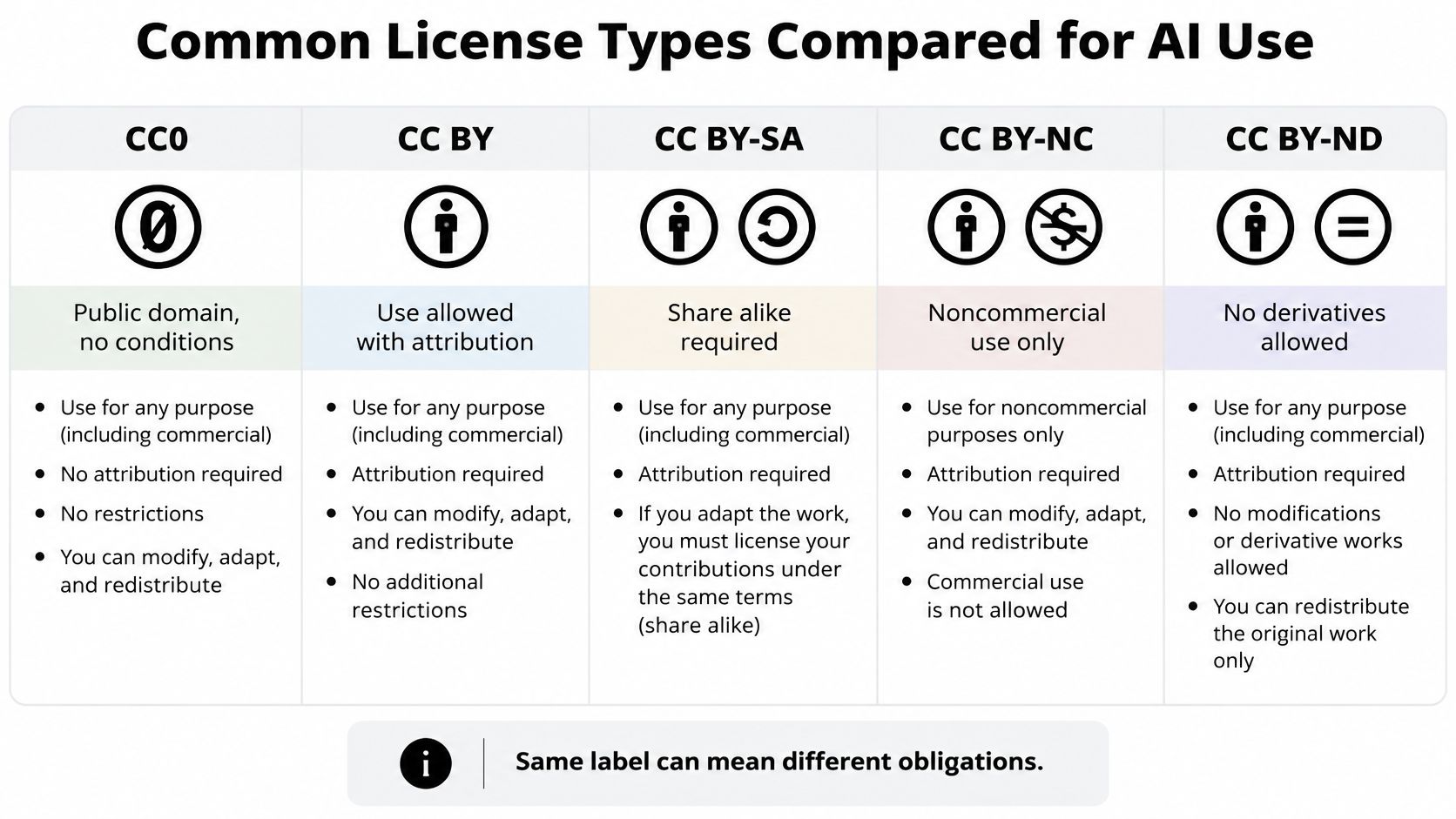
The visual comparison highlights the familiar Creative Commons labels.
Read the actual license version
Same label can mean different obligations in practice. Record the exact license version, its application to the material, and any additional terms attached to access. Don't infer that every file in a repository inherits the license displayed on its homepage.
CC BY requires an attribution plan, not merely a note in procurement records. Decide how required credits, license references, and modification notices will be preserved when material moves through preprocessing and delivery.
CC BY-SA requires closer examination of adapted material and distribution. Don't assume either that model weights automatically trigger share-alike or that training automatically eliminates the issue. CC BY-ND, summarized in the graphic as prohibiting derivatives, likewise calls for review of whether the intended activity involves creating or sharing adapted material.
CC BY-NC is a commercial-use warning. An experimental project inside a commercial company shouldn't receive automatic approval merely because an engineer calls it research. Assess the purpose and license terms before admitting it to a commercial pipeline.
Custom agreements offer an opportunity to resolve these questions directly. Ask for express training rights, downstream permissions, evidence obligations, and negotiated remedies rather than assuming a commercial invoice includes them.
For additional context on licensing concepts, the following video provides a separate viewing resource.
<iframe width="100%" style="aspect-ratio: 16 / 9;" src="https://www.youtube.com/embed/UMIG4KnM8xw" frameborder="0" allow="autoplay; encrypted-media" allowfullscreen></iframe>A license family tells the reviewer where to start. The specific grant, underlying authority, and planned use determine whether the team can proceed.
Licensing Approved Business Data Through SourceX
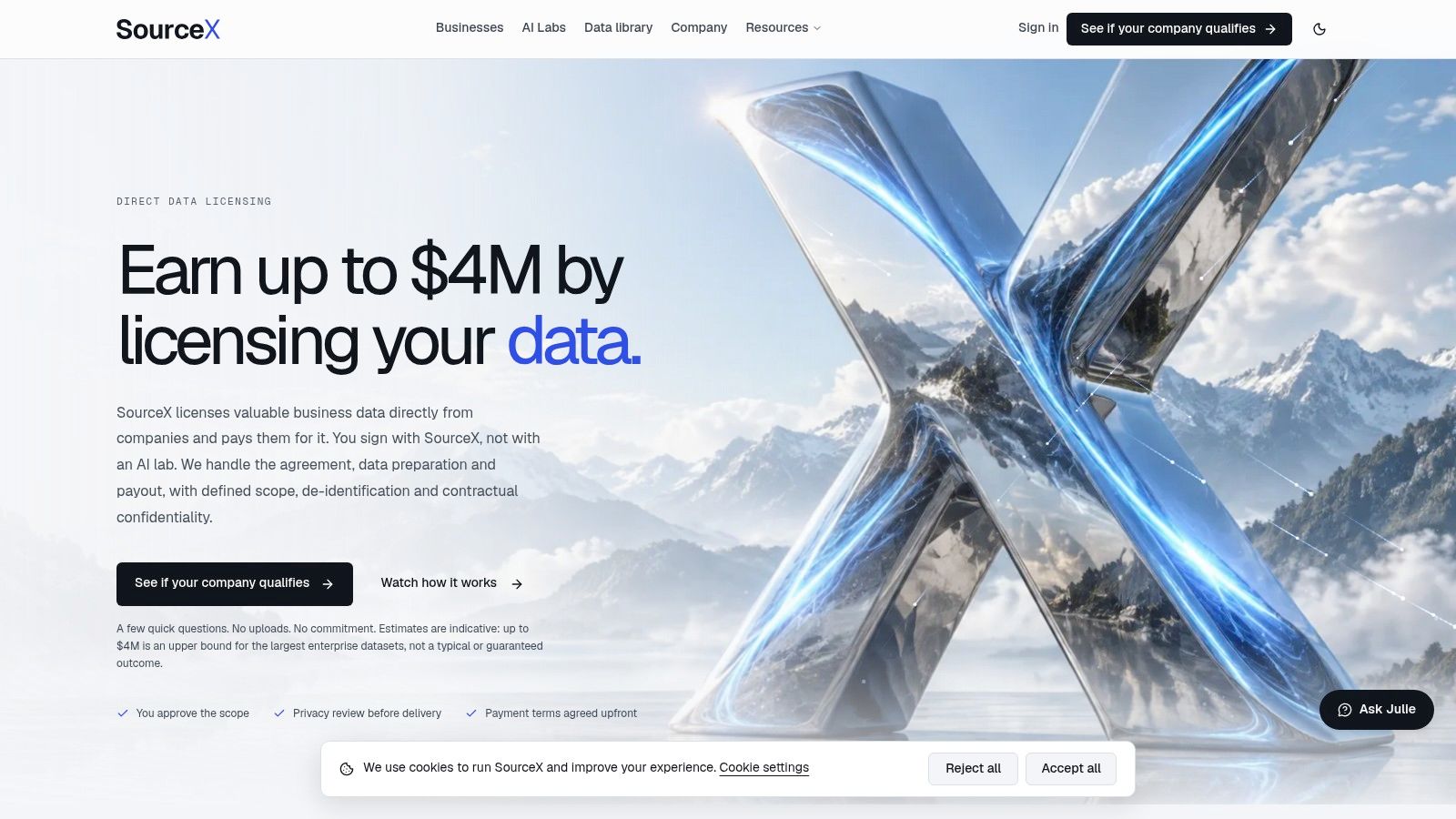
For companies considering whether operational records can be licensed, SourceX's data licensing service offers a managed relationship covering assessment, agreements, rights review, preparation, delivery, and payout. AI buyers should evaluate it as a route to company-approved business datasets, not as blanket clearance for every record a company holds.
The service's website provides a starting point for evaluating that fit.
Check fit before transferring records
-
Qualify the opportunity without an initial upload. SourceX assesses licensing potential before structured mapping of relevant systems and historical records. Don't export customer or employee information merely to demonstrate that a dataset exists.
-
Build a private inventory. Records can be summarized by source, depth, fields, and availability across systems such as Zendesk, Salesforce, GitHub, Jira, SharePoint, and Google Workspace. An inventory supports selection, but system access alone doesn't establish onward-licensing authority.
-
Review permissions and preparation together. SourceX documents source systems, licensing permissions, prior commitments, and agreed restrictions, while coordinating dataset-specific preparation and de-identification, including approved processing partners where applicable. The company must still approve scope and the applicable privacy requirements.
-
Negotiate the transaction explicitly. Companies license approved datasets to SourceX, with downstream licensing or sublicensing governed by the agreement. Confirm dataset scope, permitted uses, confidentiality, ownership treatment, exclusivity, duration, acceptance conditions, and payment timing rather than assuming standard outcomes.
-
Approve delivery against buyer demand. SourceX coordinates evaluation, packaging, authorized delivery, and supplier payouts under the signed terms. Qualification doesn't guarantee selection, and selection shouldn't be confused with unconditional payment.
This approach fits companies with fragmented operational records and teams seeking business context that isn't readily available in public corpora. It's less useful when a supplier can't establish permissions or cannot release records under acceptable confidentiality conditions.
Two-gate rule: Require both documented authority to license and approval of the prepared dataset for the agreed use.
How to Build a Dataset Manifest You Can Audit
A license file records an agreement. A dataset manifest connects that agreement to the material engineers used. Without that connection, legal approval can refer to one corpus while the training job consumes another.
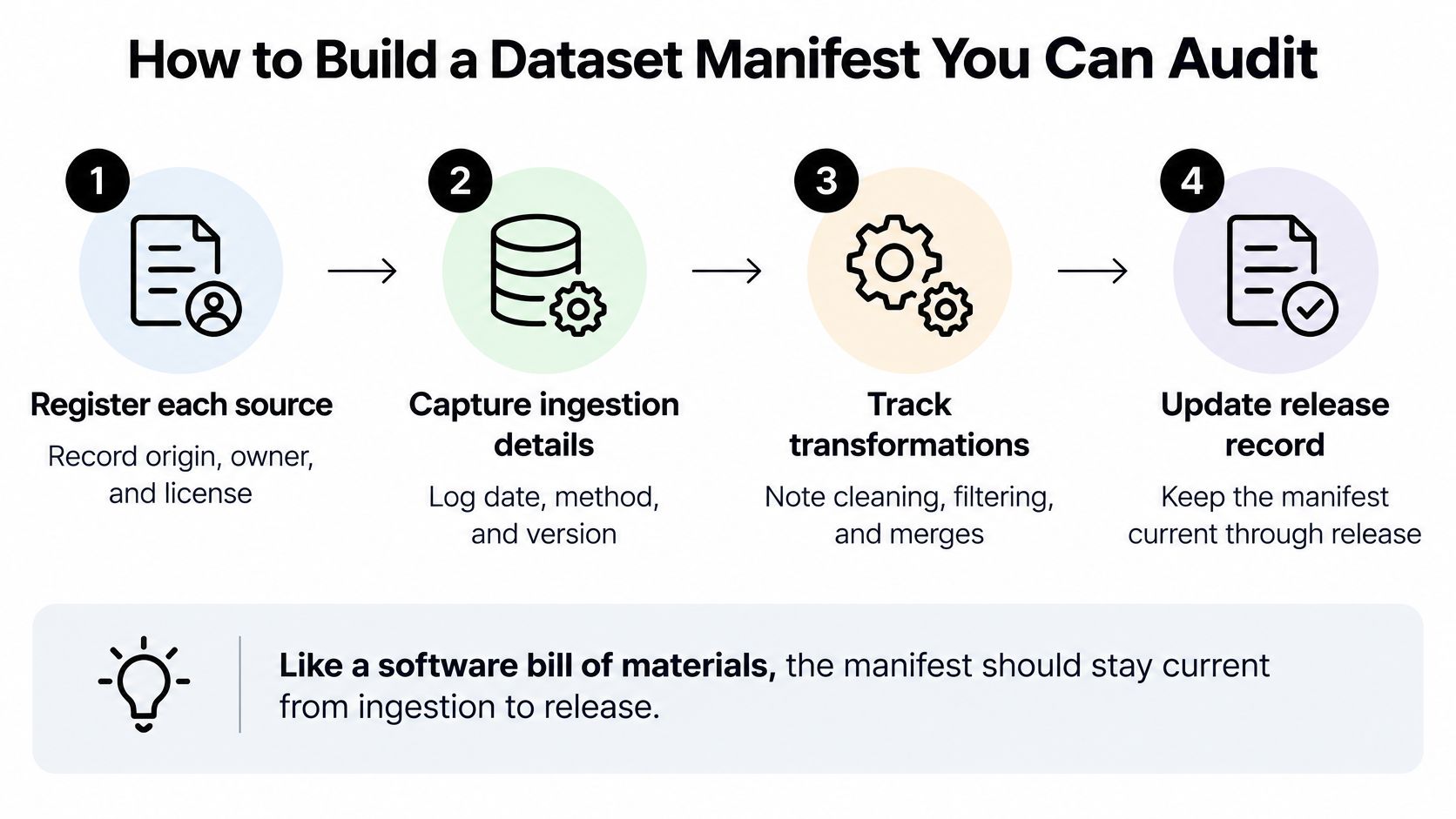
The UK government's copyright and AI progress report highlights the importance of transparency about training inputs for rights enforcement and licensing. Operationally, treat the manifest like a software bill of materials: maintain source identities, permissions, versions, and dependencies throughout the pipeline.
This workflow summarizes the recordkeeping lifecycle.
Register the material and its authorization
-
Assign stable source identifiers. Record the origin, creator or rights holder where known, license identifier, and location of supporting documents. Keep unknown ownership visible rather than replacing it with the distributor's name.
-
Capture the exact acquisition. Record collection date, access method, and a hash or stable version reference. Saving a license without identifying the covered dataset version leaves the team unable to demonstrate which files received approval.
-
Tag each authorized pipeline stage. Separate training, fine-tuning, evaluation, and commercial release permissions. A single approved flag hides restrictions that may matter only when an engineer changes the intended use.
Make the manifest machine-readable, for example as structured JSON or database records linked to immutable object-storage versions. Store the underlying agreements and acquisition evidence separately, with stable references from each manifest entry.