
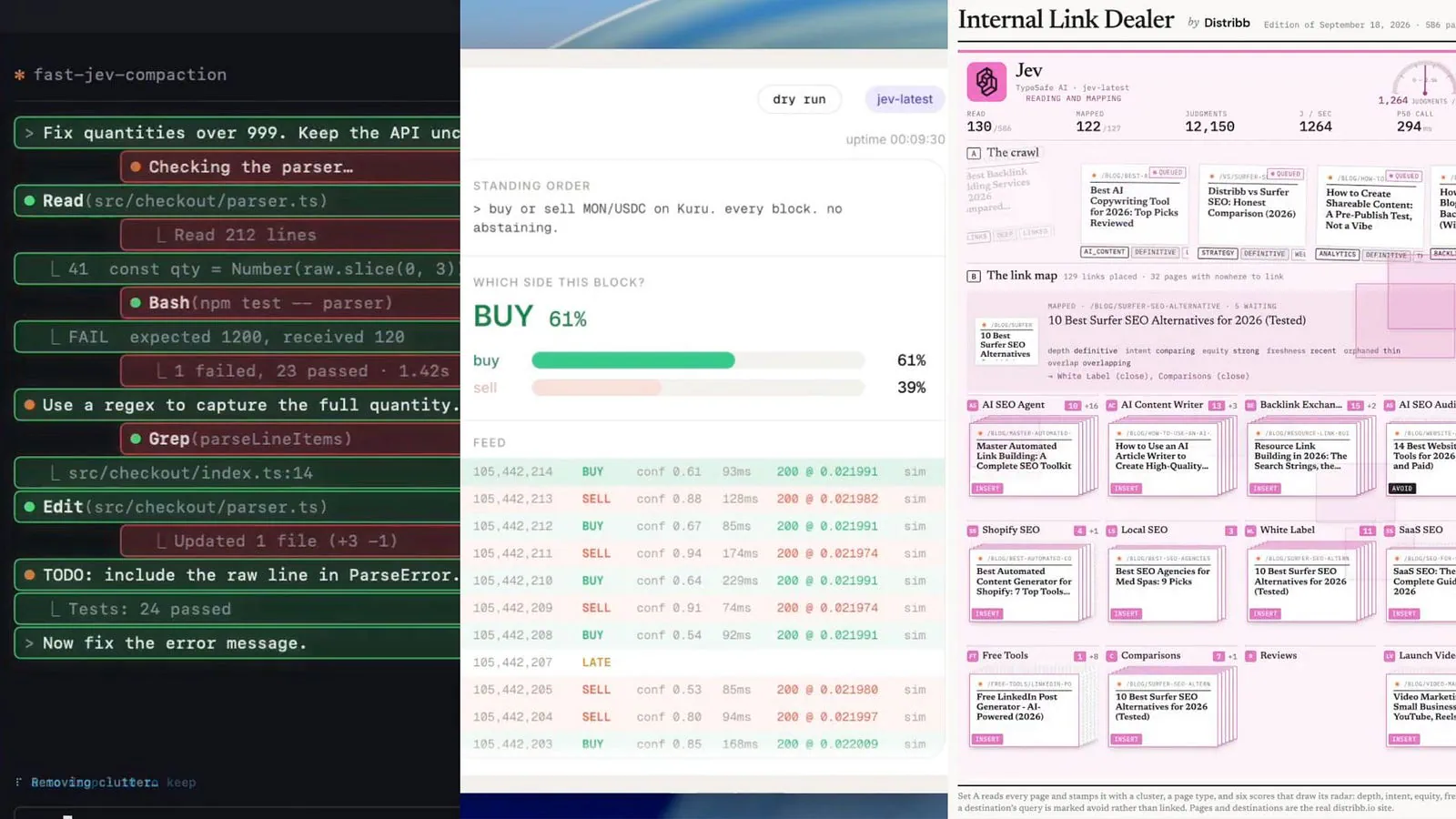
Jev has been all over my social media feed lately. If you’re like me and keep an eye on generative AI news, you’ve probably noticed it taking over your timeline too. This new model is incredibly cheap and ridiculously fast.
But what the hell does it actually do?
Here’s the quick explanation. Jev takes information and answers structured questions about it, returning decisions and probabilities that software can use directly. TypeSafe says it produces those probabilities in parallel, which helps explain the speed: there’s no paragraph of text to generate one token at a time.
I wrote a detailed article yesterday that explains how Jev works. Check it out here:
New Jev Model Is Insane 200x Faster 400x Cheaper Than Frontier ModelsFor this article, I wanted to look at what people are actually building. Here are eight examples that caught my attention, with the costs and timings reported by their creators. Have fun!
1. Reviewing Pull Requests at Almost 0 Cost
One user on X, Paolo Rosson, built a code reviewer that sends a diff, the changes in a pull request, to Jev and gets 14 checks back in one call. Those checks cover things like exposed secrets, SQL injection, authentication changes, deleted tests, and whether the description matches the code.
The reported cost is $0.00007 per review, with responses arriving in about half a second. At that rate, reviewing 1,000 PRs costs seven cents, compared with roughly $14.50 for the creator’s Opus 5 setup.
Each check comes back as a probability. The surrounding code uses those results to decide whether to block the change, request a security review, flag minor issues, or recommend merging.
I like the handling of uncertainty. When a critical check falls between 0.35 and 0.65, the system escalates it to a person or a larger model. You can adjust that rule to make the reviewer more cautious.
I’d try this on my own website projects as an initial pass. A small styling change could go through a lighter review, while anything touching authentication or the database would get more attention.
2. Jev is Really Good at Computer Use
Shiv shared a computer use tool powered by Jev that responds in under a second and costs almost nothing per interaction. It can also decide what to type, with no separate LLM needed in the demonstrated workflow.
If an agent needs to open menus, select fields, and move through several screens, even a short delay on every action adds up.
The project is available on GitHub as Third Hand. There’s also another computer use example from Instant Rice Cook if you want to compare the ideas.
For a tool like this, the engineering question is how to turn the current screen into choices the model can evaluate. Software still has to identify the available controls, carry out the selected action, and check what happened afterward.
My first experiment would be something repetitive in an admin dashboard. I have a few useful ideas for my tech blog, Zeniteq. Open an article, choose a category, change a setting, and return to the list. I already know what those actions should accomplish, so it would be easy to spot mistakes.
If it could reliably handle that sequence at the reported speed, I’d have plenty of boring work for it.
3. Finding Internal Links Across an Entire Website
Another X user used Jev in a workflow that read 586 website pages and rebuilt the internal link map in 45.1 seconds.
The run placed 584 links and cost $0.21.
It also declined to link 139 pages because it couldn’t find a suitable match. That detail made me more interested than the page count did. See it in action below:
You can basically build a workflow that gathers candidate pages, asks Jev to score their relevance, and suggests links where readers would benefit from more context. I’d want it to show me the proposed anchor text and destination together, so I could judge whether the link feels natural in the sentence.
Imagine reading a guide to AI coding tools and finding a useful link to a detailed explanation of MCP. That’s the sort of connection I’d want. Sending readers to an unrelated article just because both mention AI would annoy me.
I’d start with a preview of suggested changes on Zeniteq. Then I’d review a sample, especially links added to older posts where the surrounding information might need updating too.
The reported run demonstrates internal linking work, which is one part of an SEO audit. It doesn’t establish a ranking improvement. For me, the immediate appeal is making useful articles easier to discover while spending less time searching my own archive.
4. Sorting Tax Documents at About $0.001 per Page
Another user built a tax document classifier around Jev and reported a cost of about $0.001 per page. Compared with the team’s previous LLM pipeline, they describe it as 34 times cheaper and six times faster, with every document in their corpus classified correctly.
The classifier reads page text and asks Jev to identify the document using predefined form descriptions. That gives the next stage of the software a form category and a confidence value to work with.
The open source repository provides helpful context for the accuracy claim. Its published evaluation reports no errors across 314 filled form pages.
Tax Doc ClassifierA separate set of 753 blank form pages had no wrong labels, but 38 pages fell below the confidence threshold and counted as strict errors.
I appreciate being able to see that distinction. A page that needs another look is a different outcome from one confidently sent to the wrong place.
This is probably the least flashy example here, but I can imagine a team getting more daily value from it than from a game demo. Sorting thousands of pages is repetitive work, and a classification mistake can send the rest of a process in the wrong direction.
I’d also be curious to try the same general approach on invoices or receipts. Define the categories carefully, inspect uncertain results, and measure how much manual sorting remains.
5. Playing Subway Surfers Across 50 Games
One of the first interesting use cases I saw on X is Max Blade’s use of Jev playing Subway Surfers at what he describes as superhuman speed, along with a demonstration involving 50 games at once. He says the featured run cost less than a cent.
This is the type of experiment that makes me want to try a model myself. Games give you a quick way to see whether a sequence of decisions works: the character either avoids the obstacle or runs straight into it.
For a runner game, the available moves are limited. A controller can evaluate the current situation, pick an action such as changing lanes or jumping, then repeat as the game advances.
The surrounding software still has to provide usable game information and execute each move. The clip’s performance depends on that entire setup, so I wouldn’t assume Jev could simply watch any game and play it equally well.
There’s a related driving demo from JP Schroeder, who describes rebuilding Tesla Full Self Driving with Jev in under an hour. That’s an ambitious description for an experiment, and I’d need considerably more evidence before comparing it with a system that drives on actual roads.
Personally, I’d stick with games and simulated environments. I’d love to build a small browser game where several characters react to the same situation differently, then see how changing their decision criteria affects what happens.
A cautious character could avoid obstacles early while another takes riskier routes. Watching those behaviors emerge would be fun, and the small action space would make it easier to understand why each character made a bad move.
6. Clearing Out an Agent’s Context More Quickly
Tamara Tran used Jev to tackle compaction, the process of reducing the conversation history an agent carries into its next turn. Her project scores tool calls and results, then removes or shortens material judged unnecessary.
The retained content keeps its original wording. For coding work, I like the prospect of preserving an exact error message or command while clearing out old output that has already served its purpose.
The code is available in fast-jev-compaction. Its documented behavior includes protecting recent messages, keeping calls paired with their results, and leaving user and assistant text unchanged in the resulting conversation.
Fast Jev CompactionA long coding session can accumulate plenty of material I’d usually discard. Earlier test output may become irrelevant after a fix, and an old file read may have been superseded by several edits. Keeping all of that around makes the conversation longer without necessarily helping the next decision.
The difficult part is deciding what you’ll need later. A seemingly minor detail from an early tool result could explain a failure much further into the task.
I’d test this by returning to an earlier requirement after compaction and checking whether the agent still has enough information to follow it. Speed would be nice, but repeatedly reopening files would eat into the time saved.
Also, “instant” describes the ambition of the demo. The repository allows larger histories to require multiple requests. I’d measure the pause on my actual sessions before deciding how much faster it feels.
7. Jev as a Trading Bot
Jarrod Watts built a bot that uses Jev to choose whether to buy or sell from an asset pair’s price feed. He says it executes real trades through Kuru’s order book on Monad, targeting the chain’s 300ms block interval.
The model supplies a decision, and the surrounding application handles the order. It’s an interesting demonstration of how quickly a model’s output can feed into another piece of software.
You can also inspect the Jev Trader demo. The public page includes a dry run mode and a standing instruction to submit a bid or ask on the MON/USDC order book every block, with no option to abstain.
The bot must pick a side, so there’s always an action to observe. For evaluating a trading strategy, though, I’d want to compare that behavior with a version allowed to sit out.
I’m more interested in the implementation here than the possibility of making money. A fast buy or sell decision tells us very little about whether the decision is profitable. You’d need results over time, including trading costs and what happened when prices moved against it.
My own experiment would stay in simulation. I’d log every decision, compare it with a simple fixed strategy, and look at where the model repeatedly makes poor choices.
Even an unprofitable result could teach you something about building a responsive decision loop. I’d just want the performance chart beside the latency chart before getting excited about the trading part.
8. Organizing More Than 1,000 AI Research Papers
X user Hassan used Jev to classify 1,018 AI research papers, reporting a total classification cost of $0.08 and median end-to-end latency of 256ms per paper. The finished project gives readers a way to explore the collection by topic.
The workflow first summarized the papers with DeepSeek V4 Flash. It then sent each title and summary to Jev, along with 24 possible topics, for classification.
The summaries cost $3.99 through Together AI, while the Jev classification calls cost eight cents through TypeSafe. That puts the reported inference total at $4.07.
This is probably my favorite example because I’d actually use something like it for article research. A searchable collection is helpful, but browsing a topic can surface a paper you wouldn’t have known to search for.
I also like how easy it is to understand each model’s job. DeepSeek creates the summaries. Jev assigns the topics using the information in those summaries and titles.
For my own version, I’d start with a smaller collection around AI coding agents. Then I’d adjust the categories as I browse and see whether they help me find related work. I’d happily spend a few dollars experimenting with a research tool built around the subjects I cover.
Final Thoughts
Jev feels like the biggest AI breakthrough of 2026 so far to me. Seeing people use it for code reviews, computer control, document sorting, and games has made me think about how many everyday tasks could benefit from fast, inexpensive decisions.
The cost is a big part of why I’m excited. Vercel made it free until September 25, which is amazing. Developers can explore projects that would be difficult to justify if every small decision required an expensive model call.
There’s still plenty to learn about how reliably these projects work beyond their demos. But I like what people are already doing, especially when they combine Jev with other models, as in the research paper example. I’m curious to see which of these experiments become tools we end up using every day.
What do you think? Is Jev something you’d use in your own projects?
Sources
- https://generativeai.pub/new-jev-model-is-insane-200x-faster-400x-cheaper-than-frontier-models-4c595a3abe55generativeai.pub
- https://x.com/redp314/status/2100585126652481915x.com
- https://x.com/sxhivs/status/2101367048223982065x.com
- GitHub as Third Handgithub.com
- another computer use example from Instant Rice Cookx.com
- https://x.com/borjafat/status/2101018783976722479x.com
- https://x.com/nedwize/status/2100973868324417852x.com
- open source repositorygithub.com
- https://x.com/_MaxBlade/status/2100634359099232678x.com
- driving demo from JP Schroederx.com
- https://x.com/tamarajtran/status/2100694549362553153x.com
- fast-jev-compactiongithub.com
- https://x.com/jarrodwatts/status/2100356151468585346x.com
- Jev Trader demojev-trader.vercel.app
- https://x.com/nutlope/status/2100426999546184123x.com
- free until September 25x.com


