Anthropic has launched Claude Fable 5.2, a powerful new model featuring significant improvements in coding, reasoning, and image understanding. Operating at 30 percent faster speeds, it supports complex multi-agent workflows by coordinating up to 1,000 subagents simultaneously. This capability allows users to execute sophisticated tasks like building functional operating systems, generating high-quality product videos via external tools like Blender, and developing AAA-level 3D games. Beyond creative applications, Fable 5.2 demonstrated its utility by independently formalizing Fermat’s Last Theorem, signaling a major shift toward AI-driven scientific discovery and high-stakes software engineering.
Another week, another frontier model release. Anthropic just dropped Claude Fable 5.2, a new version of its most capable model. Anthropic says it has improved at coding, reasoning, and understanding images, and generates output up to 30% faster than Fable 5.1.
On the API, it costs $8 per million input tokens and $40 per million output tokens.
Fable 5.2 shares the same underlying model as Claude Mythos 5.2. The difference is that Fable is the generally available version and ships with extra safety measures, while Mythos is limited to approved organizations. So for most of us, Fable 5.2 is the most capable Claude we can actually use.
The benchmarks are nice, but I care more about what people do with a model once they get their hands on it. I was scrolling through X and Reddit this morning and found five things people have already built with Fable 5.2:
An entire OS built with 1,000 subagents
One-shot product launch videos
AAA-level 3D games
Build your own Digital Audio Workstation (DAW)
Solving crazy difficult math problems
Let’s discuss each of these in detail.
1. Build an entire OS with 1,000 subagents
I have seen AI build an operating system before. Back at Google I/O 2026, Google used Gemini 3.5 Flash and Antigravity to build the core of a working OS in 12 hours.
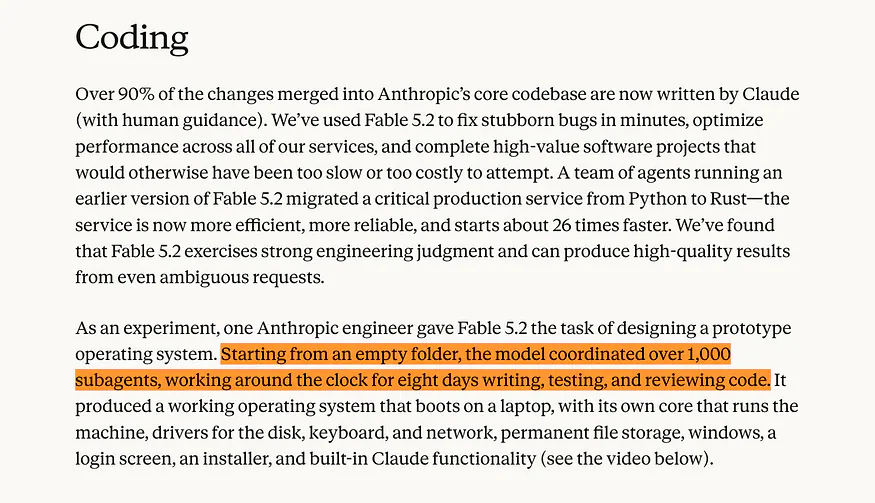
In Anthropic’s experiment, an engineer gave Fable 5.2 an empty folder and asked it to build a prototype OS. The model coordinated over 1,000 subagents and spent eight days writing, testing, and reviewing code.
As an experiment, one Anthropic engineer gave Fable 5.2 the task of designing a prototype operating system. Starting from an empty folder, the model coordinated over 1,000 subagents, working around the clock for eight days, writing, testing, and reviewing code. It produced a working operating system that boots on a laptop, with its own core that runs the machine, drivers for the disk, keyboard, and network, permanent file storage, windows, a login screen, an installer, and built-in Claude functionality
In the demo video, the OS boots on a laptop and has its own kernel, drivers for the keyboard, disk, and network, a desktop, a login screen, and an installer. It even has Claude built in.
Watch the custom OS in action below.
Loading this video connects to YouTube, which receives device and connection data and may use cookies or similar storage.
As a software developer, what impressed me most was seeing it boot on an actual laptop.
Running in an emulator is one thing, but real hardware is far less forgiving. I know how long a bug can take to track down when it only shows up on the machine you are building for.
That’s crazy. Super crazy.
2. One-shot product launch videos
I remember spending two weeks and millions of tokens trying to build an app that could generate product launch videos from just a website link and a few brand assets. Well… I failed.
Image, video, audio, and text models cannot work well together without a powerful agent directing them. Opus 5.5 was okay, but it wasn’t able to create high-quality product videos for me.
Then Fable 5.2 came out today, and I saw this post from Riley.
This is insanely cool, and at first I honestly doubted that it came straight out of Claude. Keep in mind that Claude can only create videos by writing code. It can’t even generate images on its own.
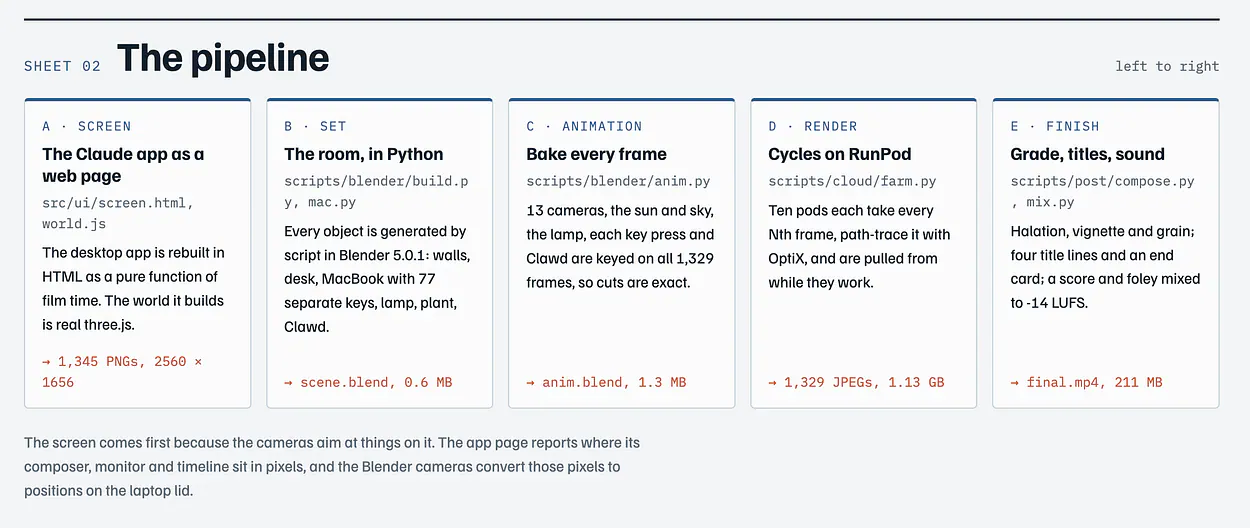
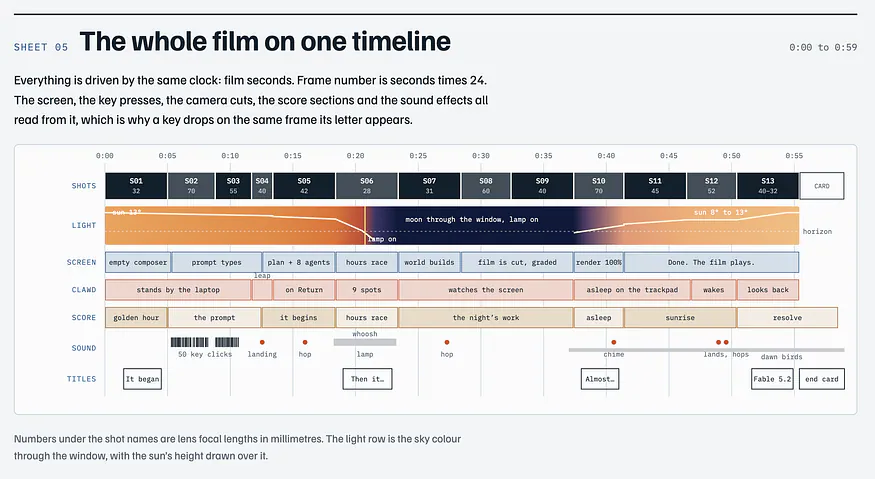
But Riley shared the actual Claude artifact, and I was blown away. Claude used external tools, Blender for the 3D scenes and RunPod for rendering, and even worked Clawd, Anthropic’s little mascot, into several shots.
The artifact also lays out the entire film on a single timeline, so you can see exactly how Fable 5.2 planned each scene.
This is incredibly useful because a product launch video of this quality would usually cost thousands of dollars and take days to make. Riley did it for less than six bucks. Let that sink in!
It was one-shotted, by the way. Here’s the actual prompt:
Hey I want you to create a video using Blender like we have in the past showing the things that fable 5.2 can do at the edge of the capability. Meaning… I want you to make a room in blender have a laptop there that builds the most insane things and edits videos and more and make it like an inspiring video with cutaway shots close ups of typing and figure out a way to make this the most beautiful video ever created as if it was an anthropic ad, please show clawd in it multiple times, and please make it REALLY good use runpod to render
Notice how casual the prompt is. There’s no storyboard, no shot list, and no technical instructions. Go ahead, try it yourself, and let me know how it goes.
3. AAA-level 3D games
I know that many of the people excited about this new model are game developers. Game demos make up about 50–60% of what I see in my social media feed right now. Fable 5.2 didn’t disappoint, because some of the examples I’ve seen are truly next level.
Gone are the days when an LLM could only make games out of basic shapes and flat textures. We are now approaching AAA quality.
Check out the example below.
If you aren’t impressed by this, I don’t know what will impress you. The environment is detailed, the character movement looks natural, and the lighting is really well done.
I have a feeling that GTA VI could be the last AAA game that’s not made by AI.
Here’s another example:
Felix shared that his game took eight hours to make and cost him $550 in API usage. That’s not cheap for a weekend experiment, but it’s nothing compared to what a studio would spend on a level like this.
Here’s the basic prompt people are using to build these games:
You know, you should also build me a FPS. Insanely detailed quality pls, something that looks visually like it can keep up with AAA. Make it small in scope (like a tiny level) but otherwise impressive photorealistic graphics.
Of course, you are free to add more details about what you want. Remember that we are entering an era of spec-driven development, where a clear spec matters more than the execution.
I don’t want to fill this post with a bunch of examples. Just go to X, search for “Fable 5.2 AAA games,” and you’ll see hundreds of them.
4. Build your own Digital Audio Workstation (DAW)
I am not into music production, but I found another cool use case for Fable 5.2 in that space. An X user, Alex, built his own Digital Audio Workstation (DAW), which is software used to record, edit, arrange, mix, and master audio.
He calls it PULP, and it’s a native Windows app built with C++20 and JUCE. This isn’t a toy that runs in a browser tab. It’s the kind of software that teams of engineers usually spend years building.
If one person can build this with an AI model, a lot of startups and expensive software products that do almost the same thing should be worried.
He open-sourced the project, by the way. You can check it out here and make your own music:
This may not be as flashy as the other examples, but I was amazed by the math demo Anthropic showed with Fable 5.2.
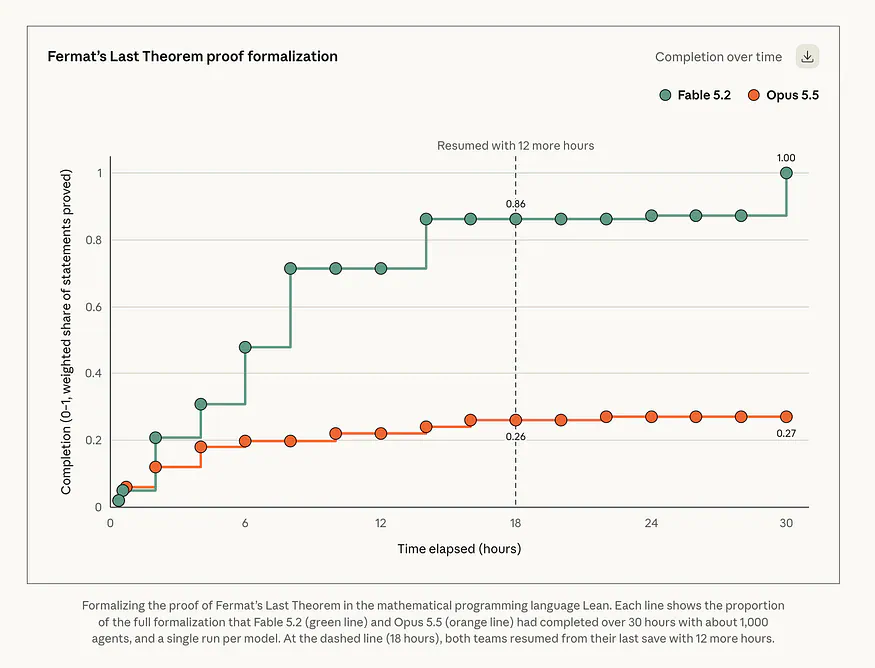
A team of 1,000 Fable 5.2 agents formalized the existing proof of Fermat’s Last Theorem in 30 hours, which means they translated it into a form a computer can check line by line.
Fable 5.2 started from minimal prompts, built its own ways to coordinate, and used no mathematical references. The only thing it had was a list of intermediate theorem statements to score its progress.
As you can see in the figure below, Opus 5.5 with the same 1,000-agent setup completed only 26% of the formalization in 18 hours and barely made any more progress after that.
You can learn more about the formalization in the blog post below.
AI being used to tackle some of the most difficult mathematical problems in history isn’t really new, as OpenAI’s Astra already did this. I am just glad to see Anthropic doing the same, because more labs pushing in this direction means faster progress.
Imagine what this unlocks. If a thousand agents can work through one of the hardest proofs ever written without a human guiding them, the same approach could be pointed at other hard problems.
What if it helps discover new drugs for some of the deadliest diseases, like cancer?
So far, I have only used Fable 5.2 to build new features and make upgrades to my own projects. I have yet to give it a project that takes several days, like some of the examples in this post.
I put this list together less than a day after Fable 5.2 came out, so these are just the first few examples that caught my attention.
I am sure people will find more interesting ways to use it over the next few days and weeks, especially once they have had time to finish some of the bigger projects they started on launch day.
That’s about it. I hope you learned something about Fable 2.5’s capabilities in this post.