Three of the five models on this list now render up to 30 seconds of video in a single generation, double what their previous versions allowed. All five generate sound along with the picture, and most of them bill by the second of output.
A 30-second clip can hold a full ad spot, a dialogue scene with several shots, or a product demo with a voiceover. Longer clips also cost more per generation, so the price per second at your publishing resolution is worth checking before you pick a model.
This guide is for creators, marketers and small studios choosing a model for real projects, including teams that call models through an API. Each section covers what changed in the latest version, where the model is strong, what it costs according to the vendor, and the limits the vendor itself admits. The order isn't a ranking.
The comparison rests on six things that decide most projects: clip length, reference control, native audio, output resolution, price per second, and whether you can self-host.
1. Seedance 2.5
Seedance 2.5 is ByteDance Seed's newest video model, launched on July 31, 2026. It extends single-pass generation from 15 to 30 seconds, and ByteDance says the model can organize "multiple logically connected shots" inside that window so a story has a setup, turning point and resolution (launch post).

Its standout feature is reference control. One request can carry up to 50 references.
Key features, per ByteDance's launch post:
- Length: up to 30 seconds per generation, with multiple rounds of extension
- References: up to 30 images, 10 video clips and 10 audio clips in a single pass
- Characters: keeps the appearances and voices of multiple characters stable in group scenes
- Editing: timestamp-level control for targeted edits to audio and video
- Reference types: clay render, motion and creative references
API pricing on BytePlus ModelArk is token-based. BytePlus gives these worked examples for a 5-second 16:9 clip without video input:
- 480p: $0.514 per clip (BytePlus pricing)
- 720p: $1.156 per clip
- 1080p: $2.843 per clip
- 4K: not supported
ByteDance rolled it out on Jimeng AI and Doubao Pro first, with API access through BytePlus ModelArk.
The tradeoff is motion. ByteDance says there's "still room for improvement, particularly regarding the physical plausibility of complex motions" and the stability of scenes where several subjects interact (launch post). Fight and action scenes fall squarely in that zone, so review them shot by shot.
2. Gemini Omni 1.2 Flash
Google released Gemini Omni 1.2 Flash on November 5, 2026, which makes it the newest model here (Google's announcement). It raises clip length from 10 to 15 seconds and adds multi-turn editing: you refine a clip with follow-up instructions instead of regenerating it from scratch.

Price is the other headline:
"We have dropped the price 30% from Gemini Omni 1.1 making it available at $0.07 per second for 720p video." (Google)
At that rate, a 15-second 720p clip costs about $1.05, by our math from Google's per-second price.
Key features, per the Gemini API docs:
- Length: 3 to 15 seconds per generation; extensions can reach 30 seconds in total
- Resolution: 360p or 720p drafts, upscaled to 1080p or 4K for finals
- Aspect ratios: 16:9 and 9:16 only
- References: up to 6 images in the Gemini API (3 per character, for 2 characters)
- Audio: native speech, music and effects, but no audio input in the Gemini API
In the Gemini app, 15-second videos are rolling out to Google AI Ultra subscribers first.
Google lists fast sports action and complex physics as areas it's still working on (announcement). In the EEA, Switzerland and the UK, the API won't edit or extend videos you upload, and only English is fully supported (API docs).
3. Wan 3.0
Alibaba's Wan3.0 (its docs drop the space) is an all-in-one model on Alibaba Cloud Model Studio. It handles text-to-video, first-frame and first-and-last-frame image-to-video, and reference-based generation in one model, at 480p, 720p or 1080p and up to 30 seconds (model page).
That 30-second ceiling doubles Wan2.7's 2-to-15-second window. Alibaba says Wan3.0 "targets higher real-world fidelity and tighter reference consistency across characters, props, spaces, and style" (Alibaba Cloud blog). It hasn't published independent benchmarks for that.
What's new, per the Alibaba Cloud blog:
- Length: up to 30 seconds per generation
- Duration help: smart duration recommendation and video extension
- Documents as references: DOC, XLS, PPT, PDF, TXT, KEY, Pages, Numbers and Markdown files
- Web pages: usable as reference inputs too
- Editing: carried forward from Wan2.7
The document inputs are unusual. A team can hand Wan3.0 a script, brief or slide deck instead of rewriting it as a prompt.
Pricing in Singapore, per second of video:
- 480p: $0.05 (model page)
- 720p: $0.10
- 1080p: $0.20
- Beijing, Tokyo, Frankfurt, Virginia and Hong Kong list lower rates, from about $0.041 at 480p
Those are list prices; Alibaba says limited-time promotions appear only in the Model Studio console.
Wan3.0 is offered through the API. Alibaba's public open-weight Wan releases on GitHub stop at Wan2.2, so you can't run Wan3.0 yourself. Alibaba also admits "audio texture and on-screen text rendering accuracy are still maturing" (Alibaba Cloud blog).
4. Kling 4.0
Kling 4.0 became available to everyone on October 15, 2026, alongside a cheaper Kling 4.0 Flash (Kling release note). It takes over from Kling 3.0 as the flagship, though 3.0 is still on sale.
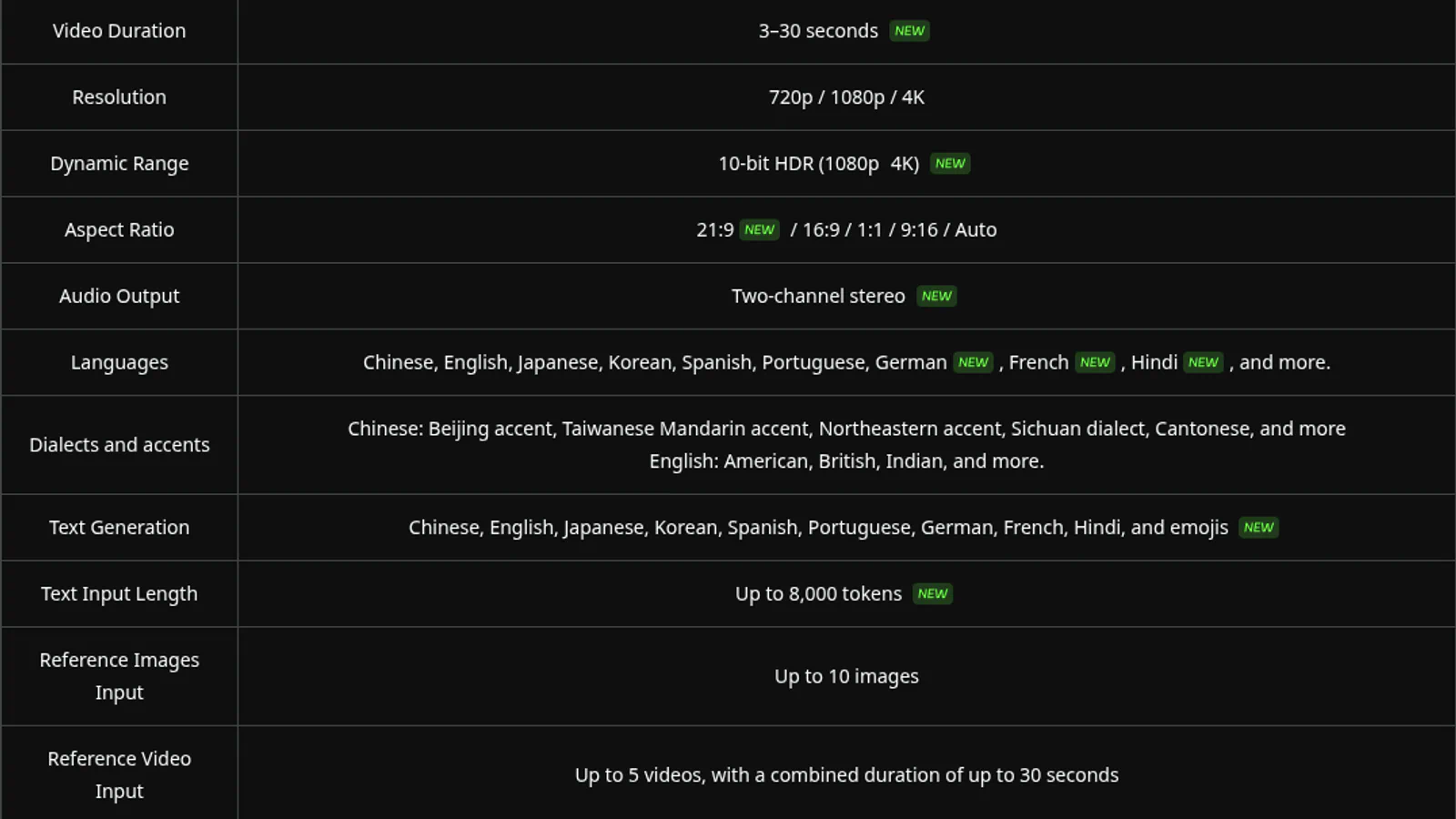
The biggest change is length: 3 to 30 seconds per generation, up from 15 in Kling 3.0. Kling also pitches it on acting. "A glance, a moment of hesitation, or the slightest change in expression can convey emotion clearly on screen," the release note says.
Key features, per the release note:
- Keyframes: up to 10 keyframe images on the timeline
- References: up to 15 assets, including images, videos and elements
- Audio: two-channel stereo with lip sync, in languages including English, Chinese, Japanese, Korean, Spanish, Portuguese, German, French and Hindi
- Aspect ratios: 21:9, 16:9, 1:1 and 9:16
- Flash: 720p only and up to 20 seconds
API pricing is in prepaid units per second of output:
- Kling 4.0: 1.0 unit at 720p, 1.5 at 1080p (Kling API pricing)
- Kling 4.0 Flash: 0.6 unit at 720p
- No 4K rate on the API; 4K is a web-app option
- Flagship packs: $500 for 3,250 units, or about $0.15 per unit, valid 180 days
At that pack rate, a 10-second 1080p clip (15 units) works out to about $2.31, by our math from Kling's API pricing. The older "General" unit packs don't work with 4.0.
Not everything is live yet. Kling's own release note lists 10-bit HDR in its spec table but describes it as coming soon in the text, so confirm HDR in the app before you plan around it. If you don't need 30-second clips, Kling 3.0 costs less on the API, at 0.6 unit per second for 720p without audio ().