
ByteDance just released Seedance 2.5, the upgraded version of its widely used AI video model.
Seedance 2.0 already made a lot of noise earlier this year. Some creators loved it because the videos looked cinematic without needing too much work. Others were more skeptical because, like most powerful AI video models, it raised the usual questions about training data, likeness, and how fast this space is moving.
Now Seedance 2.5 takes that same foundation and pushes it further. It now supports native 30-second video generation, native 4K output, up to 50 multimodal reference assets, better continuity, improved audio-video sync, and more control over longer scenes.
Topview AI has already added Seedance 2.5, so I spent the past 24 hours testing the model to see how much of the upgrade there is.
In this article, I’ll go through what’s new with Seedance 2.5, how it compares to Veo 3.1, Kling 3.0 Pro, Runway Gen-4, and Midjourney, and how to use it inside Topview.
What’s New in Seedance 2.5?
It has only been a few months since Seedance 2.0 was released, but ByteDance clearly had more planned for the model.
Seedance 2.5 focuses on the areas where most AI video models get annoying: too short lengths, inconsistent characters, terrible lip syncing, blurry details, and too much manual stitching when you’re aiming for a multi-scene video.
Here are the main upgrades:
- Native 30-second video generation: Seedance 2.5 can create longer clips without forcing you to stitch several short generations together.
- Native 4K output: The model can generate sharper videos from the base output, which helps with product shots, close-ups, textures, and repurposing content for different formats.
- Up to 50 multimodal reference assets: You can give the model more context through images, videos, audio, product references, character references, or style direction.
- Better continuity: Characters, products, backgrounds, and camera movement are more likely to stay stable across longer scenes.
- Improved audio-video sync: Useful for avatar videos, product explainers, UGC-style ads, tutorials, and short videos where the motion needs to match sound or speech.
- More control over scenes: Seedance 2.5 supports more guided workflows, including edited regions and staged layouts, so the model is not relying only on a text prompt.
- Better fit for ads and story-based videos: The longer output makes it more practical for product videos, mini stories, cinematic scenes, beauty clips, fashion content, and branded assets.
Okay, that’s quite a lot of major upgrades. There’s actually a bunch more new features you need to know. Check them all in this Seedance 2.5 spec sheet.
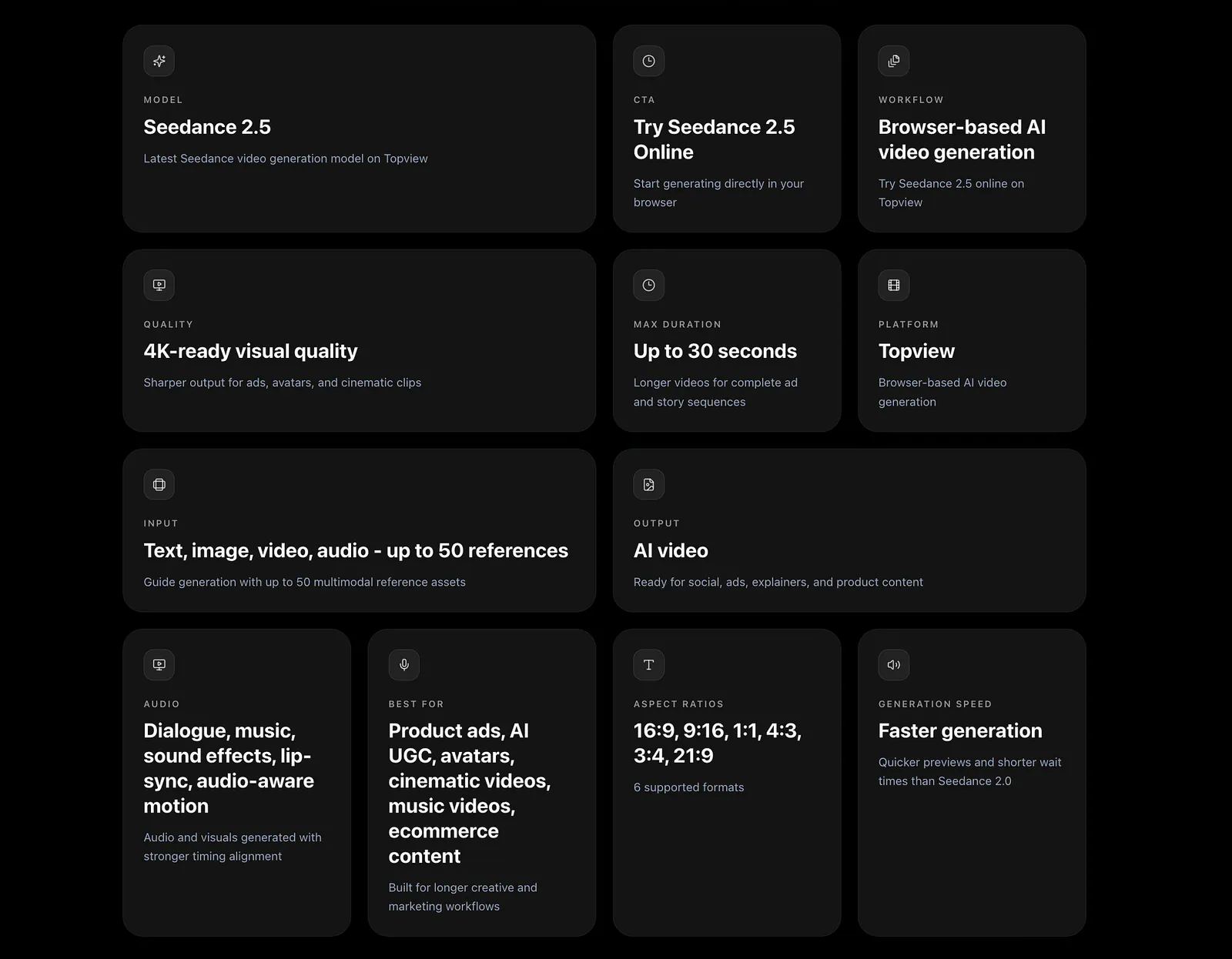
Seedance 2.5 specifications. Image by Jim Clyde Monge
The 30-second output is probably the biggest upgrade in practice.
5-second or 10-second videos were okay, but a 30-second clip can actually carry an idea. You can show a product reveal, a person using it, a close-up, and a final shot in one video.
It also reduces the amount of cleanup work. You do not need to generate five separate clips and hope the character, lighting, and product design stay the same across all of them.
The 50 reference assets are just as useful for branded content. A normal prompt can get you a good-looking video, but it may not match your product or visual direction. References give the model more to follow, so the result has a better chance of landing closer to what you wanted.
How Seedance 2.5 Compares to Other Video Models
Seedance 2.5 is coming out at a very crowded time.
Google has Veo 3.1. Kling has Kling 3.0 Pro. Runway has Gen-4. Midjourney is still one of the strongest and most capable tools for creating image references, even if it is not a native video model in the same way.
Seedance 2.5 does not win every category, but it is one of the strongest options if you care about longer clips, 4K output, and reference-heavy workflows.
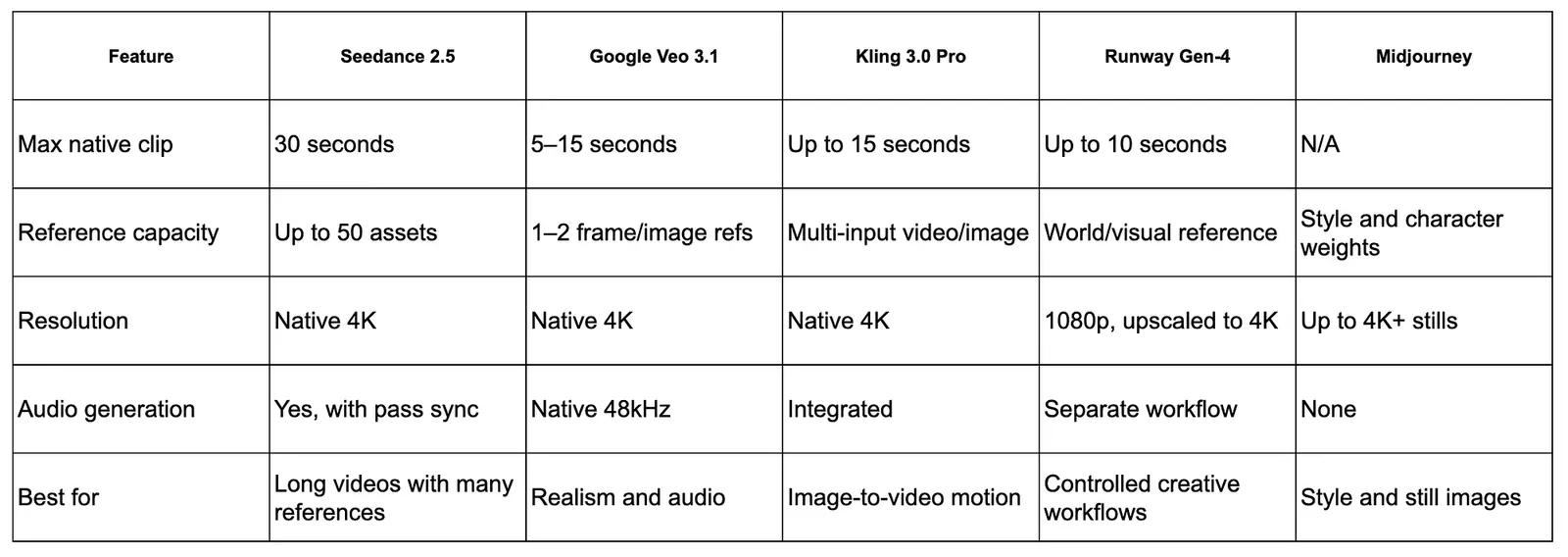
Seedance 2.5 comparison with other video models. Image by Jim Clyde Monge
- Seedance 2.5 vs. Google Veo 3.1: Veo 3.1 is still better for realism, natural movement, physics, lighting, and audio-heavy scenes. Seedance 2.5 makes more sense when you need longer clips, native 30-second generation, and more reference control for products, characters, or brand assets.
- Seedance 2.5 vs. Kling 3.0 Pro: Kling 3.0 Pro is great for image-to-video, especially when you already have one really good image. Seedance 2.5 is better when the project has more moving parts, like product shots, packaging, lighting references, brand colors, and lifestyle scenes.
- Seedance 2.5 vs. Runway Gen-4: Runway Gen-4 has the better editing workflow, especially for teams that need revisions, style control, and a more production-like interface. Seedance 2.5 has the edge on raw output, with native 30-second clips and native 4K generation.
- Seedance 2.5 vs. Midjourney Video: Midjourney Video is a good choice when you already have a beautiful image and want to animate it with simple motion. Seedance 2.5 is the better fit when you need longer native clips, more reference assets, and a more complete video workflow inside Topview AI.
How to Access Seedance 2.5 in Topview AI
Topview AI is an AI video platform for product videos, AI ads, avatar videos, UGC-style clips, social media content, and marketing assets.
To get started, head over to Topview’s AI Video tab and select the correct video model.
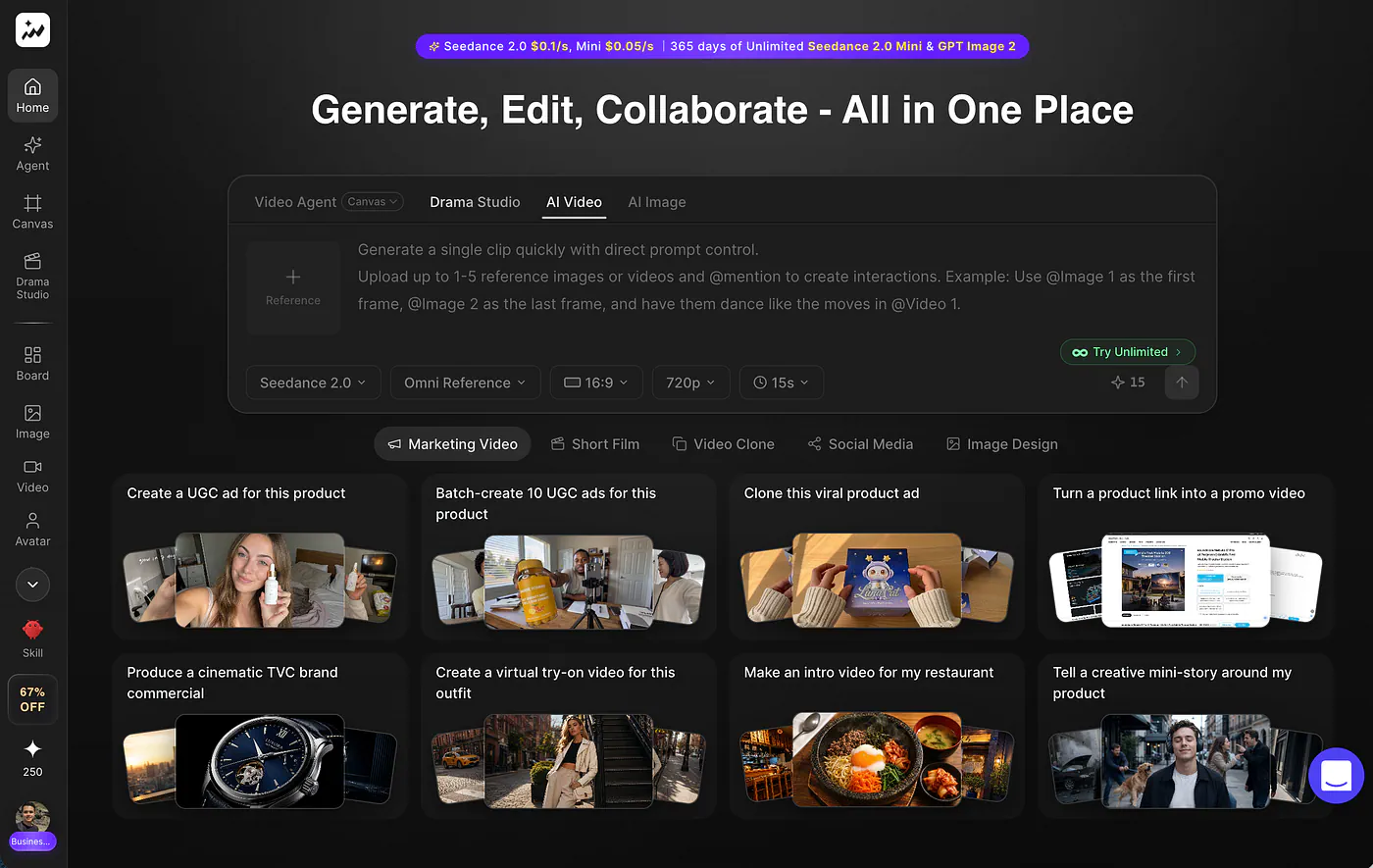
Topview AI video screen. Image by Jim Clyde Monge
What I like about Topview is that it is not just a single prompt box. It has different workflows depending on what you are trying to create. You can make videos from prompts, product links, scripts, images, avatars, and references.
Now that Seedance 2.5 is available inside Topview AI, you can use it directly from the video generator dashboard.
You can start with text only, but references help a lot.
If you are creating product videos, upload the product photo, packaging image, brand colors, and any style reference you want the model to follow. If you are creating a character scene, upload the character image and moodboard.
That is where Seedance 2.5 feels more useful than a basic text-to-video model. You are not asking it to guess everything from a paragraph.
Example videos with Seedance 2.5
Prompt: Cinematic montage in a dreamy, filmic style: A beautiful young woman with wavy dark hair and a white linen outfit walks through vibrant sunlit streets of old Havana, then transitions into surreal minimalist geometric rooms with dramatic lighting and floating panels. Intercut with intense close-up of a soccer player’s eyes and a powerful kick on a Champions League ball in a packed night stadium. Smooth, emotional, high-end commercial cinematography, 4K, natural motion, golden hour and dramatic shadows.
The camera choices, motion, lighting, and pacing all work together in this video. What surprised me most was that it came from one simple prompt. No heavy shot breakdown. No complicated prompt stack. Just a clean idea, rendered in 4K, with 30 seconds of footage that feels usable.
I love this so much. This is the first time Seedance has felt less like a fun video generator and more like a model built for commercials, cinematic scenes, and proper creative work.
You can check more sample videos from this post:
More Use Cases for Seedance 2.5
Seedance 2.5 is easy to describe as a cinematic video model, but I think its more practical use is in content production.
A 5-second clip is usually just one shot. A 30-second clip can be a full asset.
Here are some use cases where Seedance 2.5 makes more sense:
- Product ads: Show the product, close-ups, lifestyle usage, and final hero shot in one video.
- UGC-style videos: Create short ads with a hook, product moment, result, and call-to-action.
- AI avatar videos: Useful for explainers, tutorials, onboarding videos, and multilingual content.
- Cinematic story clips: Create short scenes, concept trailers, character moments, and visual sequences.
- Fashion and beauty content: Generate skincare routines, perfume ads, jewelry close-ups, outfit videos, and beauty shots.
- Social media assets: Create vertical or horizontal videos for TikTok, Reels, Shorts, YouTube, and paid ads.
- Product concept videos: Turn product images, mockups, or campaign ideas into polished video concepts.
- Brand content: Use multiple references to keep colors, style, product design, and mood closer to the original brief.
The longer output also means fewer wasted generations.
Instead of spending credits on several short clips that may not match each other, you can try to generate a more complete video from the beginning. You may still need multiple attempts, but the workflow feels less fragmented.
This also fits well with Topview AI’s other tools.
Topview already has Drama Studio, Canvas, AI-generated marketing assets, avatar tools, and product video workflows. Seedance 2.5 makes those tools stronger because the video model underneath can now handle longer, sharper, and more reference-heavy outputs.
Seedance 2.5 does not replace those workflows. It improves what you can create inside them.
Final Thoughts
That’s about it, guys. I just gave you a breakdown of what’s new with Seedance 2.5, how it compares to other video models, and how you can use it inside Topview AI.
I was impressed by the demo videos ByteDance showed during the announcement, so I wanted to see if the model would still look good in my own tests. So far, it does. The results are not perfect, but the jump in length, quality, and consistency is very noticeable.
I also like that Topview AI added support quickly. A powerful model is nice, but most users still need a good platform around it. Topview makes Seedance 2.5 easier to use for product videos, AI ads, avatar content, cinematic clips, and social media assets.
Have you tried Seedance 2.5 yet? Do you think it is the best AI video model right now, or are you still leaning toward Veo, Kling, Runway, or another tool? Let me know in the comments.
Sources
- Seedance 2.5topview.ai
- Topview AItopview.ai
- Jim Clyde Mongemedium.com
- https://vimeo.com/1204554111?fl=pl&fe=vlvimeo.com
- https://x.com/EHuanglu/status/2069302147410514020x.com
- Drama Studiotopview.ai
- Canvastopview.ai


