
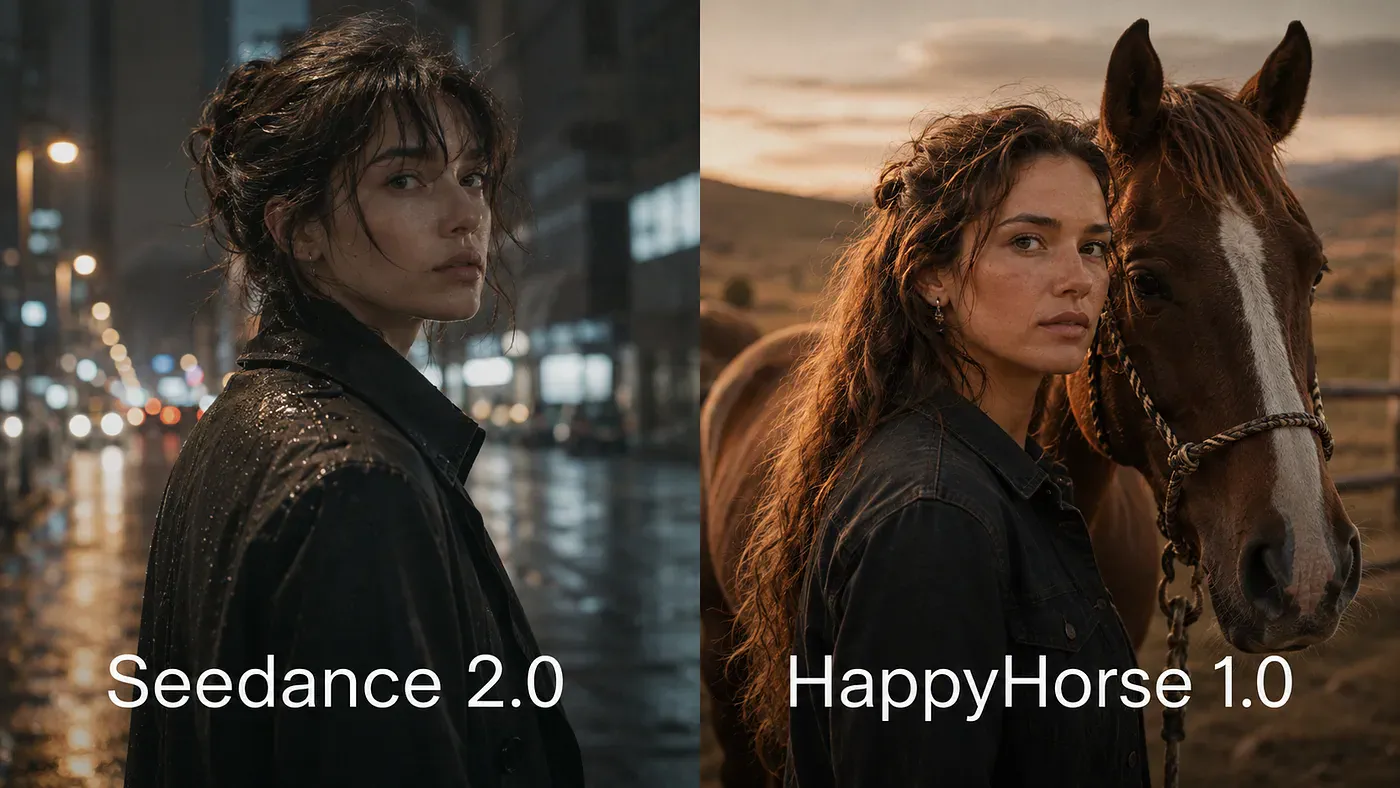
It has been a couple of weeks since Seedance 2.0 was officially released to the public, and it definitely shook the entire internet. It is by far the most capable and also the most controversial video model out there. It can generate ultra-realistic video with native audio and synchronized sound, all in a single pass.
Today, a new video model from Alibaba dropped. It is called HappyHorse 1.0. What makes this model interesting is how fast it took the top spot as the best AI text-to-video model in Artificial Analysis.
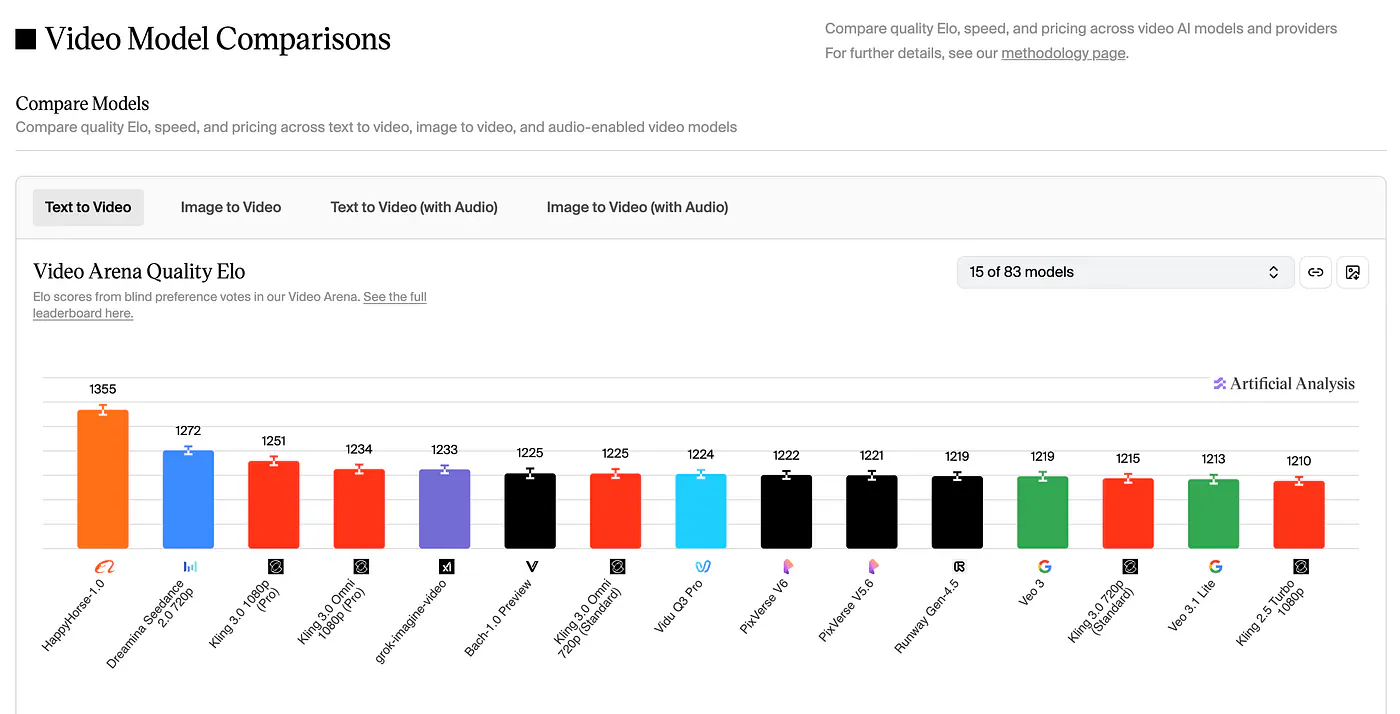
Video model comparison on Artificial Analysis
In this guide, I will show you how these two models compare by running three different videos through each model using common prompts.
I will also walk through what each model is built for, where their architectures differ, and which one I would actually reach for in a real workflow.
Let’s get started.
What is Seedance 2.0?
Seedance 2.0 is ByteDance’s flagship AI video generation model. It launched on February 10, 2026, as the successor to Seedance 1.5, and within days, it went viral for clips featuring famous actors and characters that looked practically indistinguishable from live action footage.
The model is built on a unified multimodal audio and video joint generation architecture, and it accepts four input types: text, image, audio, and video.
It also offers significant gains over version 1.5 in physical accuracy, motion stability, and controllability, and it can handle complex multi-subject interaction scenes that previous models struggled with.
I’ve already talked about the capabilities and unique features of Seedance 2.0 in one of the previous articles. You can learn more about it here:
I Tested Seedance 2 0 Like A Filmmaker Not A Prompt EngineerWhat makes Seedance 2.0 stand out is its approach to control. Instead of relying on text prompts alone, creators can upload up to nine images, three videos totaling 15 seconds, and three audio files, then reference them with structured @ tags inside their prompt.
This means you can pull motion from one clip, lighting from another, a character from a third image, and audio from a fourth source, all in the same generation. It also supports clips from 4 to 15 seconds at up to 1080p, with multiple aspect ratios.
What is HappyHorse 1.0?
HappyHorse 1.0 is Alibaba’s entry into the high-end video generation race. The model was developed inside Alibaba’s ATH AI Innovation Unit and was first spotted on the Artificial Analysis Video Arena around April 7, 2026.
Three days later, CNBC reported that Alibaba had confirmed it was the team behind the mystery model.
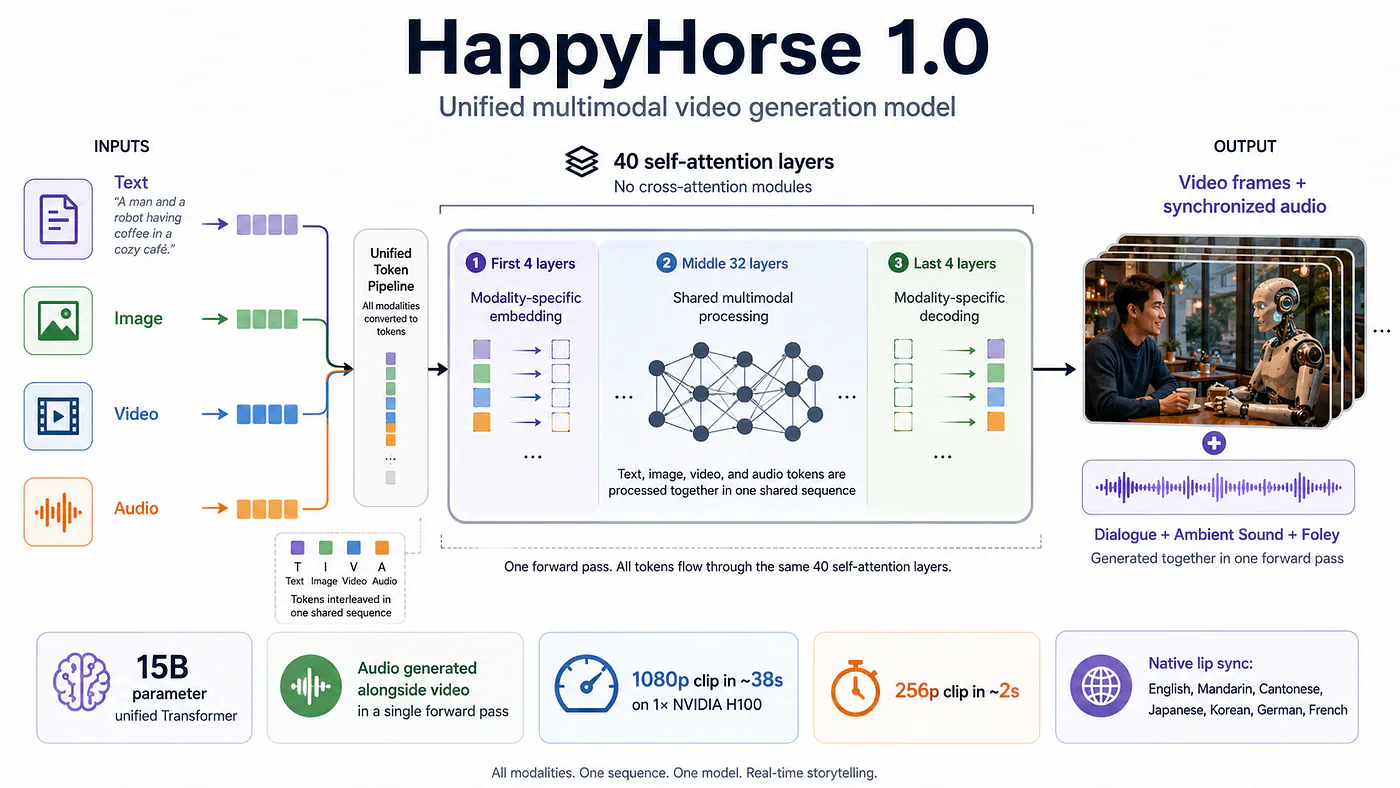
Summary of the technical details of Happy Horse 1.0
A few of the technical claims around HappyHorse 1.0 are worth digging into. It is described as a 15 billion-parameter unified Transformer with 40 self-attention layers and no cross-attention modules.
Inside the model, the first and last four layers handle modality-specific embedding and decoding, while the middle 32 layers process text, image, video, and audio tokens together in one shared sequence. This design treats every modality as just another stream of tokens in the same pipeline, which simplifies the architecture compared to dual-stream or cascaded approaches.
Audio is generated alongside the video frames in a single forward pass, not added afterward. That means dialogue, ambient sound, and Foley effects come out synchronized with the frames, with no separate audio module or post-processing dubbing step.
Alibaba claims the model can produce a 1080p clip in about 38 seconds on a single NVIDIA H100, which is fast for this resolution, and 256p clips in roughly 2 seconds. There is native lip sync support across English, Mandarin, Cantonese, Japanese, Korean, German, and French.
Here’s a summary of the technical details of this model:
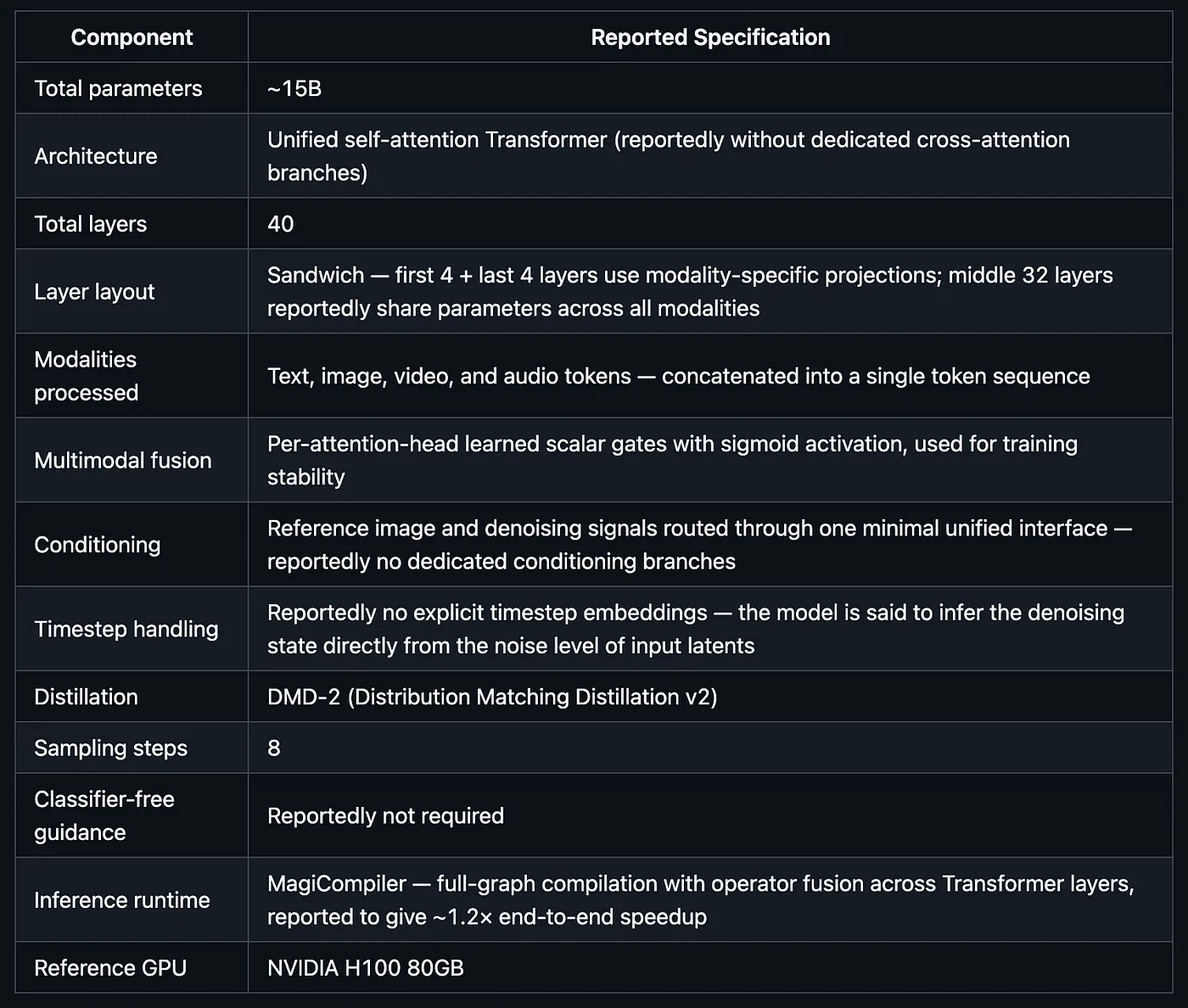
Summary of the technical details of Happy Horse 1.0
Another interesting part is the licensing. Per the model’s official site, HappyHorse 1.0 ships with full open source weights, including the base model, a distilled inference model, a super-resolution upscaler, and the full inference code.
Seedance 2.0 vs HappyHorse 1.0
For this comparison, I picked three prompts designed to test different parts of each model’s capability set.
- The first targets photorealism and physical accuracy.
- The second tests dialogue and lip sync, where joint audio-video generation actually matters.
- The third pushes both models on stylized animation, which is usually where text-to-video models break down.
A note before the comparisons. I generated the videos through Topview AI, which gives access to both Seedance 2.0 and HappyHorse 1.0 from a single interface. If you want to run these prompts yourself, that is the easiest way to access both models in one place.
To get started with the video generation, head over to Topview and create an account. Next, go to the AI video generator tool and open the Text to video tab. From here, set the model to either Seedance 2.0 or Happy Horse 1.0.
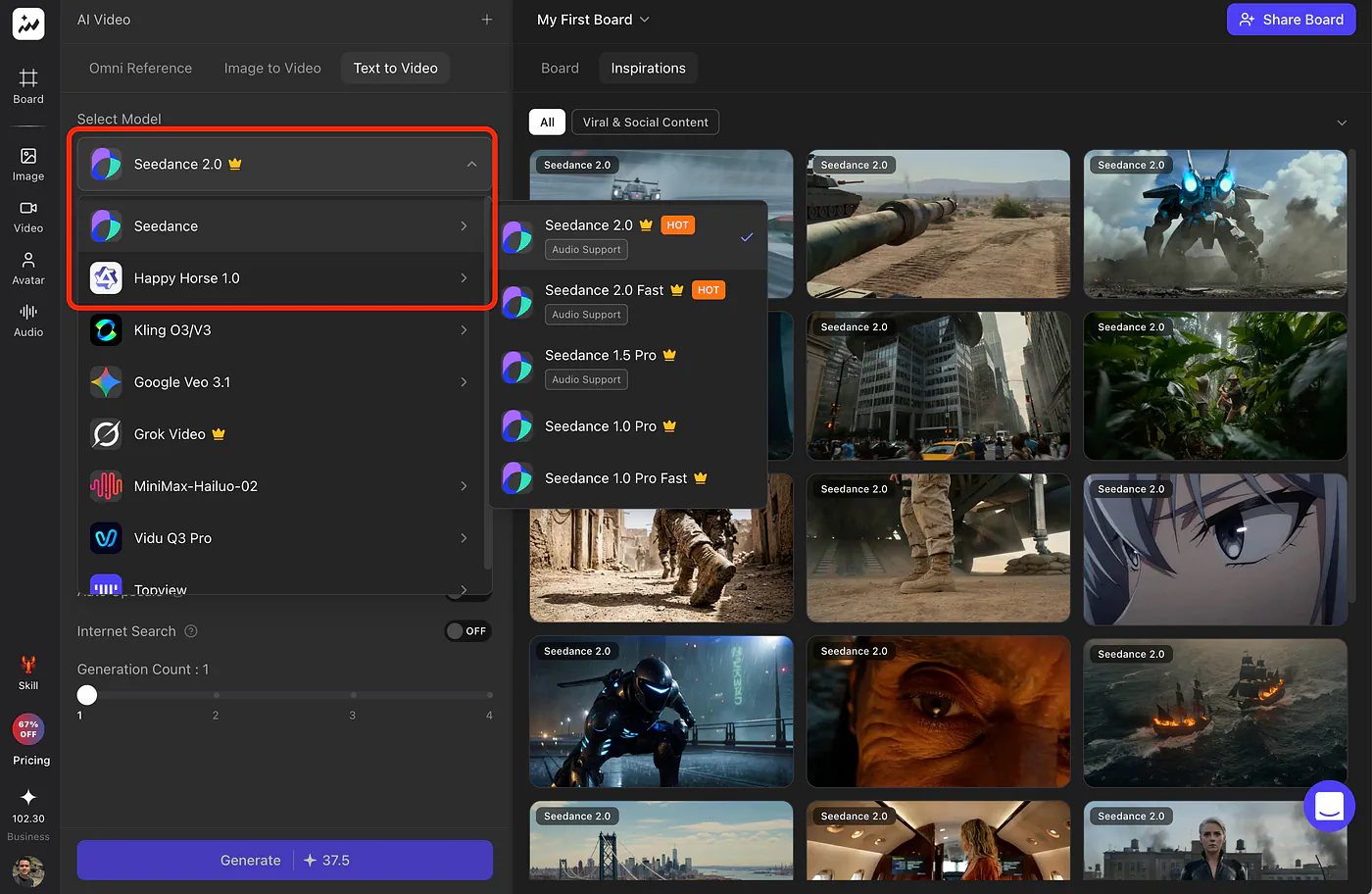
Generating videos with Seedance 2 and Happy Horse 1 on Topview
Add the text prompt and modify the video settings based on your preference. For this example, all videos are in 16:9 aspect ratio and 720 resolution.
Test 1: Photorealistic Action
Prompt: A cyclist races down a mountain trail at golden hour, dust kicking up behind the rear tire, helmet camera POV occasionally cutting to a wide drone shot. Real ambient sound of tires crunching gravel and wind rushing past.
Here’s the result with Seedance 2.0:
Here’s the result with Happy Horse 1.0:
This is a hard prompt because it asks for two camera angles within a short clip, demands physical accuracy on the dust and tire interaction, and requires natural ambient audio. Both models claim to handle native audio, but their approaches differ.
I like the output video from Seedance 2.0. It’s very realistic. I like how it handles the multi-shot and the change in camera angle. The sunset vibe is nice too, and the sound effect is really good. Could’ve been better, though, if there had been a shot showing the biker’s face or head.
For the HappyHorse 1.0 output,**** the video is very similar to the Seedance 2.0 version. But in terms of quality, this one’s a bit mushy and less realistic. The speed and action are there, though, I like it. The audio is a bit strange with the random piano sound, but the high speed and the sand and bike noise are still great.
Worth pointing out that HappyHorse 1.0 is a bit more expensive than Seedance 2.0, but falls a bit behind on this example in terms of quality.
Test 2: Dialogue Scene with Lip Sync
Prompt: Close up of a woman in her thirties sitting at a coffee shop window, looking up from her laptop. She speaks to someone off camera in English: “I think I finally figured out what was wrong with the deployment.” Soft ambient cafe noise, warm afternoon light.
Here’s the result with Seedance 2.0:
Here’s the result with Happy Horse 1.0:
This is the test that separates models that actually generate audio natively from ones that bolt it on later. Lip sync is brutally hard, and getting English phonemes right at close-up framing is where most models fall apart.
For the Seedance 2.0 output, I like the color grading better. It’s less harsh and not overly saturated. Her facial expression goes from very serious to excited, which gives it a more expressive edge over the HappyHorse version.
For the HappyHorse 1.0 output, the lip movement is really well done. You can see each word articulated on the character. The reflection of the male character on the glass is also really good in terms of realism.
Overall, I love how both models handle voice narration, lip syncing, and expressive characters. They’re both excellent in this category. I just lean more toward Seedance 2.0 because the softer tones make the video look more realistic to me.
Test 3: Stylized Animation
Prompt: A traditional Japanese ink wash painting comes to life. A crane unfolds from a single brush stroke, takes flight across misty mountains, water reflecting below. Quiet shakuhachi flute music.
Here’s the result with Seedance 2.0:
Here’s the result with Happy Horse 1.0:
Stylized animation is a tough challenge for any video model. The output needs to stay style consistent from start to finish, and it has to respect the negative space that makes ink wash work as an aesthetic in the first place.
For the Seedance 2.0 output, the ink aesthetic was nice, but it somehow skipped the part where the crane comes to life from the ink. I didn’t quite like the transition because the expectation is to have a drawing of a crane that then comes to life. Also, the shadow seems to come alive somewhere towards the end of the video, which isn’t right.
For the HappyHorse 1.0 version, it got the crane drawing coming to life correctly. I also like the effect of ink flowing off its wings while it’s flying. This model performed better with this example.
Which Video Model Is Better?
Honestly, this comparison is a bit uneven.
Seedance 2.0 is already on its second version with a refined feature set, deep multimodal control, and an editing pipeline that goes well beyond text to video.
HappyHorse 1.0 just dropped as a first version, with a strong core engine and an aggressive open source play, but a much smaller surface area when it comes to creator workflows.
Platforms like Topview made their own technical comparison of the two models. Here are the side-by-side results:
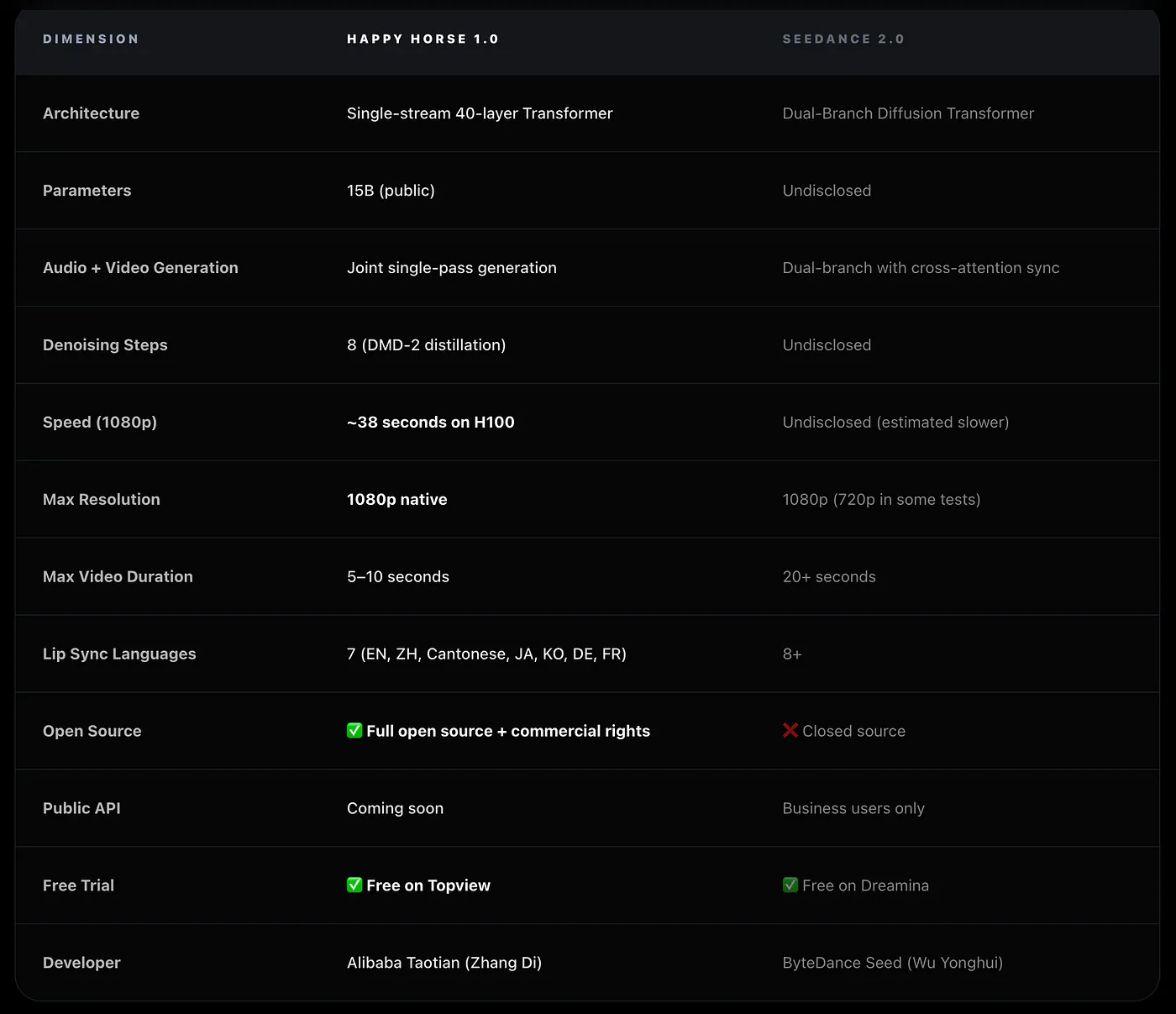
Seedance 2 vs Happy Horse 1 based on Topview comparison
HappyHorse 1.0 wins on raw visual quality, image-to-video accuracy, faster inference, and is the only top-ranked model with open weights you can self-host. Seedance 2.0 wins on audio sync, longer video duration up to 20+ seconds, and dialogue-heavy scenes thanks to its dual-branch architecture and cross-attention timing.
According to Topview: Pick HappyHorse if you care about visuals and flexibility, pick Seedance if audio and longer narratives matter more.
Here are my personal takes:
If you care about reference-based control, character consistency across multiple shots, and being able to combine text, image, video, and audio inputs in one generation, Seedance 2.0 is the clear pick. The @ tag system alone makes it the most directable AI video model on the market right now. It also has a real editing layer with clip extension, targeted edits to specific characters or actions, and continuous shot generation.
HappyHorse 1.0 is the more interesting option if you’re an engineer who wants to fine-tune a model for a custom use case, or you just value open source weights, fast inference, and joint audio-video generation in one pass. It’s the only top-tier video model right now that you can actually self-host and modify. The 38-second 1080p generation time on a single H100 makes it practical for batch workloads, too.
One more thing worth flagging is the pricing. Seedance 2.0 charges around $0.30 per second of 720p video on fal, which adds up quickly for any serious project. HappyHorse 1.0 is free if you have the hardware, or accessible at a lower cost through wrappers like Topview AI and fal until more self-hosted options come out.
Final Thoughts
Alright, I hope you find this article useful. The comparison covered what each model is, how they differ, and three prompts where the tradeoffs actually show up.
Seedance 2.0 is the most controllable video model out right now, with a multimodal reference system that nothing else matches. HappyHorse 1.0 is the most accessible top-tier model, with full open source weights and joint audio-video generation in one pass.
For my own workflow, I’d still lean toward Seedance 2.0 as the better tool today. The reference-based control and multi-shot consistency matter more to me than open source access.
Big thanks to platforms like Topview AI for making both of these models accessible without API keys or self hosted setup.
That said, comparing a second version product to a first version one isn’t really fair. Alibaba should get the chance to prove itself with HappyHorse 2.0 before any final verdict on which company is leading the race.
If you have prompts you want me to run through both models, drop them in the comments. What do you think, which of these two would you reach for first? Let me know your thoughts in the comments.
Sources
- Seedance 2.0topview.ai
- HappyHorse 1.0topview.ai
- Artificial Analysisartificialanalysis.ai
- https://generativeai.pub/i-tested-seedance-2-0-like-a-filmmaker-not-a-prompt-engineer-46151a17f295generativeai.pub
- CNBC reportedcnbc.com
- Topview AItopview.ai
- https://vimeo.com/1190678126?fl=pl&fe=vlvimeo.com
- https://vimeo.com/1190677767?fl=pl&fe=vl


