NVIDIA released Nemotron 3.5 Transcribe on October 28, 2026, bringing several speech-processing tasks into one downloadable model. Developers can request a verbatim transcript, written-form text, speaker-attributed output, translation or language identification through natural-language instructions, without retraining for each output style.
The speech-augmented language model supports recordings up to one hour long and has approximately 4.3 billion active parameters. NVIDIA provides weights under the OpenMDW-1.1 license, multiple numerical formats and a NeMo Speech fine-tuning toolkit. Its launch post and research page describe an offline model, meaning it processes recorded audio rather than promising streaming transcription.
For developers, the useful change is control over what counts as the right transcript. A searchable meeting archive, a subtitle file and a medical dictation system may need different representations of the same speech. Nemotron makes more of those choices request-level settings, although its language coverage and deployment requirements need a closer look.
One Recording Can Produce Several Useful Outputs
Nemotron 3.5 Transcribe takes audio, text instructions and optional context, then generates text. The same checkpoint can preserve spoken wording, produce conventional written forms, incorporate expected terminology or attach speaker labels.
NVIDIA illustrates the interface with this instruction:
“Transcribe this recording and label each speaker.”
That is a request to the model, not a separate training job or a command to run another diarization service. NVIDIA also documents translation, spoken-language identification, audio question answering and optional word-level timestamps. Its launch post makes an important distinction: 40-language support does not apply equally to every task.
| Capability | Published coverage or limit |
|---|---|
| Transcription | 40 languages |
| Speech translation | 31 languages to or from English |
| Speaker attribution | 13 languages, with up to eight speakers |
| Audio question answering | Trained in English |
| Recording length | Up to one hour |
| Context window | 65,536 tokens |
| Word timestamps | Available on request, with supporting inference setup |
The context-window specification comes from the model card. It is a token limit, separate from the recording-duration limit; developers should not interpret it as a guaranteed number of transcript words.
I would treat the task-by-language matrix as an integration requirement, not optional documentation. An application can support transcription for a language while lacking documented speaker attribution or translation support for that same language. A single “40 languages supported” badge would hide that distinction.
Instructions Change the Transcript’s Purpose
Verbatim and written-form transcription solve different problems. A verbatim record may preserve hesitations and spoken number forms. Written-form output can favor conventional numeric notation and cleaner presentation. Those choices matter when comparing transcripts, indexing documents or feeding structured business systems.
Contextual transcription adds another control: a developer can supply expected entities or specialized vocabulary. NVIDIA reports a six-fold reduction in named-entity errors on ContextASR-Bench when using expected-entity context. That is a vendor benchmark result, not a guarantee for arbitrary terminology lists. The practical use is to provide a focused vocabulary relevant to the recording, then check whether the audio supports the selected words. NVIDIA’s research page
This can simplify a product that currently maintains several output-specific speech pipelines. It still leaves application work around file handling, task selection, validation and downstream formatting. One checkpoint consolidates model capabilities; it does not automatically supply the surrounding workflow.
How the Model Connects Speech, Speakers and Instructions
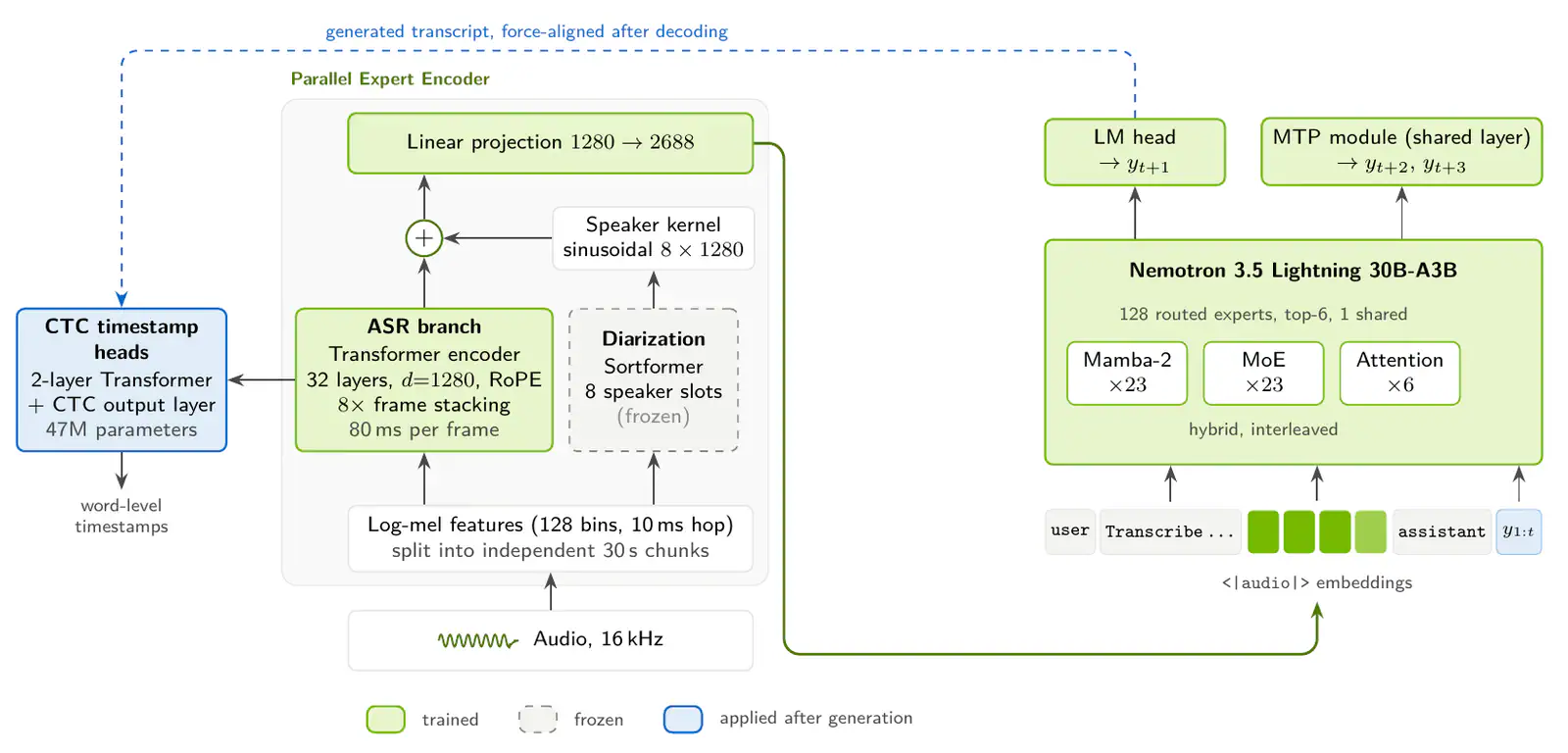
Nemotron 3.5 Transcribe combines a Transformer speech encoder, a frozen Nemotron 3 Diarization model and the Nemotron 3.5 Lightning 30B-A3B language model. The language component uses a hybrid Mamba–Transformer mixture-of-experts architecture. NVIDIA lists approximately 34 billion total parameters, including the audio encoder, with 4.3 billion active. Model card
The speech encoder represents acoustic content. The diarization component supplies speaker-activity information. NVIDIA’s Parallel Expert Encoder injects those speaker cues into the speech representations, allowing the language model to generate speaker-attributed text.
That differs from a conventional cascade in which speech recognition produces words and another stage subsequently attaches speaker labels. NVIDIA’s design gives the generator access to speaker information while producing the transcript. It does not require architectural changes to the language model itself. Research page
Word timestamps use another mechanism. After text generation, a lightweight connectionist temporal classification, or CTC, adapter aligns the generated transcript with the recording. This distinction matters for implementation: timestamping is an alignment step after decoding, not simply a matter of asking the language model to invent time values.
NVIDIA also trains the model with Multi-Token Prediction, or MTP. Its MTP layer can propose tokens for speculative decoding, while a separately released DFlash2 draft model provides an alternative. Speculative decoding accelerates generation by proposing tokens that the main model checks.
My view is that the speaker-aware encoder is the more consequential architectural detail for meeting applications. Formatting instructions are useful, but feeding speaker cues into generation addresses a harder integration problem: keeping the words and their speaker assignments connected, including in overlapping conversation.
What NVIDIA’s Benchmarks Actually Show
NVIDIA publishes results for recognition accuracy, style control and speaker-attributed transcription. The model card says its headline results were captured on October 12, 2026, before the October 28 release.
These figures are published by NVIDIA and were not independently reproduced for this article. References to public leaderboards should therefore be read as NVIDIA’s reporting of those comparisons, not as new measurements by Zeniteq.
| Evaluation | NVIDIA’s reported result | Published comparison or scope |
|---|---|---|
| English Open ASR | 4.71% mean WER | Nine public test sets; Qwen3-ASR-1.7B listed at 4.94% |
| Multilingual Open ASR | 4.62% mean WER | Seven languages; Qwen3-ASR-1.7B listed at 6.49% |
| Long-form Open ASR | 10.98% mean WER | Parakeet-TDT-0.6B-v3 listed at 13.37% |
| Preference-ASR style control | 7.56% default, 6.16% instructed WER | Same model, different instruction conditions |
| Full-session multi-speaker ASR | 15.80% mean cpWER | DiCoW v3.3 + DiariZen listed at 16.83% |
Source: NVIDIA’s model card.
Word error rate, or WER, measures substitutions, deletions and insertions against a reference transcript. Lower is better. Speaker-attributed cpWER also evaluates words grouped by speaker, allowing speaker-label matching during scoring. It should not be treated as interchangeable with ordinary WER.
The style-control result directly supports the release’s central developer proposition. Moving from 7.56% to 6.16% WER is a 1.40-percentage-point improvement, about 18.5% relative to the default result. That calculation uses NVIDIA’s published figures. It shows that instructions can affect benchmark correctness, though it does not isolate how much comes from presentation conventions versus recognition changes.
Two qualifications matter. First, the multilingual headline covers seven benchmark languages, not the entire 40-language transcription roster.
Second, NVIDIA’s launch blog reports 5.33% English average WER, while the research page and model card give 4.71% across nine public sets. The opened pages do not reconcile those English figures. They should not be silently combined or presented as the same measurement. NVIDIA’s launch post
The evidence supports a capable, instruction-sensitive model. It does not support assuming identical accuracy across every language, recording condition or output style.
Deployment: Active Parameters Are Not the Memory Budget
The 4.3-billion-active-parameter figure describes how much of the model participates in computation. It does not mean developers download or store only 4.3 billion parameters.
The model card lists approximately 34 billion total parameters and demonstrates BF16 serving on one H100 with 80 GB of memory. As a rough calculation, 34 billion parameters at two bytes each require about 68 GB in decimal units for weights alone, before runtime state, buffers and other overhead. Actual memory use depends on the checkpoint and serving configuration.
That is why I would not choose hardware from the active-parameter headline. It helps explain compute efficiency, but the total weights and numerical format remain central to deployment planning.
Frequently Asked Questions
4 questions
1Is Nemotron 3.5 Transcribe a Streaming Model?
NVIDIA describes it as an offline speech and audio model for recorded inputs, with recordings up to one hour long. The release does not promise streaming transcription.