
Liquid AI announced LFM3 on October 27, 2026, releasing an open-weight model family built around a shared 1.7-billion-parameter foundation. Its six models cover text, vision, audio, omni, and decision workloads, with specialized versions in the 2B-parameter range. Base and post-trained weights are available through Hugging Face, alongside hosted access through Liquid’s API and Playground. Liquid AI’s announcement
The practical appeal is the breadth of that small-model stack. Developers can choose a variant for their inputs, adapt it to a narrow job, and deploy it close to the application. Liquid says every model supports fine-tuning on a single GPU.
Two deployment details deserve attention. The downloadable text model advertises a 256K-token context window, while the hosted API lists 128,000 tokens. The roughly 1 GB four-bit model footprint also excludes important runtime memory. Those distinctions matter more to a deployment plan than the parameter count alone.
The LFM3 Family: Six Models, One Backbone
Every variant branches from LFM3-1.7B-Base. Vision and audio versions add modality-specific components, while the two decision models specialize the vision and omni branches.
Liquid’s technical introduction on Hugging Face maps the family as follows:
| Model | Inputs | Outputs | Foundation |
|---|---|---|---|
| LFM3-1.7B | Text | Text | LFM3-1.7B-Base |
| LFM3-VL-2B | Text, images, video | Text | Backbone plus vision encoder |
| LFM3-Audio-2B | Text, audio | Text, speech | Backbone plus audio encoder, decoder, and LiquidCodec |
| LFM3-Omni-2B | Text, images, video, audio | Text, speech | Backbone plus vision and audio components |
| d1-2B | Text, images, video | Calibrated answers | LFM3-VL-2B |
| d1-omni-2B | Text, images, video, audio | Calibrated answers | LFM3-Omni-2B |
For a document-reading application, VL is the obvious starting point. A voice interface can start with Audio. Omni combines camera, microphone, language, speech output, and structured tool-calling capabilities in one model.
The decision variants are a separate choice for applications seeking calibrated answers. That label should prompt evaluation of confidence and error behavior on the target task, especially if an answer will trigger an action.
I’d start with the narrowest variant that covers the application’s inputs. A shared backbone makes this a coherent family, but it does not make the additional encoders and decoding paths free. Omni earns its place when the application actually needs those modalities together.
A Tri-Hybrid Architecture Built Around Local Processing
LFM3 combines three sequence-processing operators across 24 layers:
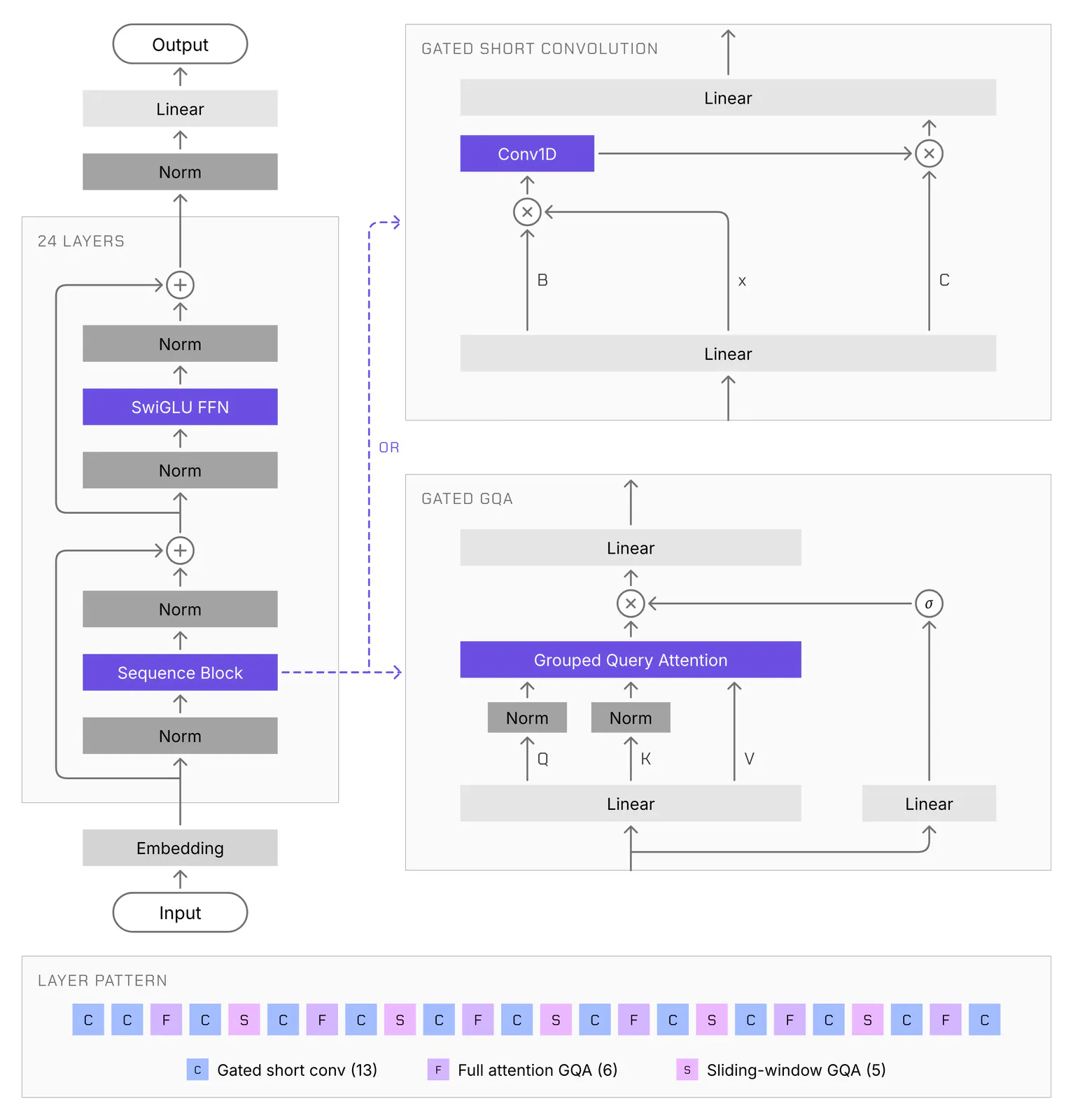
- 13 gated short-convolution layers
- Five sliding-window attention layers, each using a 256-token window
- Six global-attention layers
Convolutions process nearby information, sliding-window attention limits attention to a local region, and global attention supplies broader access to the sequence. The 256-token sliding window is a layer setting, separate from the text model’s much larger overall context capacity. Liquid AI’s architecture description
Liquid also increased the convolution kernel size from three to seven. Attention-head gates scale individual heads’ outputs, while normalization before and after each block helps keep activations well-scaled. Liquid says the gating can suppress activation outliers that make quantization harder.
The company used hardware-in-the-loop architecture search across 14 device and backend combinations, including phones, Raspberry Pi 5, laptops, CPUs, GPUs, and Qualcomm’s Hexagon NPU. That is useful evidence of the design priorities, although it is not a universal compatibility guarantee.
The shared base was pretrained on 22 trillion tokens. Its final 3.5 trillion tokens emphasized curated data, agentic traces, and tool calls, while extending the text context window to 256K tokens. The training recipe helps explain the release’s focus on specialized agents and business workflows.
What Changes for Vision and Speech
LFM3 introduces new in-house vision and audio components, not simply a new language backbone behind existing encoders.
Liquid’s vision encoder has 164 million parameters. The company reports that it matches Qwen3.5-2B’s vision encoder in accuracy with 2.2 times fewer FLOPs, measuring both with the same LFM2.5-230M language backbone. That controlled backbone comparison is useful, but it is an encoder-level result, not a measurement of complete application latency or power consumption. Liquid’s technical post
For video, the encoder embeds each pair of sampled frames into one temporal slice, halving the temporal sequence length. This reduces the representation passed downstream without implying that every video-processing stage becomes twice as fast.
The audio encoder is causal, meaning it can process arriving sound without waiting for future audio. That lets the model begin processing while a person is still speaking.
LiquidCodec handles the speech-generation side. Liquid reports approximately 87 times real-time decoding on one CPU thread of an Apple M4 Max. That figure describes the codec’s conversion of generated tokens into speech, not the speed of an entire voice conversation.
For voice products, I’d keep those measurements separate: incoming-audio processing, model generation, speech decoding, and playback all contribute to perceived responsiveness.
Local and Hosted Deployment Have Different Limits
The 256K Context Window Is Not the API Limit
The downloadable LFM3-1.7B text model supports a documented 256K-token context window. VentureBeat reports that Liquid’s hosted console lists a 128,000-token limit for the API version.
Context is the combined budget for input and generated output. A workflow built around the downloadable model’s maximum window may therefore need shorter histories or smaller document bundles when moved to the hosted endpoint.
I’d make context limits an explicit configuration setting. Assuming that hosted and self-managed deployments expose identical limits creates an avoidable migration problem.
One Gigabyte Is a Weight Estimate
Liquid says the text model fits in about 1 GB at four-bit precision. The basic arithmetic supports that scale: 1.7 billion parameters multiplied by four bits is approximately 0.85 GB of raw parameter data, before packaging and related overhead.
An application also needs memory for inference state, temporary computations, the runtime, and other components.
VentureBeat reports that Liquid clarified a separate 1.6 GB figure at 128K context as the KV cache, the stored attention information used during generation. Model weights remain additional. A complete memory budget at the maximum 256K context was not supplied.
The practical consequence is straightforward: a model that fits as a roughly 1 GB file is not a promise of a 1 GB application. Budget for the intended context length and measure peak memory under that workload.
Export Formats Need Runtime Checks
The LFM3 Hugging Face collection lists GGUF, ONNX, MLX, FP8, and NVFP4 options for the text and vision models. Audio listings include GGUF, ONNX, and MLX.
Frequently Asked Questions
3 questions
1Which LFM3 Model Fits a Voice-Only App?
LFM3-Audio-2B accepts text and audio and produces text and speech. Omni adds image and video inputs for applications that also need visual information.