

Tencent published downloadable weights for Hy4, Hy4-FP8 and pretrained Hy4 base models on November 20, 2026, according to its model repository. The release follows Tencent’s November 4 API launch and creates a different deployment option: developers can obtain the model files and run inference on infrastructure they control.
The terms deserve attention before anyone budgets for that infrastructure. Hy4 uses Tencent Hy License 1.0, not Apache 2.0. Its commercial provisions require a separate written license for covered model-as-a-service businesses above US$50 million in 12-month revenue, or products above 100 million monthly active users. Solely internal use is exempt from that threshold requirement.
The result is a substantial open-weight release with two adoption questions: can your infrastructure run it, and do the published terms cover your intended business?
What Tencent Made Available
Tencent’s Hy4 repository identifies three releases, distributed through Hugging Face, ModelScope and GitCode:
| Release | What it provides | Practical relevance |
|---|---|---|
| Hy4 | The main Hy4 model weights | A self-hosting option for teams evaluating the flagship model |
| Hy4-FP8 | An FP8 version of Hy4 | Lower-precision weights that can reduce storage and memory requirements |
| Pretrained base weights | The underlying pretrained model | A starting point for teams planning further training or adaptation |
The separate Hy4-FP8 repository gives deployment teams a lower-precision option to assess alongside the main release. Base weights serve a different purpose: a pretrained checkpoint should not automatically be treated as interchangeable with a model prepared for assistant workflows.
November 20 is the weight-release event, distinct from the earlier API introduction. An API gives developers access to a provider-operated service. Downloadable weights move responsibility for model loading, inference, capacity planning and operational security to whoever hosts them.
That distinction matters for organizations that want control over where inference runs. It also means taking on work the API provider previously handled.
A 774B Model With a Million-Token Context
Tencent’s model card lists the following specifications and capabilities:
| Item | Tencent’s published specification |
|---|---|
| Parameter count | 774 billion |
| Maximum context window | 1,048,576 tokens |
| Understanding capabilities | Text, images and video |
| Computer-use scope | Command-line and graphical-interface workflows |
The context figure is exactly (2^{20}) tokens, commonly shortened to “1M context.” Tokens are the units processed by the model, not a direct word count. Text encoding and multimodal input representation affect how much material fits.
A large context window can be useful for document collections, long interaction histories and workflows involving visual material. It is a capacity specification, however, not a guarantee that the model will correctly retrieve or reason over every detail in a full window. Serving that maximum context also has implications for memory use and latency.
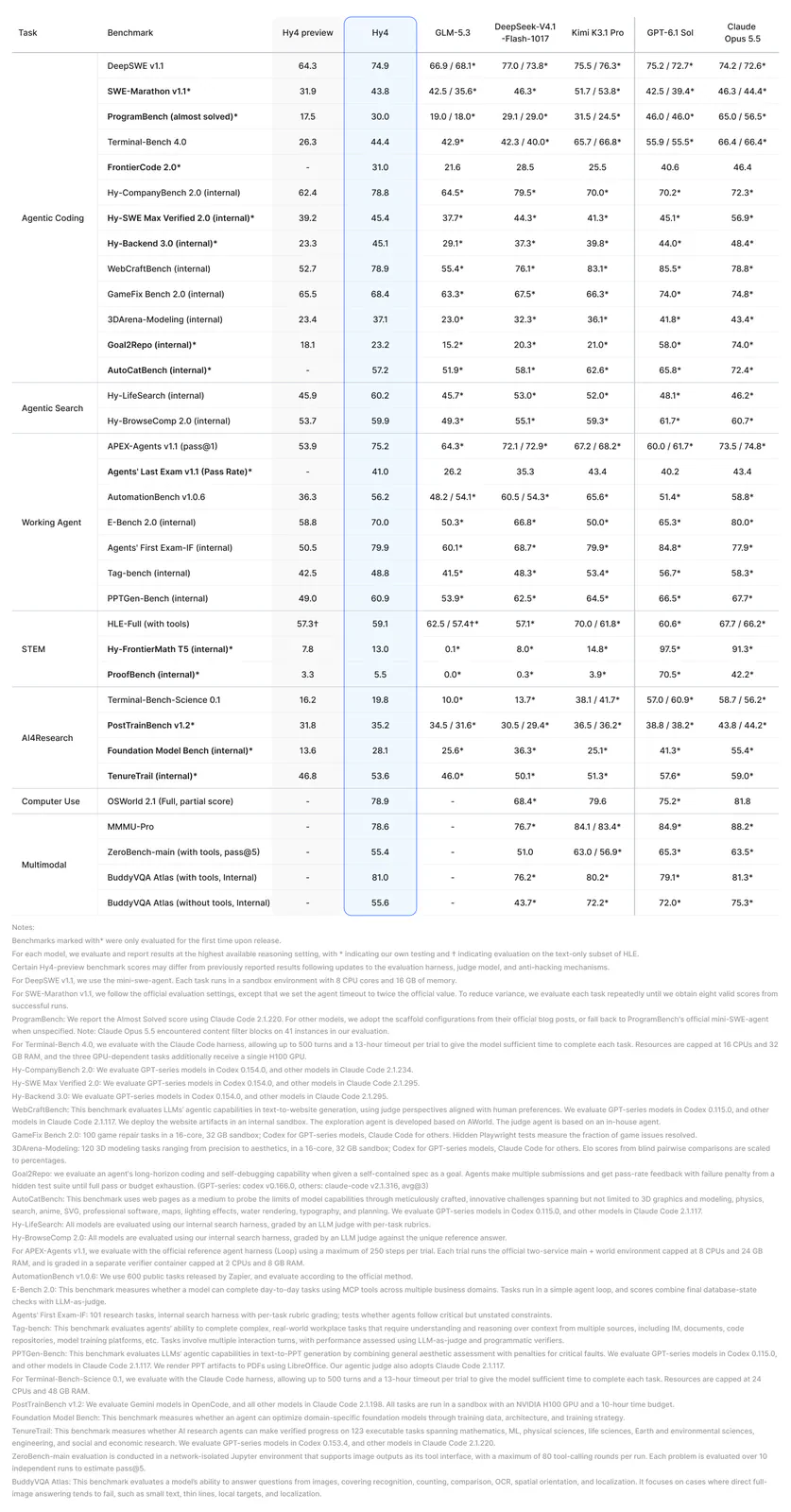
Tencent’s performance and hallucination figures are internal evaluations. The published evidence here includes no independent reproduction, so those results should remain vendor claims when comparing Hy4 with other AI models.
FP8 Helps, but It Does Not Make Hy4 a Desktop Model
FP8 represents floating-point values using eight bits. Lower precision can reduce the space needed for model weights compared with higher-precision representations, although the actual savings depend on how the checkpoint and runtime handle different components.
A simple calculation puts the scale in perspective:
774 billion parameters × one byte per parameter = approximately 774 GB, or 721 GiB, of raw parameter data.
That is an illustrative calculation based on the published parameter count, not a measured Hy4-FP8 download size or a complete GPU-memory requirement. Runtime memory also has to accommodate items such as activations, temporary buffers and cached attention state. Long contexts can add substantial pressure.
I would read “local deployment” here as self-hosting on substantial infrastructure, not a promise that the FP8 variant makes Hy4 practical on an ordinary consumer GPU. Quantization changes the resource calculation; it does not erase the scale of a 774-billion-parameter model.
A deployment plan therefore needs to account for the checkpoint, serving software, accelerator support, context length and expected concurrency. The FP8 label alone cannot answer how much usable capacity a particular system will provide.
Multimodal Understanding and Computer Use Need a Runtime
Tencent describes Hy4 as supporting text, image and video understanding, plus CLI and GUI computer-use workflows in its model card. Those capabilities broaden the release beyond a text-only LLM.
The downloadable model still needs a surrounding application. Image and video inputs require compatible processing, while computer-use workflows need software that passes observations to the model and executes permitted actions.
A model producing a command or tool call is one part of that loop. The deployment must also decide which commands may run, which files or applications are accessible, how credentials are protected and when a human must approve an action.
My view is that permissions deserve as much attention as model quality in a computer-use evaluation. A wrong answer in a chat window is one failure mode; an incorrect action taken with broad filesystem or account access has different consequences. Teams assessing Hy4 should begin with bounded tasks and narrowly scoped execution permissions.
The Commercial Thresholds in Tencent Hy License 1.0
The Hy4 model page identifies Tencent Hy License 1.0 as the governing license. That makes “downloadable weights” the useful description of access. An Apache 2.0 assumption would miss the commercial thresholds.
The opened Tencent Hy License 1.0 text sets out the relevant conditions:
| Use or scale | Commercial-threshold consequence |
|---|---|
| Covered MaaS business with more than US$50 million in revenue over 12 months | Requires a separate written license |
| Covered product with more than 100 million monthly active users | Requires a separate written license |
Frequently Asked Questions
3 questions
1Is Hy4 Available as Downloadable Weights?
Yes. Tencent’s November 20 release includes Hy4, Hy4-FP8 and pretrained base weights through Hugging Face, ModelScope and GitCode.


