

Amazon announced Amazon Polly voice cloning on November 19, 2026, making the text-to-speech feature generally available through a gated release. AWS says customers can create a custom voice from a few minutes of recordings supplied by a consenting speaker, then use that voice to generate speech through Polly’s generative engine.
Creating the voice is free. Synthesized speech is billed on a pay-as-you-go basis, and access is already enabled for selected customers. Everyone else must contact their AWS account team or apply, according to the AWS launch announcement.
The consequential detail is that a cloned voice is a controlled deployment asset, with language, account and regional boundaries. Those boundaries affect consent records, permissions, capacity planning and how a multilingual application should be built.
General Availability Still Requires Approval
AWS has launched Polly voice cloning as generally available, but that does not mean every AWS account can immediately use it. The company describes two routes for customers without access: contact an AWS account team or submit an application through the announcement.
AWS does not give an approval-time estimate. I would make access approval the first project dependency, before committing to a production launch date.
The AWS What’s New notice lists 11 supported Regions, matching the launch coverage of Polly’s generative engine:
| Geography | Supported AWS Regions |
|---|---|
| United States, commercial | US East (N. Virginia), US West (Oregon) |
| Europe | Europe (Frankfurt), Europe (Zurich), Europe (London) |
| Asia Pacific | Asia Pacific (Sydney), Asia Pacific (Seoul), Asia Pacific (Singapore), Asia Pacific (Tokyo) |
| Canada | Canada (Central) |
| AWS GovCloud | AWS GovCloud (US-West) |
The GovCloud detail is specific: the announcement names US-West, so developers should not read the broader mention of GovCloud as availability in every GovCloud Region.
For applications with residency requirements, regional availability is an initial check. It still leaves the usual work of verifying the application’s storage, permissions and compliance requirements.
Seven Languages Require Separate Voice Planning
Polly voice cloning launches with English, Spanish, German, French, Italian, Portuguese and Hindi. Each cloned voice speaks the language used in its source recordings. AWS explicitly advises creating and reviewing approved voices for each supported language in multilingual experiences.
An English recording therefore does not create a seven-language narrator. The feature generates new speech in the recorded language; the announcement does not promise cross-language voice transfer.
AIholics’ launch report adds that a voice belongs to the account and Region where it was created. Serving another Region requires creating another voice from the recordings, with consent covering that copy. The report also describes a starting quota of 10 cloned voices per account, per Region, which customers can request to increase.
Those reported limits have a concrete planning consequence:
- A brand deploying one voice for each of the seven launch languages would use seven voice slots in one Region.
- That leaves three slots under the reported default quota.
- Deploying the same seven-language set in two Regions would require 14 voice assets overall, with each Region using seven slots.
This is a capacity calculation from the published limits, not a measured deployment result. My view is that teams should track voices by speaker, language and Region from the start. A single “brand voice” entry would hide distinctions that matter for permissions, consent and rollout.
How Recording Becomes a Usable Voice
AWS describes the workflow as recording one speaker, creating the voice, waiting for it to finish building and then synthesizing speech.
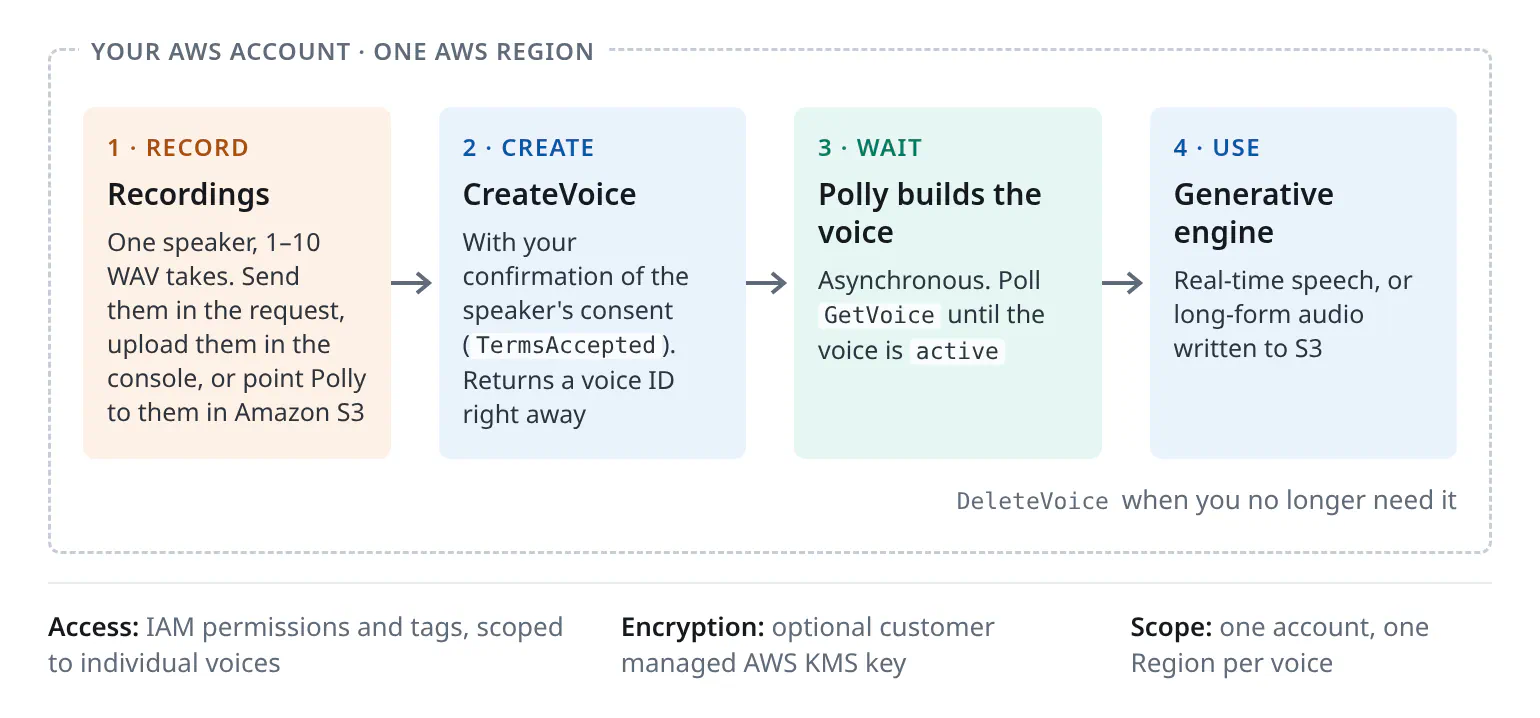
The official blog identifies three recording-input routes: send recordings directly in a CreateVoice request, upload them through the console, or store them in an Amazon S3 bucket in the Region where the voice will be created.
AIholics provides further implementation details in its account of the launch:
- Submit the creation request.
CreateVoiceaccepts one to 10 recordings, the recorded language andTermsAccepted=True, confirming the required consent. - Keep the returned identifier. Polly returns a voice ID beginning with
vc-while creation proceeds in the background. - Check readiness. Poll
GetVoiceuntil the voice reachesactiveorfailed. The report gives a typical creation time of five to 10 minutes. - Generate speech. Use
SynthesizeSpeechfor real-time output orStartSpeechSynthesisTaskfor longer output written to S3, selectingEngine="generative".
These API particulars come from the secondary report; developers should verify request schemas and current limits in their approved AWS environment before automating provisioning. The reported five-to-10-minute creation time is also separate from the unspecified wait for account approval.
The same report recommends mono WAV recordings at 24 kHz and warns that meeting applications or browser recorders can introduce processing artifacts. Clean source audio is an input to the resulting voice, not merely an upload requirement. Teams should prepare consistent recordings before starting a large batch of voice creations.
AWS says the resulting voices offer naturalness and accuracy similar to its other generative voices. That is a vendor quality claim, not an independent comparison.
Consent and Encryption Address Different Risks
AWS requires the speaker’s agreement to cloning and says customers confirm consent each time they create a voice. It also says cloned voices are automatically encrypted and access-controlled so that only the customer can access them.
The What’s New announcement makes two additional data-handling commitments: Polly does not retain a copy of the source recordings after voice creation, and it does not use those recordings to train Polly models.
Those commitments address different stages of the process:
| Control or commitment | Practical significance |
|---|---|
Frequently Asked Questions
3 questions
1Can every AWS customer use Polly voice cloning?
No. Access is gated. Selected customers already have it; others must contact their AWS account team or apply.


