

Nvidia is in advanced talks to acquire AI startup Inception for at least $500 million, with possible additional earnouts, according to The Information’s November 19, 2026 report. The report cites three people with knowledge of the discussions and says Inception’s team and technology would support Nvidia’s Nemotron models and physical-AI work.
Neither company has confirmed the talks or announced an agreement. The reported price and proposed integration remain provisional, and the discussions could end without a transaction.
The technical attraction is worth examining separately: Inception develops Mercury, a family of diffusion language models designed to generate text through parallel refinement. Its published claims suggest a potential route to faster inference. They do not yet provide evidence of what an Nvidia-integrated version would deliver.
What the Acquisition Report Says
The Information’s report describes a proposed purchase of at least $500 million, plus potential earnouts. The Decoder’s attributed summary says the transaction would include performance bonuses for the startup’s more than 30 employees and that its three co-founders are expected to join Nvidia full time.
The reported targets for the technology are Nvidia’s Nemotron lineup and physical models for robots. No confirmed closing date, employment terms or product roadmap has been published in the supplied reporting.
The Decoder’s account traces back to The Information. It is useful context, but it is not a second, independent confirmation of the negotiations. Its account also says neither company initially commented.
I’d read this as a potential expansion of Nvidia’s existing model strategy, not a completed acquisition. The meaningful signal is the reported interest in a particular model architecture and research team. Whether that interest produces a transaction, a Mercury product inside Nvidia or a future Nemotron architecture remains unresolved.
What Inception’s Diffusion Models Do Differently
Conventional autoregressive language models generate output sequentially: each new token depends on the preceding text. Tokens are the units a model processes, often words or pieces of words.
Inception’s approach uses diffusion to refine text through successive steps, allowing multiple token positions to be worked on in parallel. The company describes Mercury as a way to increase inference speed and GPU efficiency through that parallel generation process.
Parallel generation does not mean the entire answer appears instantly. Refinement still takes computation, and a deployed service still has to process prompts and deliver usable output. The practical question is how much useful text the system can produce, at the required quality, within a given time and computing budget.
That distinction matters because inference happens every time an application asks a model to respond. Faster generation can shorten repeated agent steps, make conversational pauses less awkward or increase the number of requests a deployment can handle.
Inception’s research background is also part of the reported attraction. A March 25, 2026 profile from investor Menlo Ventures identifies the founders as Stefano Ermon, Aditya Grover and Volodymyr Kuleshov and describes their long-running academic collaboration. Menlo is an investor, so its enthusiastic assessment should be read with that interest in mind.
For Nvidia, acquiring the people behind the architecture could matter as much as acquiring a current model release. That is a strategic inference from the reported team acquisition, not a disclosed Nvidia plan.
Mercury 3’s Numbers Need Their Conditions
Inception introduced Mercury 3 in an October 19, 2026 product announcement. The company claims it outperforms GPT-6 Luna and Claude Haiku 5.5 across a range of benchmarks while running four to eight times faster.
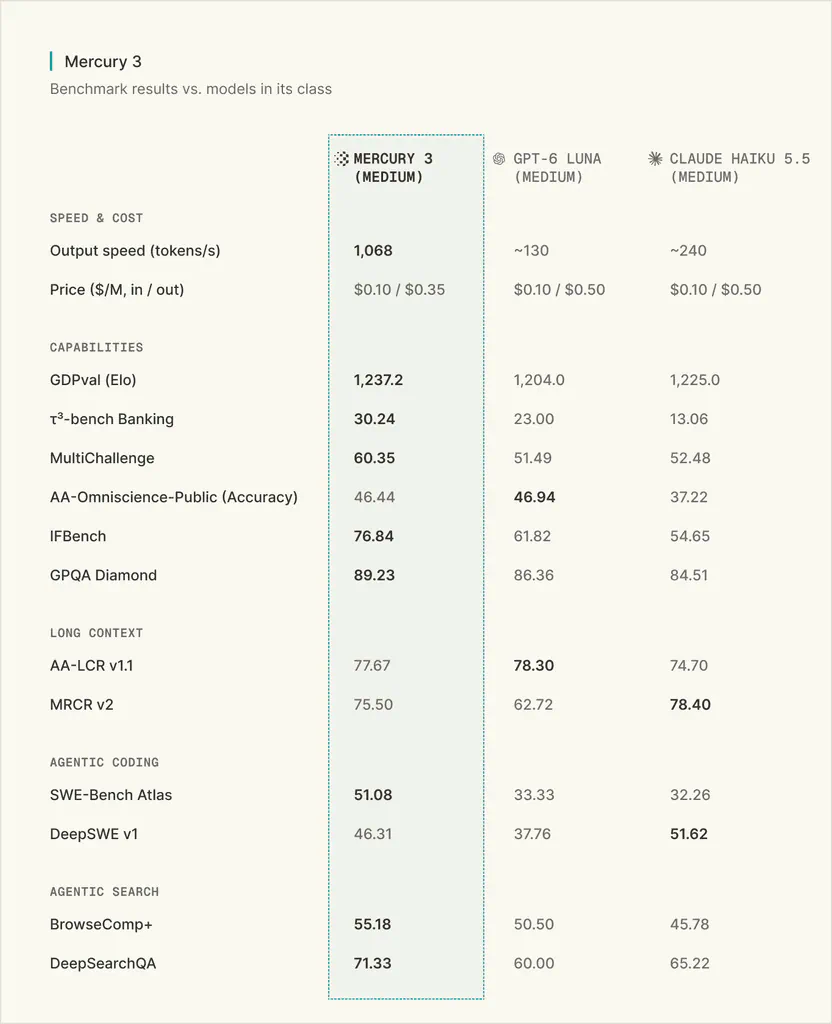
Its published specifications include:
| Metric | Inception’s published figure | Practical meaning |
|---|---|---|
| Generation speed | 1,068 tokens per second on Nvidia GPUs | A generation-rate claim, not a complete application response time |
| Context window | 1 million tokens, up from 260,000 for Mercury 2.5 | More room for supplied documents, conversation and other context |
| Standard API pricing | $0.20 per million input tokens; $0.70 per million output tokens | Separate charges for text sent to and generated by the model |
| Launch API pricing | $0.10 per million input tokens; $0.35 per million output tokens | A 50% promotional discount, not the standard rate |
These are vendor-published specifications and performance claims, not independent measurements. The announcement text does not give enough hardware, batching and serving detail to translate the headline speed into a reliable forecast for another deployment. The available sources also provide no like-for-like Nemotron measurements, so a direct Mercury-versus-Nemotron performance comparison would be premature.
The speed figure still illustrates the proposed value. At a sustained 1,068 tokens per second, generating 1,000 output tokens would take roughly 0.94 seconds. That is arithmetic using Inception’s claimed rate, not a measured end-to-end response time.
A real request also includes prompt processing, network delay and any external tool calls. An agent waiting on a slow website may gain little from faster text generation during that step. An application generating substantial text between many short tool calls could benefit more.
My view is that this workload distinction is more useful than the headline speed multiple. Buyers need to identify where their application actually waits before deciding whether a faster generation engine changes the experience.
Why This Could Matter for Nemotron and Robotics
The reported Nemotron connection gives the acquisition a more specific rationale than a general push into AI. Nvidia already has a model effort; Inception could add another architecture and a team experienced in making it commercially available.
Inception says Mercury 3 is available through its own API platform, OpenRouter, Baseten and Vercel. Its announcement also describes OpenAI API compatibility and enterprise options including dedicated capacity, autoscaling and configurable data retention. Those claims show that Mercury is being offered as a deployable service, beyond a research demonstration.
Frequently Asked Questions
3 questions
1Has Nvidia Bought Inception?
No acquisition has been confirmed. The Information reported advanced talks, and neither company has announced an agreement in the supplied reporting.


