
Microsoft says Maia 200 is already serving production Microsoft Copilot workloads. Its planned successor, Maia 300, is part of a larger ambition: making Microsoft’s own accelerator family the primary inference system for its products and services.
In its October 12 announcement, Microsoft said it would scale Azure Maia to multi-gigawatt deployments starting in 2027. Maia 300 production deployments are also scheduled to begin that year.
Those are related commitments, but they aren't interchangeable. Copilot workloads running on Maia 200 are a production milestone. Maia 300’s deployment schedule, efficiency expectations and role in the expansion remain forward-looking.
For the AI industry, the consequential development is Microsoft's proposed shift in where inference happens. Rather than positioning custom silicon as an additional option, Microsoft intends to make Maia the main system behind its own AI services. Whether that changes customer costs, coding-agent performance or dependence on outside GPUs will depend on execution beyond the chip itself.
Maia 200 Is Running Workloads, Not the Entire Copilot Portfolio
Microsoft’s announcement separates the current deployment from the next two stages:
- Already in production: Maia 200 serves Microsoft Copilot workloads and supports the MAI team developing Microsoft’s next-generation models.
- Expected by the end of 2026: GitHub Copilot and Microsoft Foundry are scheduled to follow on Maia 200.
- Beginning in 2027: Maia 300 production deployments and the Maia family’s multi-gigawatt expansion are planned to start.
Microsoft also says Maia 200 is deploying across the United States, Europe and Australia. It does not disclose what share of Copilot traffic Maia handles, how much capacity is already installed or when each product will complete its transition.
That distinction prevents a misleading reading of the announcement. Serving production Copilot workloads does not establish that every Copilot request runs on Maia, and a scheduled rollout to GitHub Copilot does not mean the coding service has already moved.
The chronology also shows how the program has progressed. Microsoft’s January 26 Maia 200 introduction described an initial deployment in the US Central region near Des Moines, with US West 3 near Phoenix next. It identified Microsoft Foundry and Microsoft 365 Copilot as intended beneficiaries.
The October update provides a more concrete workload status. It is evidence of adoption beyond an initial hardware deployment, while leaving the breadth of that adoption unspecified.
The “primary inference system” commitment applies to the Maia family. It should not be read as a promise that Maia 300 alone will replace every other accelerator when deployments begin in 2027.
Copilot, Foundry and MAI Have Different Reasons to Use Maia
The services named in the announcement place different demands on the infrastructure.
For Microsoft Copilot, production serving gives Microsoft a direct connection between application behavior and hardware design. The company says experience operating Maia 200 informed Maia 300. That creates an opportunity to optimize around actual service workloads rather than a narrow demonstration model.
Users would benefit if those optimizations translate into more available capacity, shorter waits or lower operating costs. The announcement does not establish a specific improvement in Copilot response times, subscription pricing or answer quality.
GitHub Copilot introduces a different workload emphasis. Microsoft links Maia to multi-step agentic coding experiences, where an assistant may repeatedly inspect code, generate changes and continue working through a task. A fast individual response is useful, but sustained performance across the workflow matters too.
Moving those workloads onto Maia could give Microsoft greater control over the cost of serving them. However, the end-of-2026 schedule is still a deployment plan, not evidence that users are already receiving those benefits.
Microsoft Foundry raises the question of model breadth. Microsoft says Maia 200 runs OpenAI models, its own MAI models and leading open-source model families across the listed workloads. The accelerator is therefore not positioned solely as hardware for Microsoft-developed models.
Foundry’s planned adoption could make Maia relevant to customers consuming hosted models without requiring them to manage the underlying accelerator. The announcement does not specify whether customers will be able to select Maia directly, which models will use it or whether hardware-specific pricing will be offered.
For MAI, the distinction between inference and training is especially important. Microsoft’s January announcement identified synthetic data generation and reinforcement learning as uses for Maia 200. Generating model outputs can support model development without making Maia the replacement for every training workload.
That gives Microsoft a second source of demand alongside customer-facing applications. Its model team can use inference capacity to produce data and support development, while product teams use it to answer user requests.
Maia 300 Targets the Memory and Networking Side of Inference
Microsoft describes Maia 300 as an inference-first system for long-context reasoning, latency-sensitive conversations and sustained agentic tasks.
These workloads make peak arithmetic performance an incomplete measure. During autoregressive generation, a model produces tokens sequentially. Serving that process involves accessing model weights and maintaining cached information from earlier tokens, not simply performing a large block of computation once.
Longer contexts increase the information the system must retain and access. Multi-step agents can extend that demand across repeated model calls. Microsoft’s architectural emphasis is therefore on balancing computation with memory bandwidth, data movement and communication between accelerators.
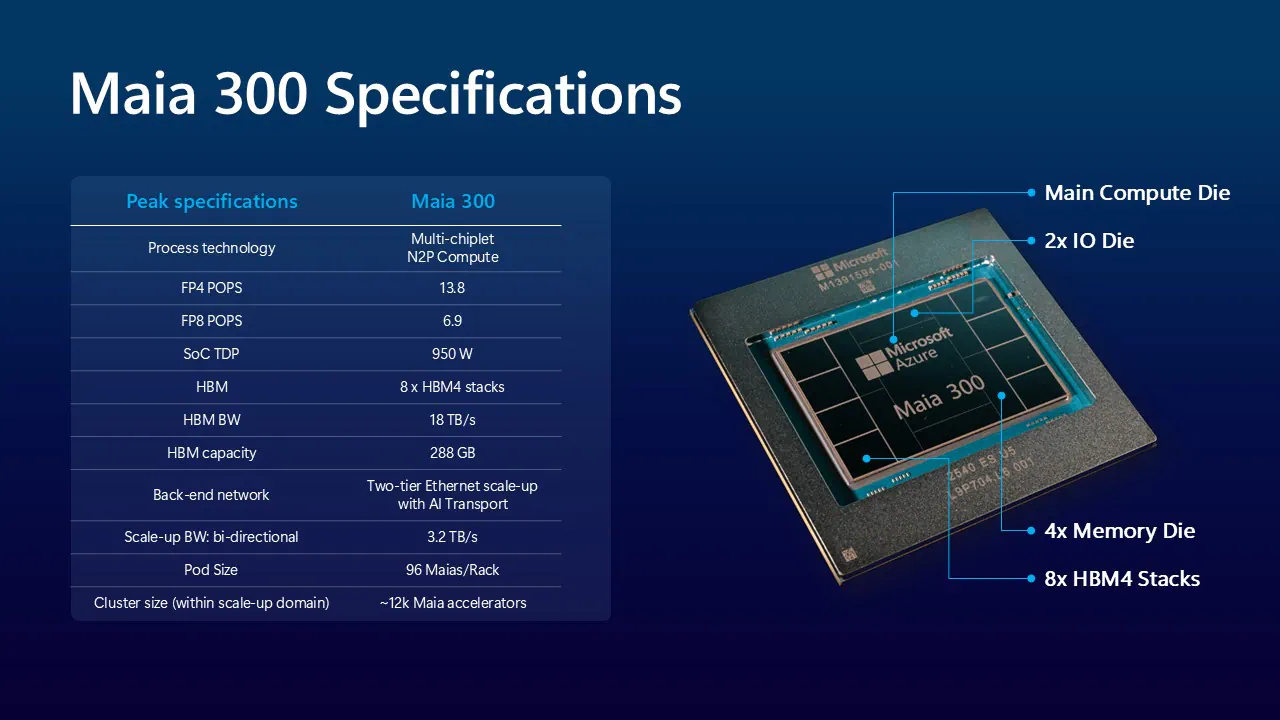
In its Maia 300 system description, Microsoft specifies eight HBM4 memory stacks providing 18 TB/s of peak bandwidth, alongside software-managed on-chip memory intended to reduce pressure on HBM. It also describes Ethernet-based scale-up networking that connects accelerators and racks.
The operational question is whether those components keep useful work moving when a service handles many simultaneous requests. Memory bandwidth that looks strong in isolation is less valuable if scheduling, networking or software prevents the system from using it effectively.
Software remains part of that challenge. Microsoft’s January Maia SDK preview included PyTorch support, a Triton compiler and optimized kernels. Those tools matter because supporting a model architecture on paper is different from serving it efficiently under production traffic.
The new system also carries significant facility requirements. Microsoft specifies 96 accelerators within a 167-kilowatt rack power envelope. Denser racks can concentrate serving capacity, but deploying them still requires suitable power delivery, cooling and networking. Multi-gigawatt ambition is therefore a datacenter execution plan as much as a silicon roadmap.
The Efficiency Claims Don't Yet Answer the Service Questions
Microsoft expects Maia 300 to deliver 40% more tokens per megawatt than “leading GPU-based systems.” It also claims up to seven times Maia 200’s rack-scale token throughput in a full 96-accelerator configuration.
Sources
- October 12 announcementblogs.microsoft.com
- January 26 Maia 200 introductionblogs.microsoft.com