Huxe’s founders previously worked on NotebookLM’s AI-generated podcast features. Now Apple has agreed to offer jobs to certain Huxe AI employees and obtain a non-exclusive license to the startup’s intellectual property, according to TechCrunch’s disclosure report.
The arrangement gives Apple a route to the talent and technology behind personalized, interactive audio without acquiring the company. The reported terms do not establish that Apple bought Huxe, hired its entire team, or secured exclusive control of its technology. Apple’s intended use of the licensed intellectual property is also undisclosed.
After their work on NotebookLM, Huxe’s founders pursued their own version of personalized audio, including briefings and conversations that listeners could interrupt to request another explanation or more detail. Apple’s agreement is a concrete competitive move in AI-generated audio, though the available evidence does not amount to an announcement of an Apple Podcasts feature.
Employment Offers and a License, Not a Company Purchase
TechCrunch describes the arrangement as a reverse acqui-hire: a larger company seeks employees and licenses technology from a startup without purchasing the startup outright.
The reported filing says Apple agreed to make employment offers to “certain employees of Huxe AI” and to “receive a non-exclusive license to Huxe’s intellectual property rights.” Those phrases define the agreement and limit what can be concluded from it.
“Certain employees” means selected staff, not necessarily the whole team. The filing, as reported, does not identify the people who received offers or say whether they accepted. Describing Apple as having hired Huxe’s founders or absorbed its entire engineering team would go beyond the disclosure.
A non-exclusive license does not grant Apple sole rights to the licensed intellectual property, and a license alone does not establish that Apple owns that IP. The public description specifies neither the licensed technology nor the financial terms or permitted uses, leaving no basis for a detailed account of what Apple obtained at the implementation level.
Apple reached an agreement combining targeted recruitment with access to Huxe’s technology. Whether particular employees joined Apple, and what they might work on there, remain unanswered questions.
Huxe’s Shutdown Came Before the June Notification
TechCrunch published its story on October 10, 2026, but reports that Apple notified the European Commission on June 9. Neither date establishes when the private deal was struck. The October story should not be read as evidence of an October agreement.
Huxe had already announced that it was winding down. Its May 21 shutdown notice set out three milestones:
- May 21, 2026: Removal of Huxe from the App Store and Play Store.
- May 28, 2026: The scheduled end of service, with features and audio playback stopping at 10 a.m. Pacific Time.
- May 29, 2026: The scheduled permanent deletion of user data.
These were the company’s announced shutdown plans, not independent verification that every step was completed.
Huxe’s consumer product was ending, while Apple’s agreement concerned employment offers and an IP license. Access to the underlying work does not amount to a promise to keep the Huxe app operating. The disclosed deal offers former users no evidence that their service will return.
The sequence also leaves the reason for Huxe’s closure unresolved. Apple’s regulatory notification followed the startup’s wind-down announcement, but timing alone cannot show that the agreement caused the shutdown. The relevant development for AI industry observers is the potential transfer of expertise and licensed technology after the standalone product’s announced end.
Huxe Pitched Audio That Listeners Could Interrupt
Huxe marketed personalized audio briefings and interactive podcasts. Its website described a listener interrupting the audio to request a different explanation, ask for more technical detail, or redirect the discussion to another subject. It also promoted audio explanations generated around a user’s curiosity, beyond a publisher’s predetermined episode.
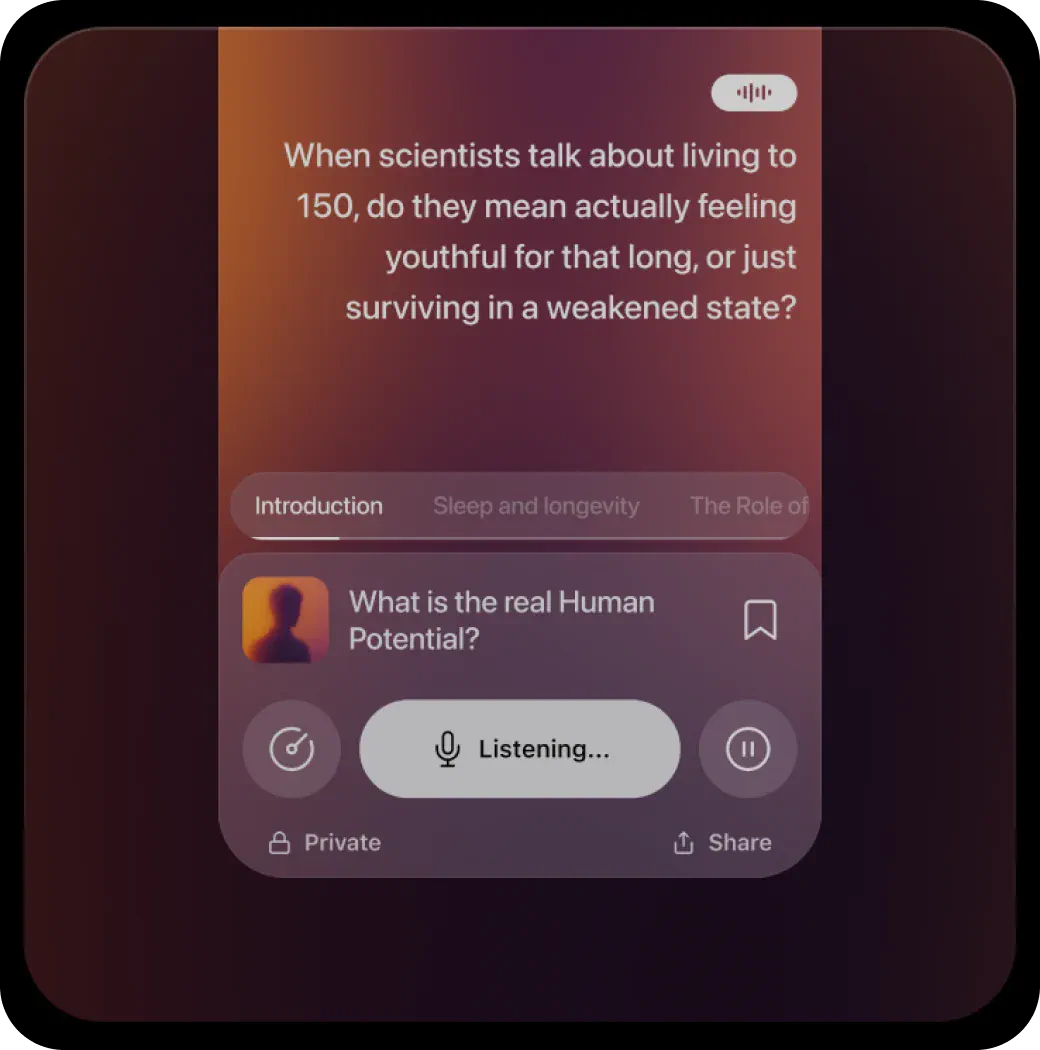
These are vendor descriptions, not independently verified performance findings. The available evidence does not establish how reliably Huxe handled interruptions, how accurate its explanations were, or how quickly it responded.
The intended interaction is clear, however. A conventional recorded episode follows a fixed sequence; Huxe pitched an experience in which the listener could influence the explanation while listening. AI-generated speech was one part of that pitch. The audio experience was also meant to respond to requests for clarification or a change of direction.
An accompanying interface updated as the listener heard relevant information, according to Huxe’s description. The product’s ambition thus extended beyond producing an audio file to combining generated explanations, listener interaction, and supporting on-screen context.
The founders’ NotebookLM background, reported by TechCrunch, connects Huxe to prior AI-generated podcast development. It does not establish that Huxe used the same architecture as NotebookLM, that Apple licensed every component of Huxe’s product, or that those founders accepted Apple’s offers. Their background identifies relevant experience, without revealing an Apple product roadmap.
The Deal Fits a Broader Talent-and-License Pattern
TechCrunch places the agreement within the growing use of reverse acqui-hires, in which larger companies obtain access to startup employees and technology without acquiring the businesses themselves.
A license provides rights to use specified intellectual property. Recruitment can bring in people who understand how the technology was developed, what worked, and where it fell short. Apple’s disclosed arrangement combines those routes, although the extent of any resulting staff movement is unknown.
The absence of a full acquisition does not make the agreement inconsequential: a company can pursue a technical capability without purchasing the corporate entity that developed it. At the same time, employment offers and a license do not confer ownership of everything the startup built.
TechCrunch suggests that these structures may allow large companies to build up AI talent and technology while attracting less antitrust scrutiny than an outright acquisition. That explanation of the broader pattern is not proof of Apple’s motive.
Nor does Apple’s notification to the European Commission establish, on the evidence supplied, a regulatory approval, an exemption from scrutiny, or a finding about competition. The transaction’s structure is known; its legal outcome should not be assumed.
Talent-and-license agreements broaden the ways an established company can gain access to specialized AI work. Each agreement still needs to be read on its own terms. Here, the non-exclusive license and unspecified employment offers leave significant limits on claims about Apple’s control.
Apple’s Product Plans Remain Undisclosed
The agreement strengthens the case that Apple is seeking access to personalized-audio expertise. Where that expertise will appear, whether it will produce a consumer feature, and when any resulting work might become available are all unknown.
Apple Podcasts is an obvious hypothesis because Huxe described parts of its product as interactive podcasts. TechCrunch reports that the filing does not disclose Apple’s plans, however, and the available evidence contains no Apple announcement tying the deal to that app.
There is also no basis here for predicting that generated, personalized audio will replace conventional podcasts. Huxe’s product pitch demonstrates what it wanted to offer, without establishing widespread listener demand or a proven business model.
Confirmation of which employees joined Apple, a clearer description of the licensed technology, or an announced product that uses it would provide the next consequential evidence. Until then, the competitive significance rests in access to expertise and technology, with deployment still undisclosed.
The agreement is concrete enough to warrant attention, but its limits belong in the story: targeted employment offers and a non-exclusive license to work from a personalized-audio startup, with no outright acquisition or announced product launch.
Sources
- TechCrunch’s disclosure reporttechcrunch.com
- May 21 shutdown noticehuxe.com
- Huxe | Content that exists because you dohuxe.com