A developer says Anthropic’s model made eliminating an engineering role seem affordable, while arguing that frontier AI still lacks experienced judgment.
Listen
AI narration
10:19
0:00 / 10:19
AI SummaryGenerated from this article
A developer identified as Cendyne claims Anthropic's Claude Fable contributed to their elimination from an engineering role, arguing the model was cheaper than their compensation rather than superior at the work. The claim remains unconfirmed with no independent verification of the company's identity or decision-making process. Cendyne distinguishes between AI executing code and choosing what work matters, arguing frontier models lack experienced judgment for product decisions and long-term foresight. The account sparked substantial Hacker News discussion about whether management confidence in cheaper alternatives can eliminate roles before technical replacement is complete, highlighting a gap between capability and managerial confidence.
A developer writing as Cendyne says Anthropic’s Claude Fable was cheaper than their compensation and gave leadership enough confidence to eliminate the company’s last engineering role. In the author’s account, the model did not need to outperform an experienced engineer to threaten their job.
The employment claim remains unconfirmed. The former employer is not identified, and the available sources do not independently establish why the role disappeared or how the business operated afterward.
The account prompted substantial discussion on Hacker News because it describes a distinction often lost in arguments about AI replacing developers: a company can decide that a model is sufficient for its immediate purposes without demonstrating that it can perform an engineer’s full job. Cendyne says AI contributed to the decision, not that Claude independently assumed every responsibility the author previously held.
The Account Describes a Business Decision, Not a Technical Victory
In the October 11, 2026 post, titled “Fable took my jorb,” Cendyne describes being the last engineer at a former employer following earlier layoffs.
The author’s explanation is economic:
“It wasn't that Fable was better at my job. As the last engineer, Fable was cheaper than my compensation.”
Cendyne says the model apparently gave the remaining leadership confidence that the business could continue until a merger or acquisition. That assessment comes from the author; the available material contains no independently documented management explanation.
This was not presented as a growing engineering organization conducting a controlled comparison between developers and AI agents. Cendyne describes a business that had already reduced staffing, prioritized maintaining its existing operations, and eliminated people the author had trusted to build replacement infrastructure.
The post includes a qualification: without models reaching what Cendyne calls Fable or Mythos-tier marketed intelligence, the author believes they would probably have kept the job, but only for a short while. Financial pressure and an already shrinking organization may therefore explain much of the decision. AI may have changed the timing or made the final cut easier to justify; it is not established as the sole cause.
Cendyne puts it directly:
“AI took my job” is far more fun to say than “AI contributed to my role being eliminated.”
Work with Zeniteq
Let’s work together
We’re open to thoughtful collaborations with teams building in AI. Explore the ways we can work together.
Treating the headline as proof of complete technical replacement would contradict the author’s more careful explanation.
Engineering Taste Is the Capability Cendyne Says Is Missing
Cendyne argues that frontier models still cannot replace an experienced engineer, despite their usefulness for some coding work. The claimed deficiencies concern product judgment and consequences beyond the immediate implementation.
The post uses “taste” to describe knowing which changes a product should accept, which it should reject, and which existing customer needs deserve attention first. Generating an implementation does not resolve those choices.
For example, Cendyne contrasts responding to a complaint by immediately building a feature with recognizing that the feature would create a long-term commitment that does not fit the product. The question is whether to choose that work in the first place.
Foresight is another concern: understanding how decisions affect operating costs, complexity, accessibility, and customer affordability over weeks, months, or years. Those judgments can determine whether a technically functional product remains practical to operate and worth buying.
These are Cendyne’s assessments, not independently established limitations of every frontier model. The post provides no controlled evaluation showing where Fable succeeds or fails across those responsibilities.
Cendyne also sees value in coding agents for carefully directed, measurable work that can proceed through checkpoints, particularly reproducing or porting known behavior. Executing a defined objective and deciding whether that objective is sound are different responsibilities. The author can see the technology as an incomplete substitute for expert work while believing its apparent capability affected a staffing decision.
If leadership’s objective was simply to reach a transaction, as Cendyne suggests, the relevant threshold may have been narrower than sustaining a well-maintained product indefinitely. That is a possible interpretation of the account, not evidence that management explicitly adopted such a calculation.
Anthropic’s Product Claims Do Not Verify the Layoff
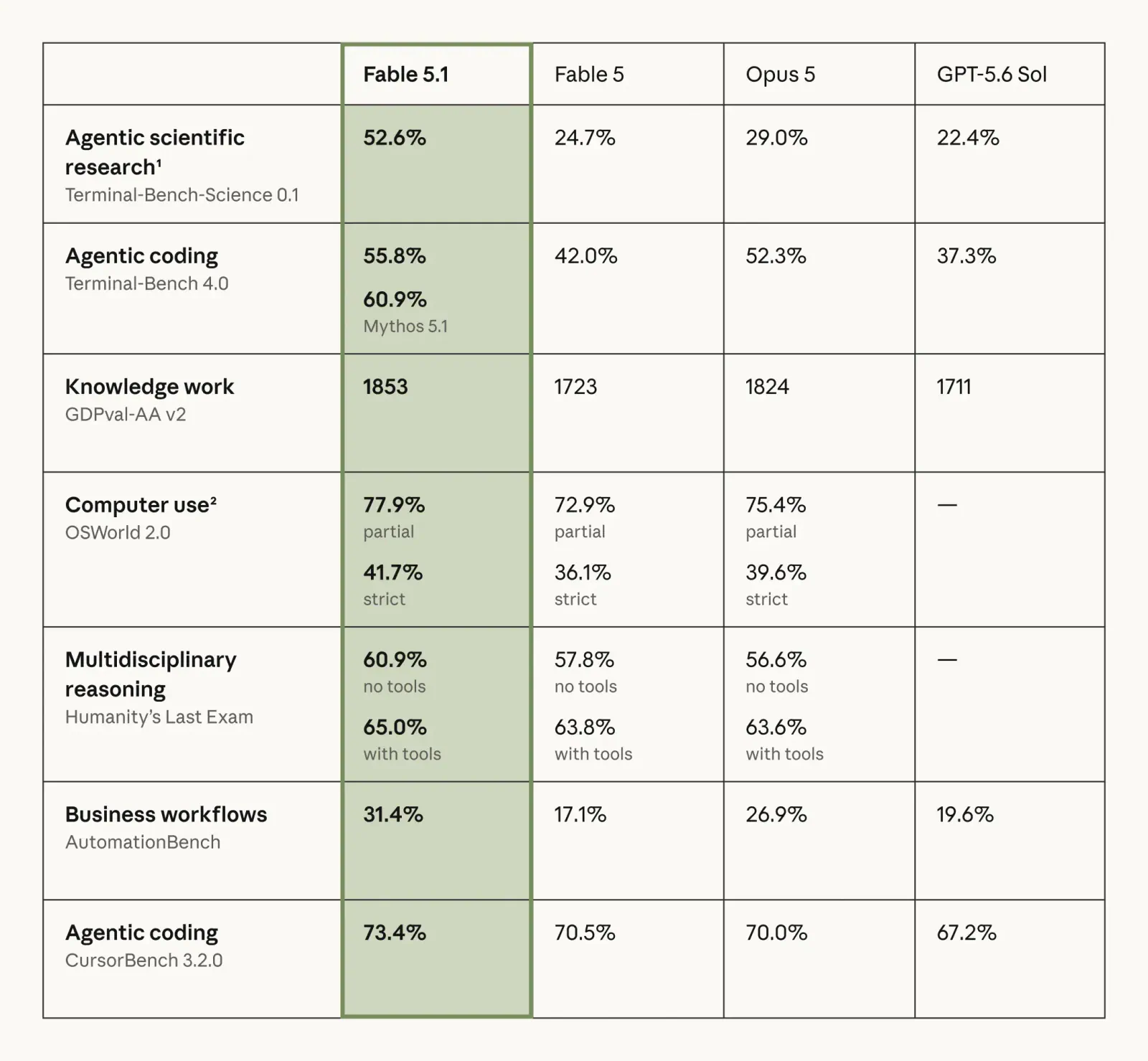
Anthropic’s Claude Fable product page describes Claude Fable 5.1 as its most capable generally available model and positions it for ambitious, long-running coding and knowledge work.
The company says the model can handle agentic jobs lasting hours and spanning multiple applications. Its coding description includes codebase-wide features, code review, performance work, and multi-day autonomous sessions. Anthropic also says Fable can write tests to check its work and use vision to compare outputs with a design or goal.
Anthropic is marketing sustained execution with less continuous supervision, beyond the role of a conversational coding assistant. These remain vendor claims and do not establish what happened at Cendyne’s former employer.
Cendyne refers to Fable and Mythos-tier models, but the available account does not establish the precise model version, configuration, or workflow involved. Fable 5.1’s advertised capabilities cannot simply be assigned to that unidentified deployment.
Anthropic lists standard API pricing of $10 per million input tokens and $50 per million output tokens for Fable 5.1. Those usage-based rates alone cannot meaningfully estimate the cost of replacing an engineering position. A comparison would require information about workload volume, supervision, verification, maintenance, and failures.
The account provides no like-for-like cost analysis. Cendyne’s statement that Fable was cheaper than their compensation remains an attributed assessment, not a demonstrated total-cost finding.
No response from the former employer or Anthropic to this specific account appears in the available sources. That absence is not confirmation, and there is no basis here to imply that either party was contacted for this article.
Hacker News Debated Whether Expertise Still Protects Jobs
A snapshot of the Hacker News discussion showed 182 points and 233 comments. Those figures establish substantial circulation within that forum, not independent verification of the employment circumstances or a representative survey of developers.
Commenters disagreed about whether continued technical value necessarily protects an engineering position.
Commenter gregwebs argued that engineers who can direct AI more effectively than non-engineers can still produce substantial value. In that view, the role increasingly centers on shipping software and providing technical leadership rather than writing every line of code.
Another commenter, rnd33, questioned how quickly companies would recognize that advantage. Poorly managed software could take a long time to produce visible commercial consequences, allowing staffing mistakes to persist before customers or business results reveal the damage.
A commenter using the name nip emphasized the less visible work separating a functioning prototype from software that large numbers of people can reliably use. That response challenged the idea that making initial implementation cheaper resolves product quality, usability, or ongoing operational work.
These individual forum arguments are not established forecasts, nor do they amount to a unified backlash against Anthropic. The thread contains differing assessments of AI’s usefulness, management decisions, and engineers’ future responsibilities.
The disagreement helps explain why Cendyne’s account attracted attention. Some commenters argue that expert oversight remains economically valuable; others ask whether employers will recognize that value before reducing staff. Both positions can accept that models have limitations while disagreeing about how much protection those limitations offer workers.
The Unanswered Question Is What Happened Afterward
The strongest missing evidence concerns the company’s operations after the role disappeared.
An employer account of the decision, documentation of the model workflow, and evidence about maintenance, incidents, customer outcomes, or outside engineering support would help distinguish genuine substitution from a business accepting reduced capability. None of that is established by the available sources.
The eventual outcome would also matter. A company operating temporarily with fewer resources presents a different case from one sustainably delivering the same quality of service without engineering expertise. Cendyne’s account does not resolve that distinction.
For now, a developer has publicly attributed part of an employment decision to Claude Fable, carefully qualified that claim, and prompted a substantial technical-community debate. The account is not evidence that Claude broadly replaces engineers.
Its warning concerns the threshold employers may apply. Demonstrating that an experienced engineer remains better at the work does not necessarily answer whether leadership believes it can tolerate a cheaper, less complete substitute. If Cendyne’s explanation is accurate, that gap between capability and managerial confidence is where the job disappeared.