I am not exaggerating when I said that Seedream 2.0 could dethrone Google’s Veo 3.1 and OpenAI’s Sora 2 as the leading video models in the market. I’ve had the opportunity to get early access to the model and was able to do sample tests with my custom prompts.
The results are mind-blowing. I’m not even sure how this is gonna go through copyright infringements because you can literally generate videos of real personalities and characters protected by IPs. In fact, the AI video of Brad Pitt and Tom Cruise brawling has already reached global headlines.
Here are the reasons why Seedance 2.0 is so popular right now:
- It allows you to combine up to 12 assets (9 images, 3 videos, 3 audio files) and text in one prompt to define exactly how your video looks, moves, and sounds.
- Generates video and audio simultaneously, providing perfectly timed sound effects, ambient noise, and accurate multi-language lip-syncing.
- Automatically breaks a single prompt into a sequence of cinematic shots (e.g., wide to close-up) while keeping characters and environments consistent.
- Accurately simulates real-world physics, such as gravity, momentum, and collisions, to prevent common AI glitches like “morphing” limbs.
It also supports “Video Extension” to lengthen clips and “Subject Replacement” to swap characters or objects in existing footage without changing the background.
How to try Seedance 2.0
Today, you can now use Seedance 2.0 on platforms like Pollo AI.
Head over to the AI Video generation dashboard and set the video model to Seedance 2.0. You can adjust several parameters like the aspect ratio, duration, and resolution.
Press enter or click to view image in full size
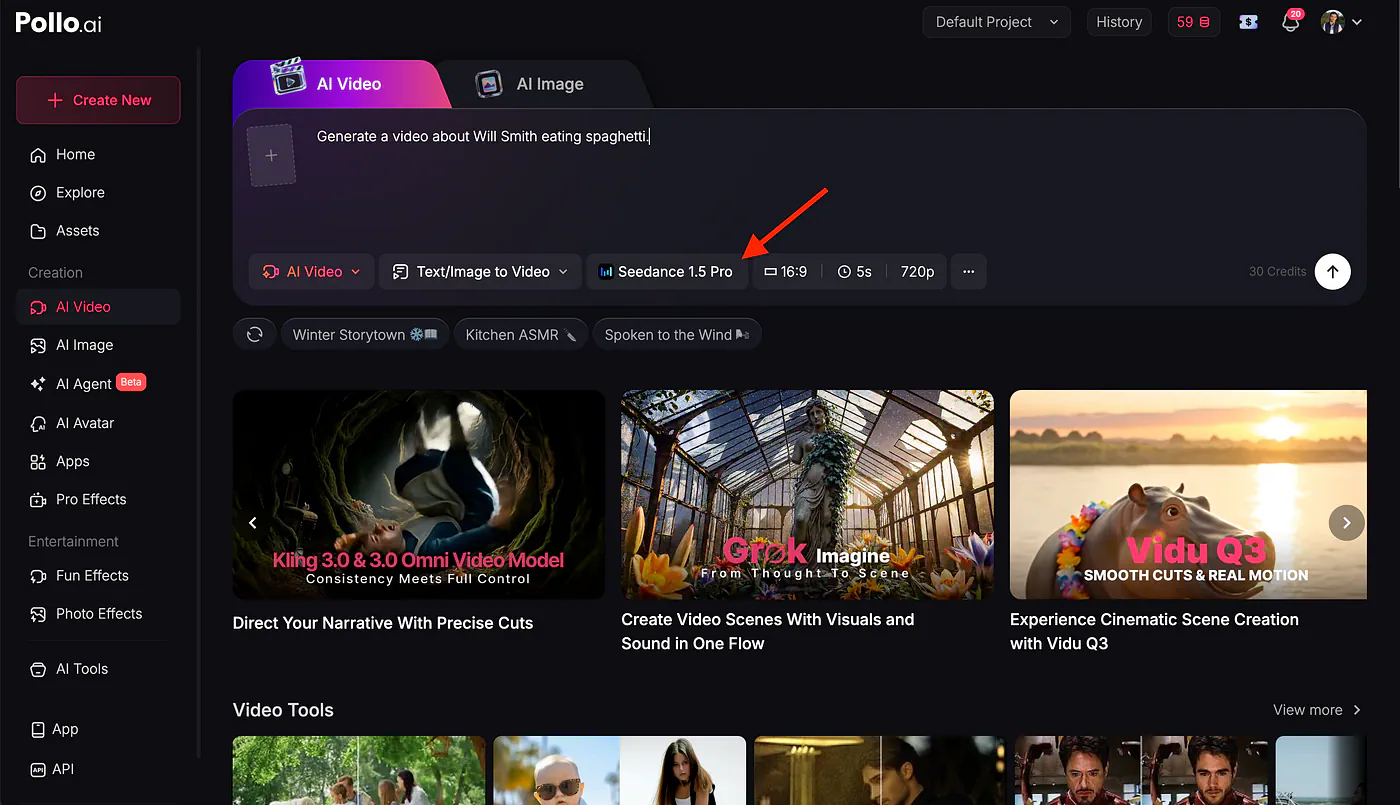
Now, let’s do an example. Here’s the famous Will Smith eating spaghetti prompt.
Prompt: Generate a video about Will Smith eating spaghetti.
Awesome! The consistency and physical accuracy feel like this technology shouldn’t exist.