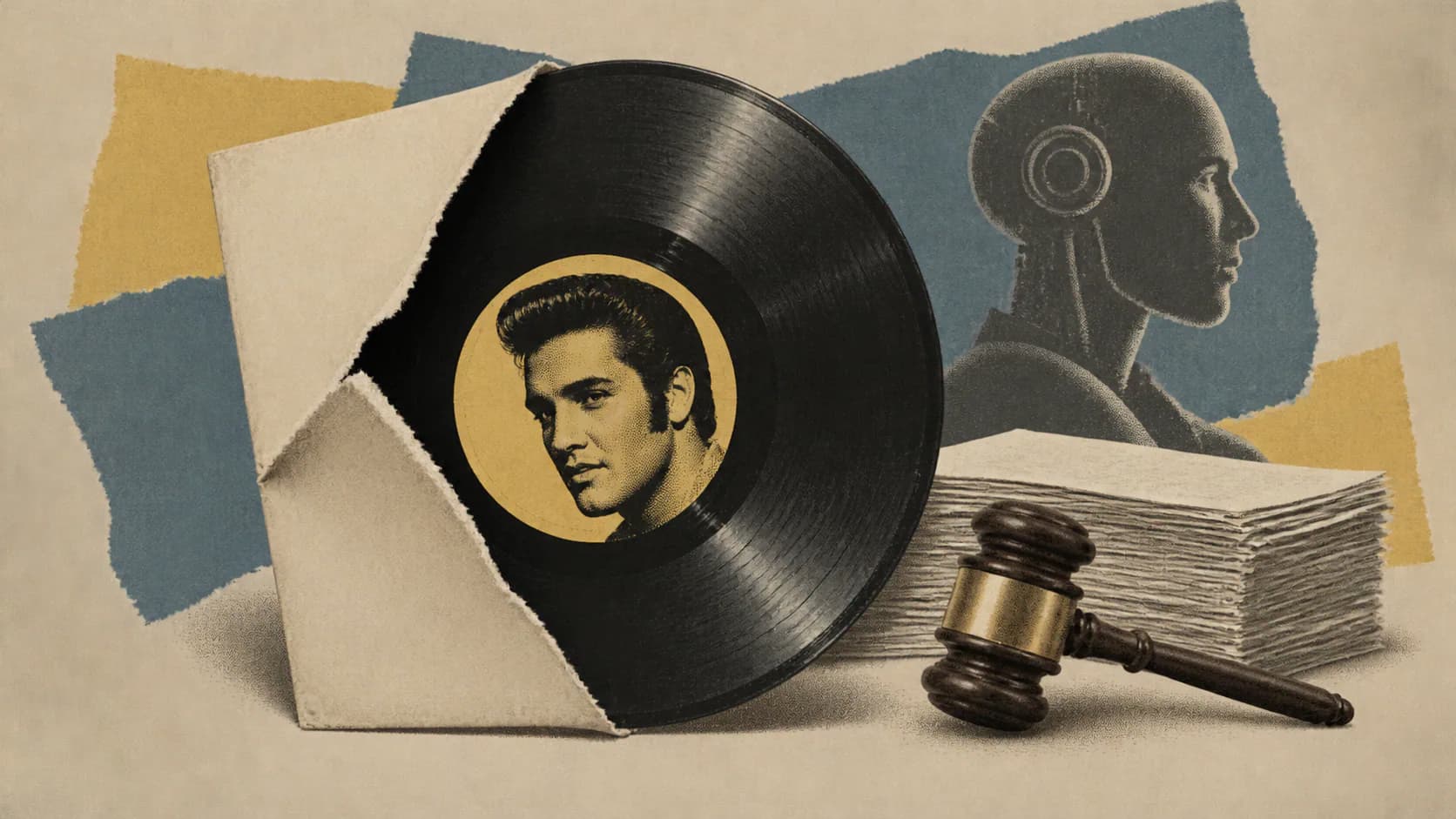
Elvis Presley rights holders have sued Anthropic, alleging that the company used 274 copyrighted songs without permission to train its AI models. The lawsuit was filed on October 23, 2026, according to Billboard’s original reporting, and covers songs including “Can’t Help Falling in Love,” “A Little Less Conversation” and “Don’t Be Cruel.”
The case also targets alleged Claude outputs. Reporting describes requests to recreate songs for a modern audience, followed by responses that the plaintiffs say retained protected elements of the originals. That puts two distinct questions into the same dispute: what Anthropic used during training, and what Claude subsequently generated.
The complaint itself was unavailable for direct review, so its contents are described here through attributed reporting. Those reports establish that rights holders have made allegations and requested damages. They do not establish infringement or independently verified Claude behavior.
Who Is Bringing the 274-Song Claim?
A unit of Authentic Brands Group, joined by other entities owning Elvis-related rights, brought the case, Billboard reports. Rolling Stone identifies it as ABE EPE LLC v. Anthropic.
Billboard describes Authentic Brands Group as controlling much of Presley’s intellectual property, including a substantial portion of his song catalog, trademarks, and rights to his name, image and likeness. The claimants therefore should not be reduced to a single unnamed estate or described simply as Presley’s family. The reporting identifies a corporate rights holder and additional rights-owning entities.
The 274-song figure is the scope alleged by the plaintiffs, not a verified inventory of Anthropic’s training data. It also counts works, not training examples, files, model versions or the number of times material may have appeared in a dataset.
That distinction matters. A catalog-level allegation can identify which works the plaintiffs say were infringed without revealing how those works allegedly entered a model-development pipeline. The available reporting does not supply a training-data manifest that readers can inspect.
The descriptions also focus on copyrighted songs and musical compositions. They should not be read as confirmation that Claude reproduced Presley’s recorded voice or generated copies of his audio recordings.
Training Data and Generated Outputs Raise Different Questions
The strongest way to understand this complaint is to keep its training allegations separate from its output allegations.
| Issue | What the plaintiffs reportedly allege | Evidence needed to assess it |
|---|---|---|
| Training use | Anthropic used 274 protected songs without permission while developing its models. | Records identifying the material used, its source, relevant permissions and the training process. |
| Claude outputs | Claude generated material that infringed the songs, including allegedly unauthorized derivative works. | Complete prompts and responses, model details, and comparisons with the protected works. |
These questions can overlap, but an output example alone cannot identify the contents of a training corpus. Likewise, an allegation that a song appeared in training does not tell readers exactly what a particular Claude version will produce in a particular conversation.
That is the consequential distinction for this case. Training provenance and output behavior require different evidence. Treating one as a shortcut to proving the other would leave important gaps in the analysis.
Billboard places the lawsuit alongside existing copyright cases against Anthropic, including litigation brought by music publishers. It also reports that AI companies invoke copyright’s fair-use defense in disputes over training. That broader industry position should not be presented as Anthropic’s specific response to this new complaint; the supplied reporting contains no merits response from the company.
My view is that the two-part structure makes this case worth following beyond its famous catalog. It potentially tests both the justification for using protected material during development and the treatment of allegedly similar material at the product’s output stage.
What the Reported Claude Examples Actually Show
Rolling Stone’s October 24 report quotes allegations that Claude recreated songs when asked to adapt them “for a modern audience.” According to that account, the plaintiffs say the behavior continued despite safeguards Anthropic had introduced following earlier litigation.
The report also reproduces a passage in which Claude allegedly characterized the results as having the “same structure, same hooks reused with light rewording.”
Those details give the output allegation more substance than a general assertion that AI can imitate songs. They point to specific features the plaintiffs consider problematic: structure, recurring hooks and extensive song sections surviving an apparent rewrite.
But the examples remain complaint-described evidence, not independently reproduced tests. The opened reporting does not provide the complete prompts, conversation history, exact model version, settings or full outputs needed to evaluate the behavior in context. Its reference to a recent Claude iteration is insufficient to identify a particular release.
Claude’s alleged assessment of its own response also needs careful handling. A generated statement can be part of the evidence presented by a claimant. It is not an independently verified account of training data, and it cannot decide the legal status of the text it describes.
For me, the useful question is how closely the actual output tracks protected material. The model’s confident wording may make the allegation sound striking, but the underlying comparison carries more analytical weight than its self-description.
The Damages Request Is About $41 Million, Not an Award
Rolling Stone reports that the lawsuit seeks $150,000 per infringed track, or roughly $41 million.
The arithmetic is straightforward:
274 works × $150,000 = $41.1 million.
That is the reported damages request. It is not an amount a court has awarded, a settlement figure or a finding that every listed work was infringed. Any eventual recovery would depend on the legal findings and damages determination.
The available excerpts do not support a detailed account of any requested injunction, deletion requirement or changes to Claude’s operation. Those remedies should not be inferred from the damages claim.
Anthropic’s response is similarly time-bound. Billboard reported that a company representative , following the Friday filing. That establishes the response status at that reporting point, not continuing silence or a refusal to defend the case. No subsequent Anthropic response or ruling appears in the supplied evidence.
Frequently Asked Questions
3 questions
1Who is suing Anthropic over the Elvis songs?
Billboard identifies an Authentic Brands Group unit and other Elvis-rights entities as the plaintiffs. Rolling Stone names the case ABE EPE LLC v. Anthropic.