This Dad Built an Open-Source Tool That Interrupts Every Time His Son Yells While Gaming
A dad used Claude to build S.T.F.U., a local Windows utility that interrupts midnight gaming yells without pretending software can replace parenting.
Last updated on
A developer had a familiar household problem: his son would play games quietly with headphones, then suddenly yell loudly enough to wake everyone. Repeated…
AI Summary
S.T.F.U. is a free, open-source Windows utility built with Claude that interrupts a child’s game after detecting agreed-upon shouting, while keeping audio processing local and participation transparent.
Introduced in an August 20, 2026 Reddit post, the Sound Trigger Focus Utility calibrates using ten seconds of silence, ten seconds of normal speech, and one yell. It converts 20-millisecond audio frames into loudness values, discards the samples, and uses no runtime AI, transcription, or network connection. A first trigger minimizes the game and displays a four-click moving-button overlay; later triggers return the user to the desktop for ten seconds. Version 1.1.0 added scheduled off-hours, alongside cooldowns, PIN-protected controls, event reports, CSV exports, and log-only testing.
The project’s central safeguard is consent: the developer’s son knew about, tested, and agreed to the tool. Its limits also matter—false triggers remain possible, administrators can terminate it, and software cannot replace family judgment or conversation.
A developer had a familiar household problem: his son would play games quietly with headphones, then suddenly yell loudly enough to wake everyone. Repeated reminders worked briefly, while taking away the headphones created a new argument. His characteristically developer-minded response was to build software.
The resulting app, introduced in an August 20, 2026 Reddit post, is called S.T.F.U., short for Sound Trigger Focus Utility. It monitors microphone loudness and interrupts the game when it detects shouting. The father built it with help from Claude and released the project as free, open-source software.
It’s funny, deliberately excessive, and more thoughtful than its name suggests. The important part isn’t that AI helped a parent automate discipline. It’s that the developer placed clear limits around the technology: the processing is local, the child knows it is running, and the consequence was agreed upon in advance.
S.T.F.U. Turns a Warning Into an Immediate Consequence
S.T.F.U. starts with a calibration process rather than assuming everyone speaks at the same volume. The user remains quiet for ten seconds, talks normally for another ten, and then yells once. The app uses those measurements to establish a personal threshold between ordinary speech and shouting.
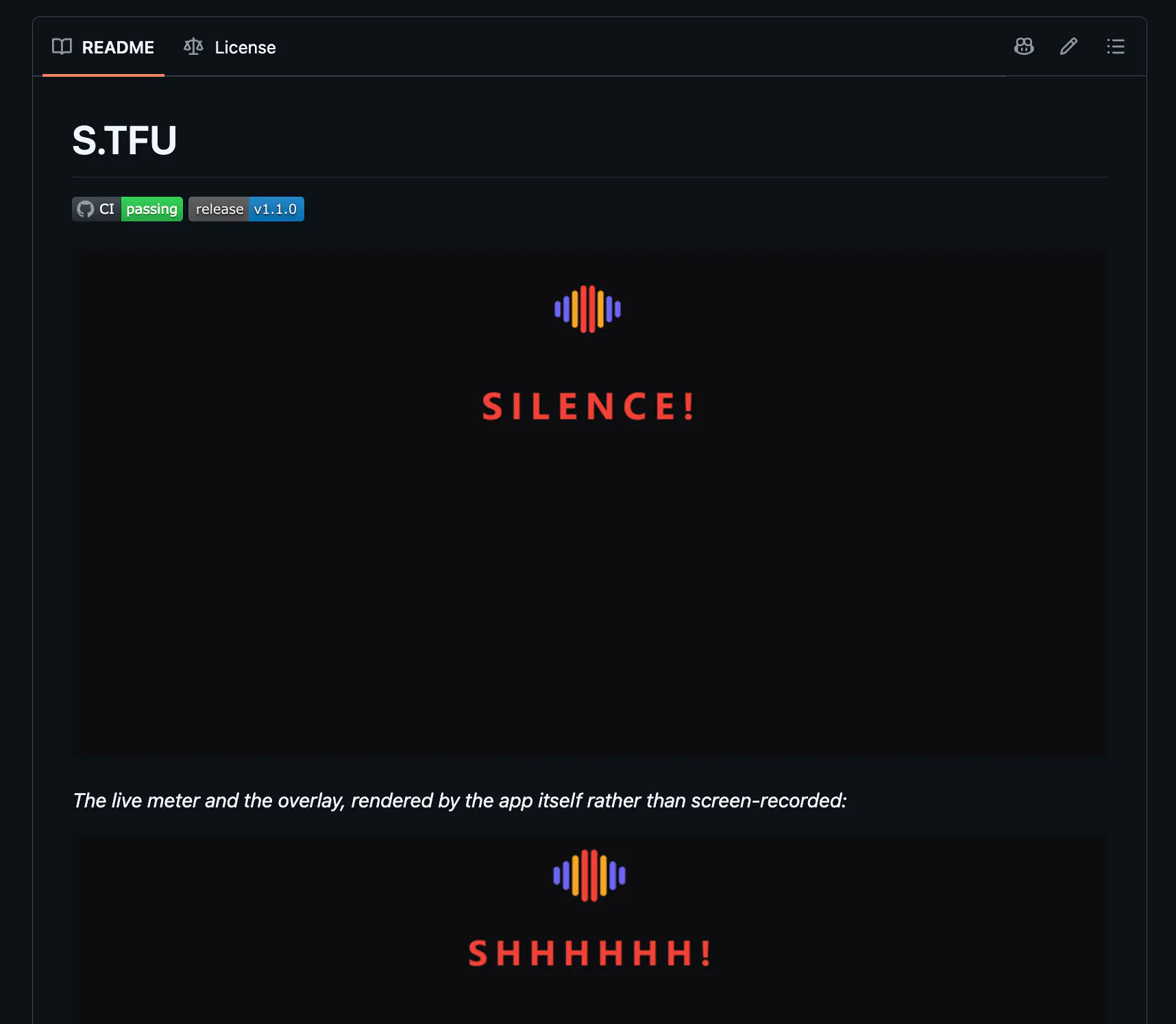
When the user crosses that threshold for the first time in a session, S.T.F.U. minimizes the foreground game, plays a sound effect, and displays a large overlay. Closing it requires four clicks, with the button moving after each one. Later triggers send the user directly to the Windows desktop and display a ten-second message.
The S.T.F.U. documentation also describes a configurable cooldown, multiple threshold modes, PIN-protected controls, a live loudness meter, event reports, and CSV exports. The PIN protects settings, recalibration, pausing, and exiting, although the developer openly describes it as an inconvenience rather than serious security.
That distinction matters. The application isn’t trying to permanently confiscate the computer or secretly impose parental controls. It creates a predictable interruption at the exact moment the agreed rule is broken. The consequence is irritating enough to be noticed without ending the entire gaming session.
The Best Technical Decision Was Leaving AI Out of the Detector
Although S.T.F.U. was built with Claude, its yell detection does not appear to use an AI model. It doesn’t transcribe conversations, classify emotions, or ask a cloud service whether a sound qualifies as unacceptable behavior.
Instead, the app converts each 20-millisecond audio frame into a loudness value and immediately discards the underlying samples. Its primary detection rule looks for short spikes across a rolling window, which suits the actual problem: long periods of relative silence interrupted by one explosive shout. The personal calibration places the default threshold between the measured speaking and yelling levels.
This is better engineering than forcing AI into the runtime. Speech recognition would introduce latency, more ways to fail, and difficult questions about storing or transmitting a child’s conversations. The application doesn’t need to know what was shouted or why. It only needs to recognize an unusual increase in volume.
The project’s published Python dependencies cover audio capture, numerical processing, charts, images, sound playback, and the Windows tray interface. The repository says there is no network code and that only event details, such as the time, measured level, and triggered action, are written to disk.
AI helped build the tool. It doesn’t need to remain inside the tool, constantly collecting data and making subjective judgments. That separation should be far more common.
Transparency Keeps It From Becoming Household Spyware
A microphone-monitoring application installed on someone else’s computer deserves immediate suspicion. S.T.F.U. addresses that concern socially rather than pretending it can solve it with a privacy policy.
The app displays a tray icon, explains itself during setup, and makes its reactions impossible to miss. More importantly, the father says his son knew about the project, participated in the build process, helped test it, and agreed to the consequence. They even selected the bundled trigger sounds together, which reportedly included fart effects.
A parent and child do not negotiate from equal positions, so “consent” in this context shouldn’t be treated as a formal contract. Disclosure and participation still create an important boundary. A visible feedback tool that supports an existing household rule is categorically different from a hidden process listening to a child’s microphone.
The project’s README is unusually direct about this. It says the software works best when everyone involved has agreed to it and acknowledges that a technically capable user with administrator access can terminate the process. That honesty makes the application more defensible, not less.
This Is Parenting, but It Isn’t All of Parenting
Some Reddit commenters offered a simpler solution: turn off the computer, remove gaming privileges, or stop allowing games at midnight. Those aren’t unreasonable responses. Depending on the child, the time of year, and the frequency of the behavior, they may be better ones.
Still, describing S.T.F.U. as a substitute for parenting misses what it actually does. The parent establishes the rule and consequence. The software handles detection and immediate enforcement, sparing everyone another midnight argument or a sleepy walk down the hallway.
What the app cannot do is interpret context. It doesn’t know whether the microphone captured the player, a friend in the room, a dropped object, or a genuine emergency. It cannot decide whether the larger problem is poor volume control, excessive gaming, inadequate sleep, or a family rule that needs to change.
The father also acknowledges that his son may simply learn to yell more quietly. That would technically satisfy the application without addressing emotional self-regulation. S.T.F.U. can provide feedback, but conversation still has to supply meaning. If the family stops talking because the software exists, the project has failed even if the house becomes quieter.
Claude Makes One-Household Software Worth Building
The more interesting AI story is economic. S.T.F.U. addresses a problem so specific that no conventional software company would sensibly build a full product around it. Its original target market was essentially one family.
Agentic coding systems make that kind of personal software more practical. Anthropic describes Claude Code as a system that can read a codebase, edit files, execute commands, and run tests. That can reduce the implementation cost of turning a strange household requirement into a functioning application.
S.T.F.U. is more than a disposable script. Its repository separates audio capture, detection, configuration, event logging, Windows actions, overlays, and reporting into dedicated modules. The developer also reports hundreds of automated tests. Claude may have accelerated the construction, but the father still had to define the problem, choose the escalation rules, identify privacy constraints, and decide which failures were acceptable.
That is a more credible picture of AI-assisted development than the idea that anyone can type one prompt and receive flawless software. The human supplies context and judgment. The AI reduces the cost of implementation and iteration.
Anyone Installing It Should Still Be Cautious
S.T.F.U. remains a young, independent project. The downloadable Windows executable is unsigned, so Windows SmartScreen displays a warning. The developer recommends building it from source if that warning is unacceptable. Exclusive-fullscreen behavior can also vary between games, and heavily scaled displays have received less testing.
The latest release available on August 21, 2026 was version 1.1.0, published one day earlier. It added scheduled off-hours, allowing families to define periods when the microphone detection shuts down completely. New users should also consider running the built-in log-only mode before enabling interruptions, giving them a chance to identify false triggers.
Open source is helpful, but it isn’t an automatic guarantee of safety. Microphone access and screen control justify inspecting the code, building locally when possible, and testing carefully.
Final Thoughts
S.T.F.U. isn’t an AI parent, and it isn’t a universal answer to children yelling while gaming. It is a narrowly designed consequence machine, built for one family’s recurring problem.
Its strongest features are the limits: no cloud audio processing, no hidden surveillance, no claim that software understands the child, and no attempt to make the application impossible to remove. Claude made an unusually specific tool easier to create, while the father and son decided how it should fit into their relationship.
That is the useful lesson. AI-assisted software becomes most valuable when it helps people build small, contextual tools without pretending that code can replace trust, judgment, or an uncomfortable conversation.
Frequently Asked Questions
4 questions
1
What does the S.T.F.U. app do?
S.T.F.U. is a Windows tray application that monitors microphone loudness and interrupts the foreground game when it detects a yell. The first trigger displays an overlay requiring multiple clicks, while later triggers send the player to the desktop and show a timed message. It also provides calibration, PIN-protected settings, cooldowns, and event reports.
2
Does S.T.F.U. use AI to detect yelling?
S.T.F.U. does not use an AI model for runtime yell detection. It measures microphone loudness in short frames and compares those measurements with a threshold created during personal calibration. Claude helped the developer build the application, but the released software uses conventional local audio processing rather than speech recognition, emotion detection, or a cloud-based AI service.
3
Does S.T.F.U. record or transmit conversations?
S.T.F.U. does not record, store, or transmit microphone audio, according to its privacy documentation. It calculates a loudness value from each 20-millisecond audio frame and discards the samples immediately. The app stores event records containing information such as the trigger time, measured loudness, and action performed.
4
Can a child disable S.T.F.U.?
A child may be able to disable S.T.F.U. if they have sufficient Windows permissions. A PIN protects ordinary settings, pausing, recalibration, and exit controls, but the developer describes it as a deterrent rather than a secure lock. Anyone with administrator access can terminate a running process, which is one reason the app is intended for an agreed household arrangement rather than covert monitoring.