This is the kind of result that scientists spend entire careers hoping to see. On August 19, 2026, Merck and Moderna announced that their personalized mRNA-based cancer vaccine, combined with Keytruda, met the primary and a key secondary endpoint in a pivotal Phase 3 trial for patients with surgically removed high-risk melanoma, marking the first positive Phase 3 result for an individualized neoantigen therapy and for any mRNA-based cancer treatment.
The therapy is called intismeran autogene (also known as V940 or mRNA-4157). Decades before mRNA vaccines became a household name, scientists were already exploring the technology as a way to treat cancer. Merck and Moderna have been working on this melanoma vaccine for about a decade. That long road just paid off in a very big way.
As someone who covers AI's role in medicine closely, I can say this result lands differently than most announcements. This isn't AI writing a better marketing email. It's AI helping design a treatment that keeps people alive longer after one of the deadliest forms of skin cancer. That's a different category of impact entirely.
What Is Intismeran Autogene?
Before getting into the numbers, it's worth understanding what makes this therapy so different from a standard cancer drug.
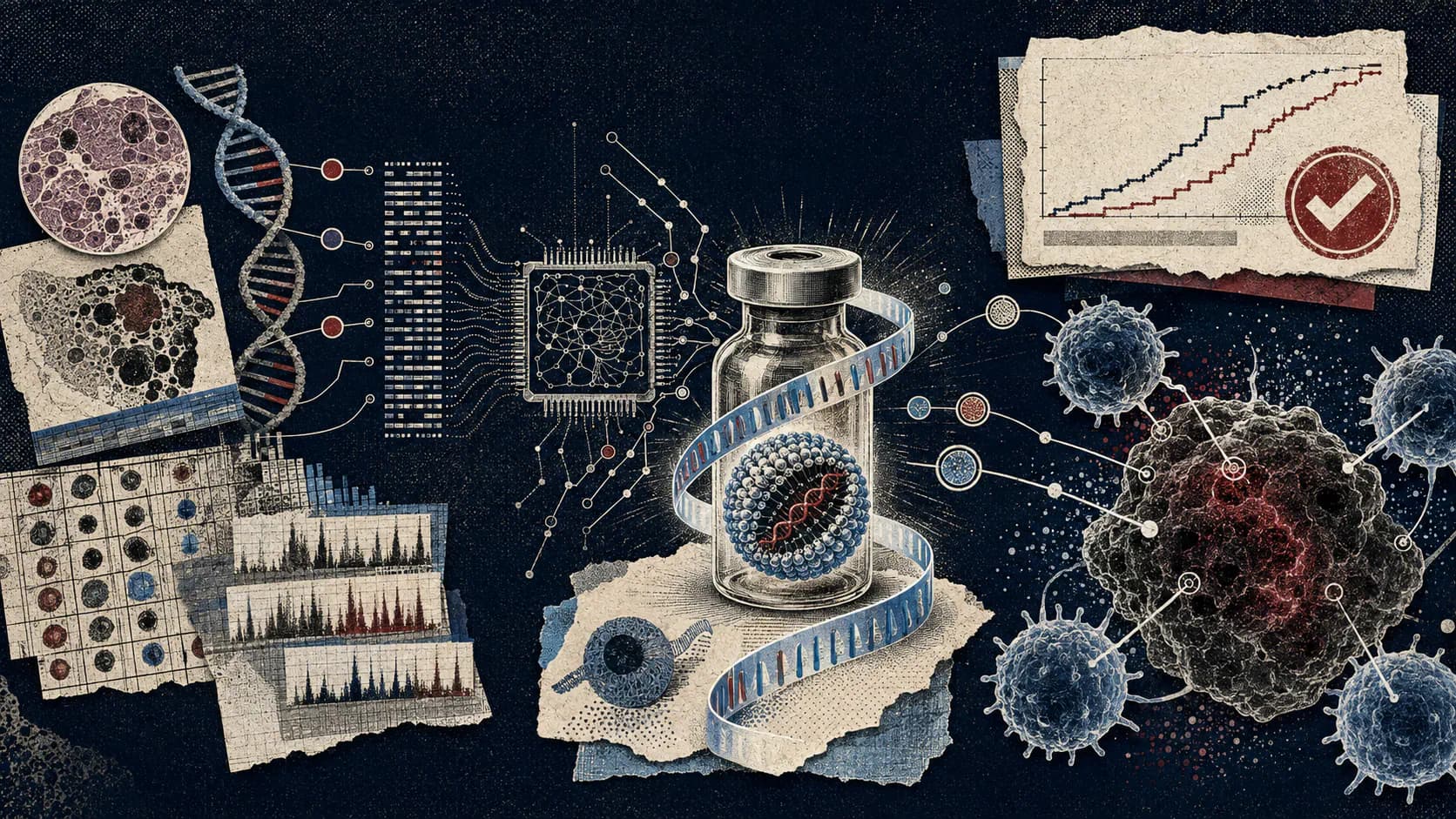
Intismeran autogene is a novel, potential first-in-class investigational mRNA-based individualized neoantigen therapy jointly developed by Merck and Moderna. It is designed and produced using a patient's tumor sample to identify the unique mutational signature, or "fingerprint," of their cancer and generate an anti-tumor immune response.
In plain terms: every patient gets a different drug. There's no off-the-shelf formula. The treatment is built from scratch for each person's specific tumor.
Intismeran is designed using a sample of each patient's tumor to identify the unique mutational signature of their cancer, then generating a synthetic mRNA that codes for up to 34 neoantigens specific to that individual. The therapy is intended to train the immune system to recognize and attack those cancer markers, working alongside Keytruda, which is already a standard of care for resected melanoma.
How AI Drives the Whole Process
The AI component here isn't a buzzword. It's doing the hard computational work that makes personalization at scale even possible.
AI plays an important role in simplifying these processes and helping move with speed and precision, especially when confronted with thousands of patient batches. On the design end, a series of fully integrated AI algorithms takes next-generation sequencing data from tumor and blood samples, reviews their genetic mutations, and predicts up to 34 of those neoantigens that are most likely to elicit an immune response.
That last part matters enormously. Tumors carry hundreds of mutations, but not all of them are useful targets. You need to know which ones the immune system can actually "see" and respond to.
Machine learning and deep learning approaches enhance neoantigen prediction by integrating peptide–major histocompatibility complex (MHC) binding, antigen processing, and T cell receptor recognition, thereby improving immunogenicity assessment beyond conventional pipelines.
Conventional prediction pipelines often generate many false positives, with only a small fraction of predicted binders proving truly immunogenic. AI-enhanced models aim to improve this process by integrating peptide MHC binding, antigen processing, T cell receptor recognition, tumor expression, and HLA diversity into more comprehensive prediction frameworks.
The AI also gets smarter over time. This algorithm has the potential to learn over time, through pairing clinical and immunogenicity data, and will hopefully become better at selecting the most clinically active neoantigens.
The Phase 3 Trial Results
The INTerpath-001 trial is the largest and most definitive test of this approach yet.
The INTerpath-001 trial enrolled 1,137 patients who had previously had their cutaneous melanoma surgically removed. These patients either received intismeran autogene along with Keytruda, or Keytruda alone.
At a pre-specified interim analysis, the Phase 3 INTerpath-001 trial met its primary endpoint of recurrence-free survival (RFS) and a key secondary endpoint of distant metastasis-free survival (DMFS) for intismeran autogene combined with Keytruda.
The companies said that the improvements in both RFS as well as a secondary endpoint of prolonging survival without a distant metastasis had been "statistically significant and clinically meaningful." The partners observed no new safety signals in the trial.
These Phase 3 results build directly on years of earlier work. The Phase 3 readout builds on previously reported Phase 2b results from the KEYNOTE-942/mRNA-4157-P201 trial, including the five-year follow-up data presented at the 2026 ASCO Annual Meeting, in which the combination demonstrated a 49% reduction in the risk of recurrence or death (HR=0.51) and a 59% reduction in the risk of distant metastasis or death (HR=0.411) compared to Keytruda alone.
To put those numbers in human terms: in the Phase 2b trial, intismeran autogene plus pembrolizumab significantly improved recurrence-free and distant metastasis-free survival compared with pembrolizumab alone in resected stage IIB-IV melanoma. The five-year cancer-free rate in the combination arm was 68.8%, compared to 49.1% on Keytruda alone.
What the Market Said
The financial reaction was immediate and dramatic. Merck shares climbed more than 12% on Wednesday, while Moderna's stock soared about 177%. The size of those moves reflects the companies' relative size entering Wednesday: Merck's market cap was around $333 billion, while Moderna's sat near $25 billion.
Moderna CEO Stéphane Bancel captured the moment succinctly: "It's a big moment for medicine, a big moment for patients."
From Merck's side, the sentiment was equally direct. "These first Phase 3 findings for intismeran in combination with KEYTRUDA as adjuvant therapy reinforce the promise of a more personalized approach to cancer treatment. We believe individualized neoantigen therapies have the potential to redefine how patients with completely resected stage IIB-IV melanoma are treated."
What Comes Next
Regulatory filings are now on the table. Merck and Moderna plan to present the full data at an upcoming international medical conference and said they will engage with regulators on potential approval filings. Overall survival data is still maturing, so the full picture of long-term benefit will take more time.
The pipeline beyond melanoma is already well underway. The INTerpath program currently consists of nine total Phase 2 and Phase 3 clinical trials across multiple tumor types and stages of disease, including melanoma, non-small cell lung cancer, bladder cancer, and renal cell carcinoma.
Additional clinical studies include a Phase 1 study exploring adjuvant pancreatic ductal adenocarcinoma, perioperative gastric carcinoma, and perioperative non-small cell lung cancer. Pancreatic cancer, one of the hardest cancers to treat, is now in the sights of this platform.
It's estimated there will be about 112,000 new cases of melanoma diagnosed and over 8,500 deaths resulting from the disease in the U.S. in 2026 alone. Despite advances in treatment, patients with resected melanoma remain at risk of disease recurrence, which most often occurs within the first two years. A therapy that meaningfully cuts that recurrence risk changes the prognosis for tens of thousands of people every year, just in the United States.
Frequently Asked Questions
5 questions
1What is intismeran autogene?
Intismeran autogene is a novel, potential first-in-class investigational mRNA-based individualized neoantigen therapy jointly developed by Merck and Moderna. It is custom-built for each patient based on the unique mutations found in their tumor.