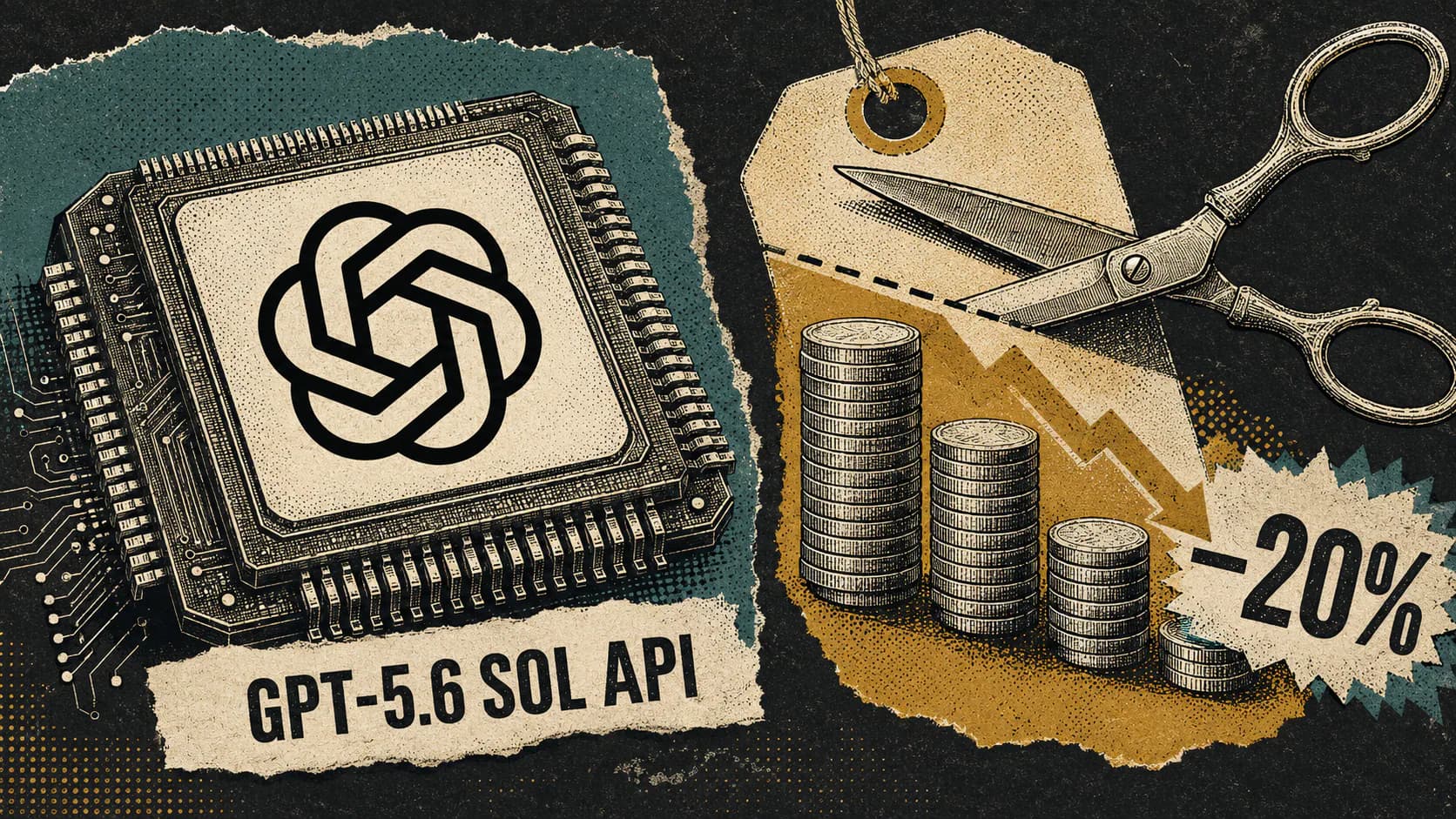
OpenAI lowered the price of GPT-5.6 Sol on Friday, August 21, cutting standard short-context API rates from $5 to $4 per million input tokens and from $30 to $20 per million output tokens. Although OpenAI describes the promotion as a reduction of “more than 20%,” the output price has fallen by roughly 33%, making the savings potentially much larger for generation-heavy workloads.
The new rates are available through at least November 21, 2026. They also extend to eligible token-based usage in Codex and ChatGPT Work, but OpenAI has not reduced the monthly price of Plus, Pro, or Business subscriptions. Included plan usage and existing five-hour and weekly limits are unchanged.
The timing has produced an obvious interpretation on X: OpenAI is putting additional pricing pressure on Anthropic while the Claude developer prepares for a potential public offering. That reading is plausible, especially because GPT-5.6 Sol now undercuts Anthropic’s Claude Opus 5 on standard token prices. Still, the public evidence supports “ahead of Anthropic’s formal IPO roadshow” more clearly than “during the roadshow.”
The Output Discount Is Much Larger Than the Headline
The updated GPT-5.6 Sol model card lists three lower token rates. Cached input has received the same percentage reduction as uncached input, while output receives the deepest cut.
| Token type | Previous price per million | Promotional price | Reduction |
|---|---|---|---|
| Input | $5.00 | $4.00 | 20% |
| Cached input | $0.50 | $0.40 | 20% |
| Output | $30.00 | $20.00 | 33.3% |
The actual reduction on an API bill depends on the ratio between input and output. An application processing one million uncached input tokens and producing 100,000 output tokens would previously have spent $8. Under the promotion, the same traffic costs $6, a 25% reduction.
An unusually output-heavy workload can save more. One million input tokens and one million output tokens would fall from $35 to $24, a reduction of about 31.4%. Real applications rarely maintain a one-to-one ratio, but coding agents, report generators, research systems, and long-running automation can produce enough output for the larger discount to materially change their economics.
The advertised $4 and $20 rates apply to standard short-context usage. OpenAI says prompts containing more than 272,000 input tokens are charged at twice the input rate and 1.5 times the output rate for the full request. That makes the effective promotional price $8 per million input tokens and $30 per million output tokens for requests crossing the threshold. Developers planning around GPT-5.6 Sol’s 1.05-million-token context window need to include that surcharge in their calculations.
OpenAI Is Repricing the Entire GPT-5.6 Family
The Sol promotion is part of a wider shift rather than an isolated discount. OpenAI’s GPT-5.6 announcement was originally published on July 9 and later updated twice: on July 30 for price reductions to GPT-5.6 Terra and Luna, and on August 21 for the Sol promotion. Terra fell by 20%, while the cheaper Luna tier received an 80% reduction.
Sol remains the flagship member of the family. OpenAI recommends it for complex reasoning and coding, with Terra positioned as the middle option and Luna intended for cost-sensitive, high-volume workloads. Sol supports a context window of 1.05 million tokens, up to 128,000 output tokens, image input, function calling, structured outputs, web search, file search, and computer-use tools.
Reducing the newest flagship matters more strategically than discounting a previous-generation LLM. OpenAI is not merely clearing out an older model or directing customers toward a successor. It is using lower prices to accelerate adoption of the model it currently presents as its strongest general-purpose API option.
The Promotion Changes Metered Use, Not Subscriptions
For API customers, the change is straightforward: eligible GPT-5.6 Sol token usage is immediately billed at the promotional rates. The same pricing is rolling out across eligible credit-based or token-metered activity in OpenAI’s agentic products, including ChatGPT Work and Codex. Reuters reported that the promotion covers all three product surfaces.
OpenAI’s ChatGPT rate card adds an important limitation. The promotion applies to token-based usage billed in US dollars, but not to legacy metering. Included plan usage, legacy credit rates, and existing five-hour and weekly allowances remain unchanged.
This is not a general ChatGPT subscription sale. A Plus, Pro, or Business customer will not receive a lower monthly bill merely because OpenAI reduced its underlying Sol token rates. The direct beneficiaries are developers paying for API calls and organizations purchasing eligible metered capacity for Work or Codex.
GPT-5.6 Sol availability is also unchanged. OpenAI says it remains available in Work and Codex for Plus, Pro, Business, and Enterprise users, while Free and Go users receive GPT-5.6 Terra in Codex rather than Sol.
The Anthropic Timing Is Strategically Awkward
Anthropic currently prices Claude Opus 5 at $5 per million input tokens and $25 per million output tokens. GPT-5.6 Sol’s promotional rates are therefore 20% lower on both sides of the standard token calculation. Before the August 21 change, Sol matched Opus 5 on input but cost 20% more for output.
That reversal helps explain the competitive interpretation circulating on social media. If a company is already evaluating both frontier models, OpenAI can now present Sol as the cheaper option before discussing benchmark results, latency, caching, or tool support. The discount also arrives while Anthropic is holding reported investor meetings ahead of a possible 2026 IPO. Those meetings are part of the preparation process, but available reporting has described them as preceding a formal roadshow rather than confirming that the roadshow is already underway.
The distinction matters. OpenAI has not said it lowered GPT-5.6 Sol pricing to interfere with Anthropic’s offering, and pricing decisions can also reflect inference optimization, capacity planning, competitive responses to Chinese models, or a desire to increase API adoption.
The promotion nevertheless runs until at least November 21, placing it across much of Anthropic’s expected IPO window. That creates an uncomfortable question for Anthropic’s prospective investors: how durable is frontier-model pricing when a direct competitor can reduce output rates by one-third with little warning?
Token Prices Do Not Measure the Cost of a Completed Task
OpenAI’s new rates improve Sol’s sticker price, but price per million tokens is only one part of an LLM’s production cost. A model that needs more retries, longer prompts, additional tool calls, or greater reasoning effort can remain more expensive even when its published token rates are lower.
Before migrating a workload, developers should examine:
- Real input-to-output ratios: The savings will be closer to 20% for input-heavy applications and closer to 33% when output contributes more heavily to the bill.
- Long-context behavior: Crossing the 272,000-token threshold changes the price of the entire request, not just the tokens above the threshold.
- Successful completion rates: A cheaper request is not helpful if the model requires repeated attempts or more human correction.
- Caching patterns: GPT-5.6 Sol’s cached-input price is $0.40 per million tokens, but cache writes cost 1.25 times the uncached input rate.
- The November 21 deadline: OpenAI has not committed to keeping the promotional rate permanently or specified the exact price that will follow it.
OpenAI’s launch material contains strong performance claims for Sol across coding, knowledge work, science, computer use, and agentic evaluations. Some results are based on OpenAI’s own testing, however, and performance varies substantially by benchmark. Teams considering a switch should run both models on representative tasks and calculate cost per acceptable result, not cost per raw token.
The temporary structure also makes this promotion resemble a migration campaign. Three months gives developers enough time to run evaluations, integrate the API, build prompt caches, and move production traffic. Once an application depends on a model’s behavior and tooling, reversing that migration can cost more than the initial token savings.
Final Thoughts
The output reduction is the consequential part of OpenAI’s GPT-5.6 Sol promotion. Cutting input by 20% is competitive, but lowering output from $30 to $20 directly benefits the coding agents, research workflows, and long-form automation that frontier models are increasingly designed to handle.
OpenAI has also placed Sol below Claude Opus 5’s standard API price during an important period for Anthropic. That does not prove the promotion was designed around the IPO, particularly because Anthropic’s formal roadshow has not been publicly confirmed as underway. It does show how model pricing can become a strategic weapon alongside benchmarks and product releases.
What happens after November 21 will determine whether this is a lasting reset or a three-month acquisition push. A permanent $4 input and $20 output rate would establish a new reference point for frontier AI pricing. A return to higher rates would reveal the promotion for what it currently appears to be: an aggressive, carefully timed incentive to move GPT-5.6 Sol into more production workloads.
Frequently Asked Questions
4 questions
1How much does the GPT-5.6 Sol API cost?
GPT-5.6 Sol currently costs $4 per million input tokens, $0.40 per million cached input tokens, and $20 per million output tokens for standard short-context requests. Prompts exceeding 272,000 input tokens are charged at twice the input rate and 1.5 times the output rate for the entire request.