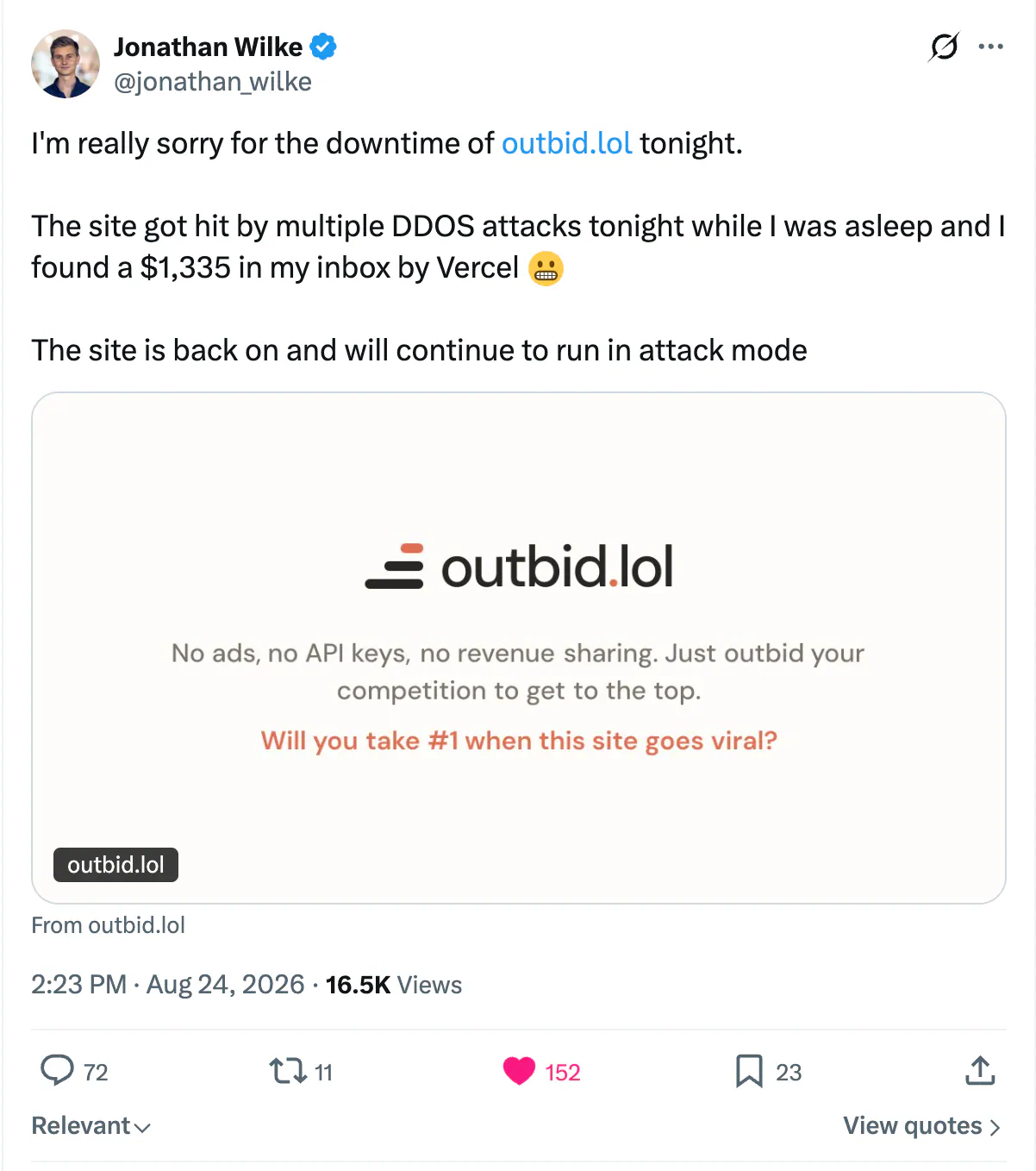
The viral Outbid.lol website went offline for several hours on August 24, 2026, after multiple distributed denial-of-service attacks, according to founder Jonathan Wilke. The outage interrupted one of the week’s most visible indie launches only days after the pay-to-rank board began spreading through AI startup and developer circles.
Wilke said the attacks occurred while he was asleep and that he woke to a reported $1,335 charge from hosting provider Vercel. In a post on X, he apologized for the outage and confirmed: “The site is back on and will continue to run in attack mode.”
When checked following the restoration, the Outbid homepage was online and displayed more than one million visitors since launch. The incident compresses several risks facing small viral products into a single night: sudden traffic, metered cloud infrastructure, a one-person operations team, and attackers capable of turning attention into downtime and unexpected costs.
Outbid Became a Target Five Days After Launch
Outbid launched on August 19 with a deliberately simple model. Anyone can submit a product, website, or social profile and pay to appear on its public leaderboard. Listings start at $5, while higher bids move above lower-paying competitors. Within days, bids reached five figures, and many prominent positions were occupied by AI products, developer tools, and marketing platforms.
That visibility is central to Outbid’s appeal. Every new leader, price increase, screenshot, and return-on-investment claim gives participants another reason to share the board. It also creates a highly visible target whose busiest period is especially valuable to disrupt.
The DDoS Claim Does Not Mean Outbid Was Hacked
A DDoS attack uses numerous connected systems to flood a website or application with traffic, preventing legitimate users from reaching it. It primarily targets availability rather than stealing information or modifying data. Government security guidance notes that DDoS attacks are unlikely to affect confidentiality or integrity directly, although attackers can use them to distract from other activity.
Wilke has not disclosed the attack vector, request volume, source, duration of each wave, or suspected motive. There is also no public evidence that payment information, user records, or administrative accounts were compromised. Until Outbid or Vercel publishes a technical postmortem, this should be described as a founder-reported availability incident, not a confirmed data breach.
The $1,335 Vercel Charge Needs More Context
The reported charge initially appears to conflict with Vercel’s DDoS documentation, which says automatic mitigation is available across its plans and that traffic blocked by the firewall is not billed. In May 2026, Vercel also announced that CDN requests and data transfer denied, challenged, or rate-limited by its web application firewall would be waived automatically.
Those protections do not guarantee that every malicious request is immediately identified. Vercel says charges can still accrue for requests successfully served before automatic mitigation begins and for automated traffic that its systems do not classify as DDoS. Without Wilke’s itemized usage data, it is impossible to determine whether the $1,335 came from pre-mitigation traffic, unrecognized bots, compute consumption, or another metered resource. The figure should therefore be treated as a reported charge rather than a final assessment of what Vercel will ultimately collect.
Attack Mode Trades Friction for Availability
Wilke’s reference to “attack mode” appears to mean Vercel’s Attack Challenge Mode. The feature places a browser verification step in front of a deployment, requiring visitors to complete a JavaScript-based security challenge before requests reach the application. Successful visitors receive a temporary challenge session, while scripts and many automated clients are blocked.
For a browser-first leaderboard such as Outbid, that is a reasonable emergency tradeoff. It may add friction for visitors and interfere with legitimate automation or direct API calls, but it gives the founder time to analyze the traffic and create narrower firewall rules. Vercel itself describes the feature as a temporary response rather than a complete long-term security configuration.
Viral AI Products Need Security Controls Before They Trend
The Outbid attack is useful security news for AI founders because it shows how quickly a side project’s threat model can change. A product can move from negligible traffic to a high-profile target before its creator has configured monitoring, spending controls, or an incident-response plan.
Several precautions can reduce the damage:
- Configure spending controls before launch. Vercel’s Spend Management can send notifications, trigger a webhook, or pause production deployments when a chosen threshold is reached, but the pause action must be enabled by the account owner.
- Protect expensive endpoints separately. Public APIs, image-processing routes, database queries, and AI inference requests need tighter rate limits than cached pages.
- Monitor cost as closely as uptime. Request volume, compute use, transfer, and third-party API spending can rise before a small team notices that the site is under attack.
- Prepare an emergency configuration. Tested firewall rules, challenge mode, contact details for the hosting provider, and preserved logs shorten the response when an attack occurs overnight.
These measures cannot prevent every DDoS campaign, but they can keep a traffic flood from becoming an open-ended financial event.
Final Thoughts
Outbid’s outage does not prove that its application was breached, nor does the reported bill by itself prove that Vercel’s protections failed. The missing invoice details and attack telemetry matter.
The clearer conclusion is that virality can turn infrastructure security into an immediate business requirement. Outbid was still behaving like a fast-built side project when its audience, bids, and public profile had already made it an operationally significant service. For AI and indie developers, the lesson is to configure the financial blast radius before publishing the launch post, not after waking up to an attack.
Frequently Asked Questions
3 questions
1What happened to Outbid.lol?
Outbid.lol went offline for several hours on August 24, 2026, after multiple DDoS attacks, according to founder Jonathan Wilke. He said the attacks occurred while he was asleep and reported finding a $1,335 Vercel charge. The website was subsequently restored and placed behind an attack-challenge mode.
2
Sources
- In a post on Xx.com
- Outbid homepageoutbid.lol
- Vercel’s DDoS documentationvercel.com
- Vercel’s Attack Challenge Modevercel.com