Anthropic’s Claude Credited in Unconfirmed Exoplanet Search
Pavel Rabtsevich reports an agent-assisted analysis, while TESS independently lists follow-up observations for the target, not confirmation of a planet.
Listen
AI narration
11:50
0:00 / 11:50
AI SummaryGenerated from this article
Pavel Rabtsevich claims Anthropic's Claude Code assisted in identifying an exoplanet candidate around star TIC 4206066, with a signal repeating every 3.18 days and estimated radius of 1.4 Earth radii. TESS has accepted a follow-up observing program for the target, confirming only that the claim warrants investigation, not that a planet exists. Claude reportedly handled data retrieval, code writing, transit fitting and false-positive checks while Rabtsevich directed the scientific questions. The analysis reports a false-positive probability of 0.03–0.04 but explicitly disclaims statistical validation. Upcoming two-minute-cadence observations offer opportunities to test whether the signal recurs, though distinguishing its source remains separate from confirming its planetary nature.
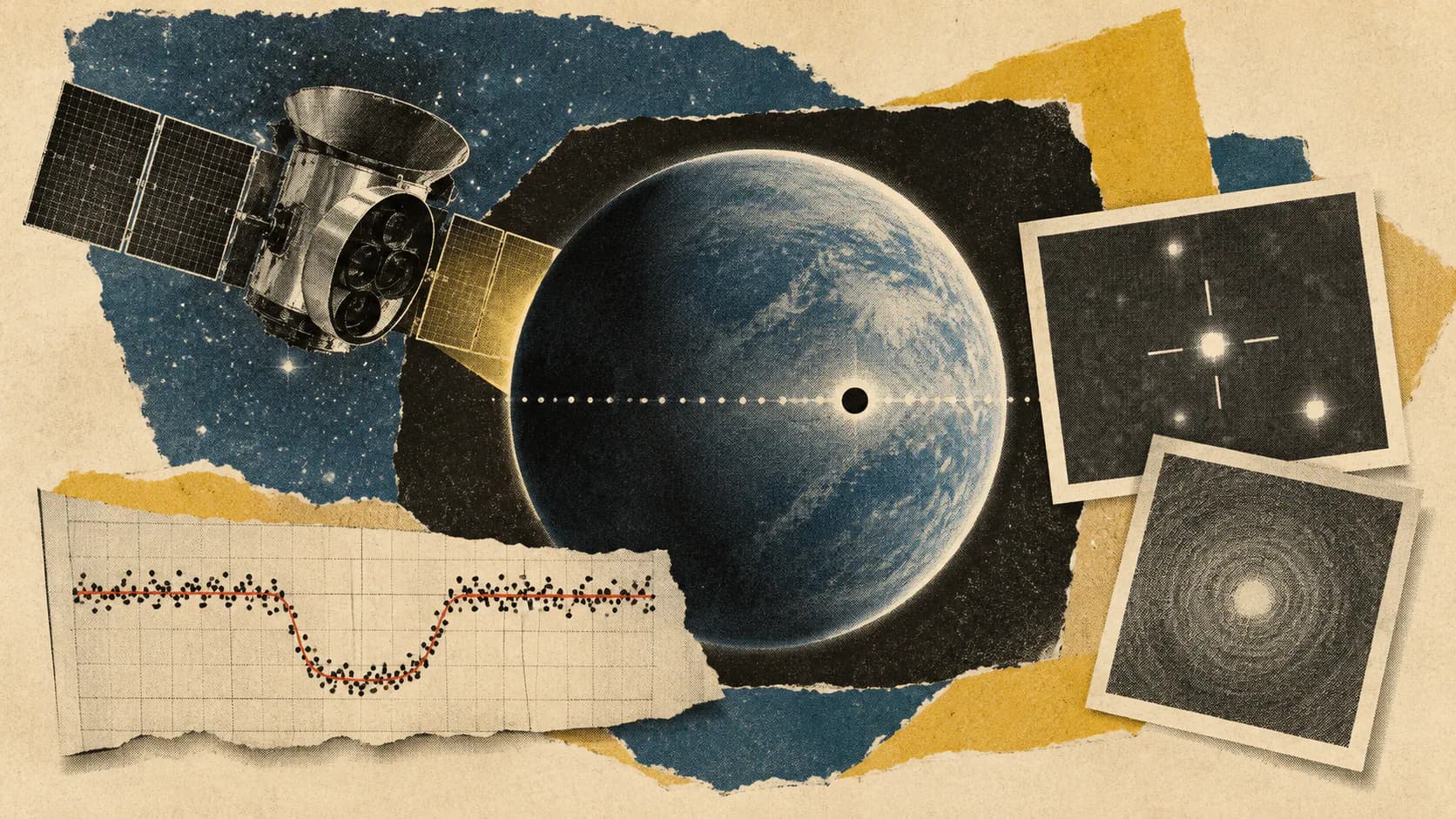
The TESS Science Office lists an active observing program for TIC 4206066, the star at the center of Pavel Rabtsevich’s claim that Claude Code helped him uncover an exoplanet candidate. DDT Program 100 names Rabtsevich as principal investigator and requests two-minute-cadence observations of a nearby K-dwarf with a candidate estimated at 1.4 Earth radii.
The listing is the strongest independent evidence in this story: the target has an active follow-up program. It does not establish that the signal comes from a planet, that the estimated size is correct, or that an AI agent independently made a scientific discovery.
Rabtsevich says Anthropic’s Claude Code handled much of the computational work: retrieving data, writing search code, fitting transits, checking false positives and rerunning analyses. His published preprint explicitly stops short of statistical validation. The useful question is how an agent-assisted analysis can produce a claim that other researchers can inspect, challenge and test against new observations.
TESS Has Accepted a Follow-Up Target, Not a Discovery
The official TESS entry is unusually concrete for an unresolved AI-assisted research claim. It identifies the investigator, the target, the requested observing cadence and the program’s active status. The mission’s Science Office maintains the listing, making it a source separate from Rabtsevich’s own statements.
TESS says Director’s Discretionary Target proposals are reviewed by the mission’s principal investigator, a selected science expert and its operations team. Targets are also checked for observability. That process supports allocating observations to a proposed investigation; it does not independently reproduce the analysis or validate the proposed planet. The candidate description in the table identifies the subject of the observing program, not a confirmed classification.
Two-minute cadence means measurements spaced two minutes apart. More closely spaced observations can help characterize a transit-like dip, including its timing and shape. They also provide an opportunity to test whether a signal identified in earlier data returns when predicted.
The program’s active status alone does not show that those observations have been completed or that their results support the candidate. TESS also says DDT observations have no proprietary period and enter the archives alongside other observations from the relevant sector. Outside researchers can then examine the follow-up data without relying solely on the claimant’s interpretation.
Claude Code’s Reported Role Was the Analysis Work
Work with Zeniteq
Let’s work together
We’re open to thoughtful collaborations with teams building in AI. Explore the ways we can work together.
In his public account, Rabtsevich describes Claude Code as carrying out much of the implementation while he chose the scientific questions, tests and pass/fail criteria.
The tasks he attributes to the agent cover several stages of the workflow:
Downloading and parsing public TESS data.
Writing code to search for repeating transit-like signals.
Fitting the candidate signal and producing plots.
Running false-positive checks.
Repeating analyses and auditing the results.
This account is more specific than saying an AI “found a planet.” It describes a coding agent helping construct and execute an investigation, with a human directing what should be tested.
Each task carries different evidentiary weight. Successfully downloading data says little about whether the subsequent analysis is correct. A convincing plot can still depend on questionable filtering, and a transit fit can estimate parameters for a signal without establishing that a planet caused it.
Rabtsevich’s account of Claude’s contribution has not been independently reproduced in the evidence available here, so it should remain attributed to him. The published preprint provides a scientific claim to examine. It does not independently verify which parts of the work the agent performed or how reliably it performed them.
For readers interested in AI products, this is a reported use of a coding agent in scientific analysis. It is not an Anthropic product announcement, a benchmark of research capability or evidence that Claude can autonomously validate discoveries.
The Stronger Signal Repeats Every 3.18 Days
Rabtsevich’s September 25, 2026, preprint reports two transit-like signals in TESS photometry of TIC 4206066, also identified as StKM 1-561. It describes finding the signals in Sector 98 and tracing them back to Sectors 6 and 32.
The stronger signal has a reported period of approximately 3.18 days. The abstract describes 23 transits with a depth of roughly 500 parts per million, equivalent to a 0.05% reduction in measured brightness.
If the object orbits the target star, Rabtsevich estimates a radius of 1.4 ± 0.1 Earth radii. That condition is essential: the size is inferred under a particular explanation of the signal, not directly measured as a planetary radius.
A transit analysis connects the amount of dimming to the sizes of the occulting object and its host star. If the dimming originates on another star whose light is mixed into the measurement, the same observed dip can imply a different object size. Establishing what has been found therefore requires identifying the source of the signal.
The preprint reports vetting, localization checks and examination of Gaia astrometry, photometry and radial velocities. Rabtsevich’s interpretation is that a planet transiting an unresolved, gravitationally bound companion remains the main alternative host scenario. Even if the transiting object proved planetary, that alternative could change which star it orbits and undermine the quoted radius estimate for the target-star interpretation.
The paper also reports a weaker signal with an approximately 11.13-day period. Its abstract describes roughly three-sigma significance in a post hoc test and a tentative timing prediction. This is not evidence of a second confirmed planet and should not be promoted as an additional discovery.
A False-Positive Calculation Is Not Confirmation
The preprint reports a false-positive probability of approximately 0.03–0.04 from TRICERATOPS. Rabtsevich says that probability is dominated by companion scenarios that other data disfavor.
The number comes from a model-based assessment. Its meaning depends on the assumptions, observations and alternative scenarios included in the calculation; it cannot settle the object’s identity on its own.
The abstract states the limit explicitly: “No statistical validation is claimed.”
The Zenodo record describes the document as a research note prepared for submission to the Research Notes of the AAS. A public preprint makes the argument available for scrutiny, but a repository listing does not establish acceptance or independent peer review. The record also identifies a supporting data-and-code deposit, offering a route toward reproducibility without proving that reproduction has occurred.
Several questions remain separate: does the dip persist under defensible processing choices, does it originate on the target star, and is a planet the best explanation? Repeat observations can help address the first question without necessarily resolving the others.
Follow-up work capable of distinguishing nearby or unresolved sources may therefore matter alongside another transit detection. The observing program advances the testing of the claim, while those alternatives remain unresolved.
Preregistration Makes the Next Observation More Informative
Rabtsevich also reports publishing fixed transit predictions and pass/fail rules on October 6, before the new observations. This is his account of a preregistered test, not an independently audited demonstration that every analytical choice was fixed.
Preregistration changes what counts as success. An analysis of existing data can involve trying different periods, filters and selections until something looks persuasive. A prospective test asks whether a specified signal appears where an earlier prediction said it should.
A useful preregistration needs more than a predicted transit time. It should specify which observations will be evaluated, how they will be processed, what uncertainty is allowed and what outcome will count against the hypothesis. Otherwise, adjustments made after seeing the data can blur the distinction between prediction and explanation.
Held-out data serve a related purpose. Measurements not used to choose the period or tune the processing provide a cleaner test than another fit to data already examined. Finding a recurring pattern across older TESS sectors can be informative, but whether it qualifies as a held-out test depends on those sectors remaining unseen while the hypothesis and analysis settings were selected.
Preregistration does not eliminate false positives. Another astrophysical source could repeat on schedule. Its narrower contribution is to make particular predictions falsifiable and expose a failed prediction more clearly, including when an agent can rapidly generate alternative analyses.
Fresh-Agent Audits Need an External Check
Rabtsevich describes repeated reruns and audits as part of the workflow. A fresh-agent review can be useful if it starts with the data, code and explicit objections to investigate, rather than simply being asked whether an earlier conclusion looks convincing.
Such a review could check whether transit times were selected consistently, whether filtering changes the signal, or whether plotting and fitting scripts use the same measurements. It can also request tests aimed at rejecting the favored explanation.
Another agent’s agreement, however, is not peer review. Agents can share mistaken assumptions, use the same flawed implementation or accept an interpretation embedded in the material they receive. Repetition within an AI-assisted workflow does not guarantee independent evidence.
A stronger audit separates the checks: inspect the implementation, reproduce the calculation through an independent route, challenge its astronomical assumptions, and compare fixed predictions with fresh measurements.
TIC 4206066 now offers a concrete opportunity for that last step because TESS lists an active follow-up program. If the predicted signal returns, it will strengthen evidence for a repeatable event. Identifying its source and establishing its planetary nature will still require scrutiny.
Claude Code’s reported contribution is worth examining because the result is testable. The scientific credit must remain provisional until those tests constrain what the object actually is.