
Ramp’s latest spending data puts a number on a question that AI labs usually answer with benchmarks: how much will businesses pay for the best available model?
In the August 2026 Ramp AI Index, Anthropic’s Claude Fable 5 accounted for 11.4% of dollars spent on Anthropic models but only 6% of the company’s tokens. OpenAI’s GPT-5.6 Sol had a much broader footprint, representing 23% of OpenAI model spending and 25% of tokens. In absolute terms, Ramp estimates that Fable produced only about 75% as much model-attributed spending as Sol during July.
That would be notable on its own. The stronger signal comes from what happened next. Anthropic’s cheaper Opus 5 quickly overtook Fable in Ramp’s spending data, while OpenAI cut Sol’s price on August 21, 2026. Together, these developments suggest that the enterprise AI market is becoming less tolerant of large premiums for relatively narrow capability gains.
Ramp’s Data Reveals a Price Ceiling for Frontier AI
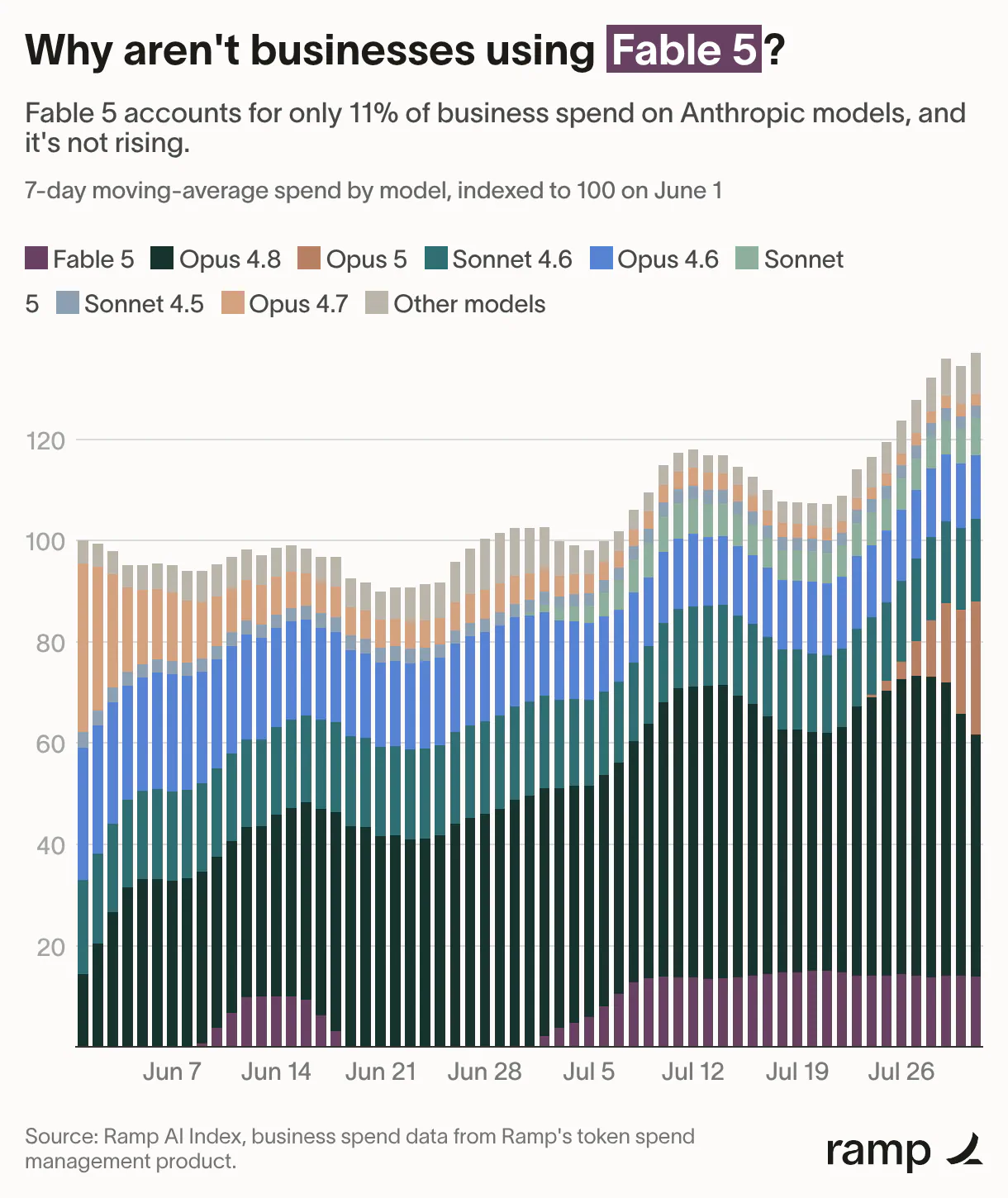
Fable’s share of Anthropic spending is almost 1.9 times its share of tokens. That gap reflects the model’s premium price, but it also shows that the higher price has not translated into comparable workload volume. Sol’s spending and token shares, by contrast, are close to proportional.
The percentages use different vendor-level denominators, so 6% of Anthropic tokens cannot be compared directly with 25% of OpenAI tokens as if they were portions of one market. Ramp’s absolute spending estimate addresses part of that problem: despite its higher price, Fable generated less model-attributed revenue than Sol in July.
There is also an important sample distinction. Ramp serves more than 70,000 businesses, and its economics dataset covers more than 50,000 U.S. businesses. However, the model-level Fable analysis comes specifically from Ramp’s token spend management product, not every company in the broader AI Index. Ramp says that subset is more technology-heavy than its normal sample, but it does not publish the exact number of firms included in this chart.
Ramp’s conclusion is still direct: Fable may reveal an upper bound on what businesses currently pay for frontier intelligence. Better performance has value, but it does not automatically justify a much higher cost across production-scale workloads.
Fable 5 Is an Escalation Model, Not a Default
Anthropic launched Fable 5 on June 9, suspended access on June 12, and restored it globally on July 1. Ramp’s July data therefore covers its first full month of stable availability, although the disrupted introduction could still have slowed initial integration and testing.
The model was always positioned for unusually difficult work. Anthropic describes Fable as a system for long-running coding, research, scientific, and knowledge tasks that lesser models cannot reliably sustain. Its standard API price is $10 per million input tokens and $50 per million output tokens.
That combination naturally limits volume. A business may use Fable to investigate a critical production failure, complete a complex software migration, or analyze a high-value research problem. It is less likely to route routine classification, extraction, summarization, and support tasks through the same model.
Low token share does not prove that Fable lacks value. A small number of successful runs could produce considerable economic benefit. It does show that businesses are treating the model as a scarce resource rather than making it their general-purpose AI layer.
Opus 5 Gives Anthropic Customers a Cheaper Substitute
Anthropic complicated Fable’s commercial position when it released Claude Opus 5 on July 24. The company says Opus approaches Fable’s frontier intelligence at half the price, charging $5 per million input tokens and $25 per million output tokens. On some of Anthropic’s evaluations, Opus came close to Fable’s peak results while completing tasks at a substantially lower cost.
Ramp’s chart shows Opus 5 overtaking Fable in model-attributed enterprise spending shortly after launch. That is an unusually clear example of internal substitution: Anthropic’s own near-frontier model appears to be absorbing demand that might otherwise have gone to its most capable product.
For most businesses, the relevant metric is not intelligence in isolation. It is the cost of reaching an acceptable result. If Opus completes a task reliably for half the model price, Fable must either solve something Opus cannot or reduce enough retries, human review, and execution time to recover the difference.
This is good product segmentation for customers. It is more difficult for the economics of a premium frontier tier, because every improvement to Opus narrows the set of workloads capable of supporting Fable’s price.
OpenAI Cut Sol’s Price After It Had Already Gained Traction
Ramp published its findings on August 12. Nine days later, OpenAI reduced GPT-5.6 Sol’s API pricing, strengthening the price-performance contrast identified in the report.
As of August 25, 2026, standard prices per million tokens are:
| Model | Input tokens | Output tokens |
|---|---|---|
| Claude Fable 5 | $10 | $50 |
| Claude Opus 5 | $5 | $25 |
| GPT-5.6 Sol | $4 | $20 |
OpenAI reduced Sol from $5 to $4 per million input tokens and from $30 to $20 per million output tokens. The promotional pricing is scheduled to remain available through at least November 21, 2026. At current standard rates, Fable costs 2.5 times as much as Sol for both input and output, while Opus costs 25% more. Cached tokens, long-context requests, batch processing, and other service tiers can alter the effective comparison.
The timing matters. The price cut cannot explain Sol’s July usage because it happened afterward. Sol had already reached 25% of OpenAI token volume and 23% of spending at its previous price. The reduction may now expand the number of workloads for which companies consider Sol economical.
OpenAI is effectively betting that greater volume, stronger customer retention, and broader production use are more valuable than maintaining the original frontier-model margin. That puts additional pressure on competitors to justify premium prices through measurable differences in completed work, not benchmark leadership alone.
The Best AI Model Is Becoming a Routing Decision
Enterprise AI systems rarely need one model for every request. Production teams can route work according to complexity, risk, latency, and expected value:
- Use an inexpensive model for repetitive, high-volume tasks.
- Escalate uncertain or difficult cases to Opus, Sol, or another frontier model.
- Reserve Fable-level capability for tasks where failure or human delay is particularly expensive.
Frequently Asked Questions
4 questions
1What did Ramp find about Claude Fable 5 usage?
Ramp found that Claude Fable 5 represented 6% of Anthropic tokens and 11.4% of spending on Anthropic models during the measured period. GPT-5.6 Sol accounted for 25% of OpenAI tokens and 23% of OpenAI model spending. Ramp also estimated that Fable generated about 75% as much absolute model-attributed spending as Sol in July.
2
Sources
- August 2026 Ramp AI Indexramp.com
- economics dataset covers more than 50,000 U.S. businessesramp.com
- OpenAI reduced GPT-5.6 Sol’s API pricingopenai.com
- Claude Fable 5anthropic.com
- Claude Opus 5anthropic.com
- GPT-5.6 Soldevelopers.openai.com
- AI Token Spend Management productramp.com