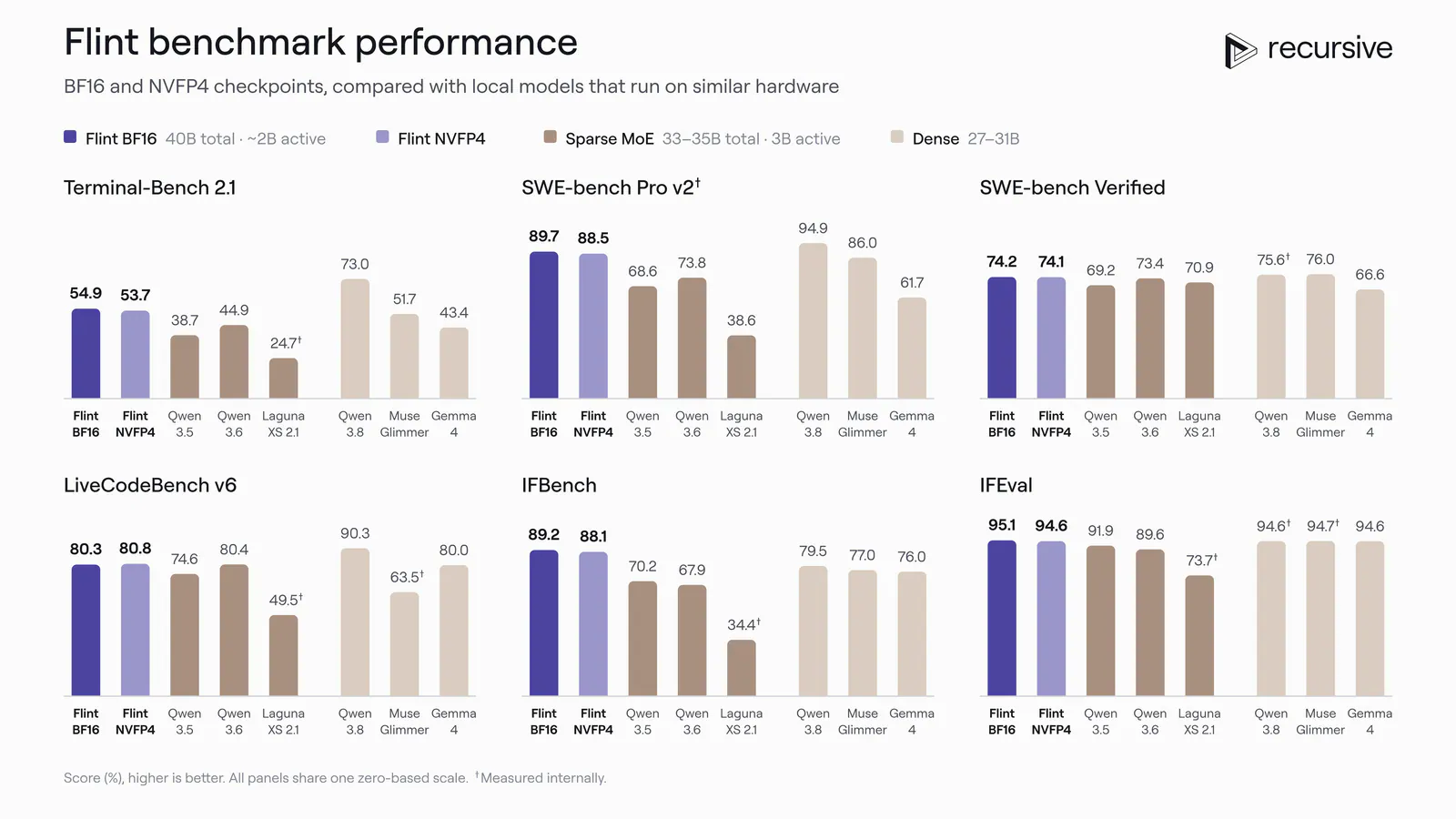
Recursive’s optimized Mac setup for Flint requires a supported Apple chip and at least 48GB of unified memory. For developers with that hardware, the 40-billion-parameter coding LLM offers a way to work without sending code to a hosted model.
Recursive’s announcement describes a mixture-of-experts model that activates approximately 2.5 billion parameters per token. The company says it supports up to 512K tokens of context, although it recommends staying within 256K for best results.
The October 21 release carries another claim: Recursive says its Eureka Machine automated research system contributed throughout development, helping a small team build Flint from scratch in under four months.
For developers, the immediate question is whether Flint delivers useful coding assistance on hardware they own. Its benchmark leadership, inference speeds, and automated-development results are vendor-reported. The downloadable weights make those claims testable; they are not independently established results.
Local Coding Requires More Than a Small Active Count
Flint is designed to investigate repositories, fix bugs, implement features, and write tests. Its weights are available under Apache 2.0, according to both the announcement and the Hugging Face model card.
Developers can use it as an alternative to paying a hosted service for model inference, keeping code and prompts on their own machine in a fully local workflow. Hardware, electricity, and maintenance still cost money, but local operation removes the hosted model’s per-token API bill.
Flint has approximately 39.8 billion parameters in total, rounded to 40B in its release branding. Only about 2.5 billion participate in generating each token, reducing the active computation compared with using the entire model every time.
For memory planning, though, Flint is not equivalent to a 2.5B model. The other experts still belong to the model and need storage and a suitable memory-management strategy. The BF16 checkpoint is roughly an 80GB download; the model card distinguishes it from separately prepared quantized variants for NVIDIA and Apple Silicon runtimes.
Recursive’s local setup documentation specifies an M4 Pro, M5 Pro, or M5 Max with at least 48GB of unified memory for its optimized rec Mac engine. That is a much more useful purchasing constraint than the phrase “runs on a laptop.”