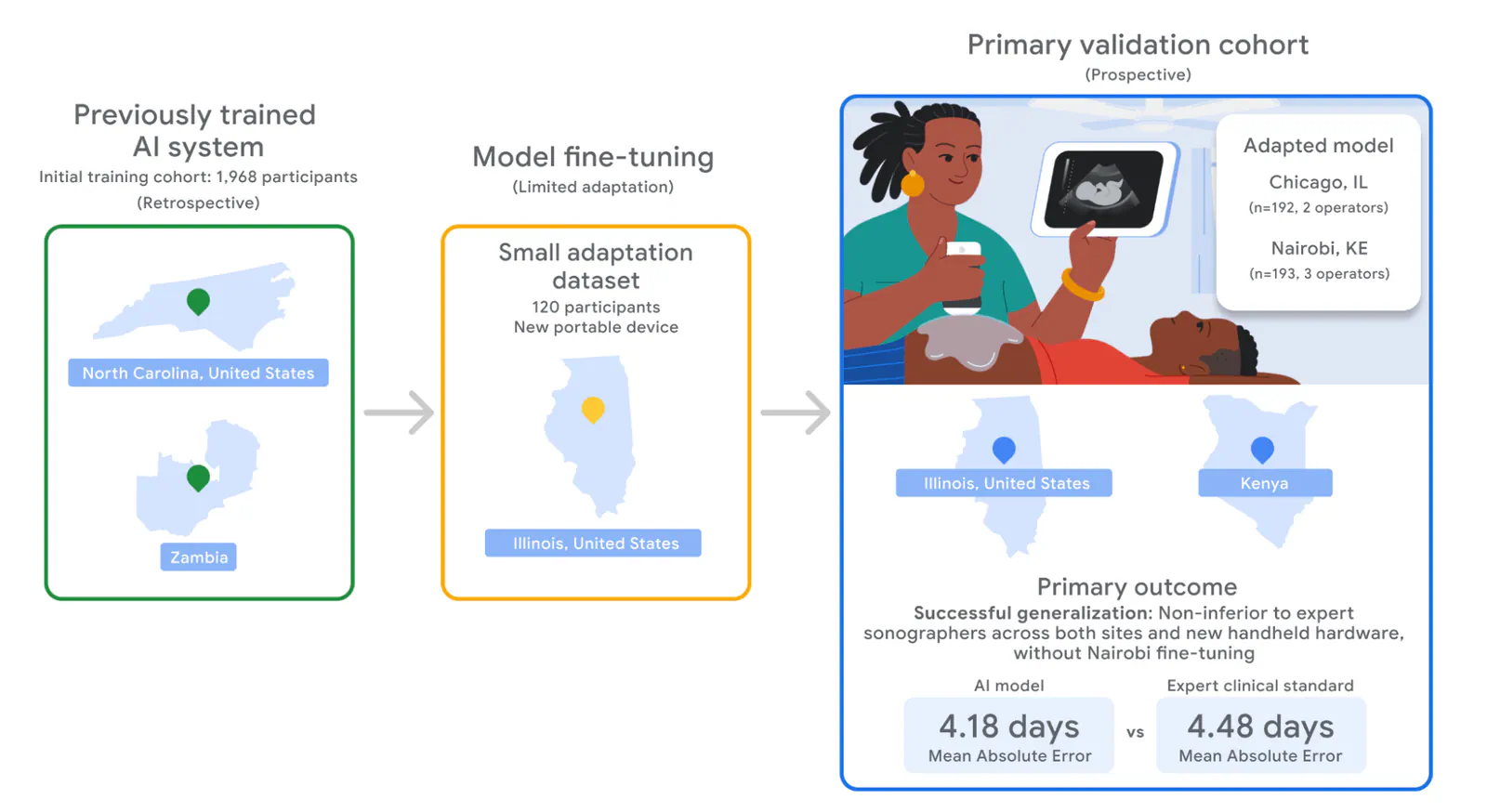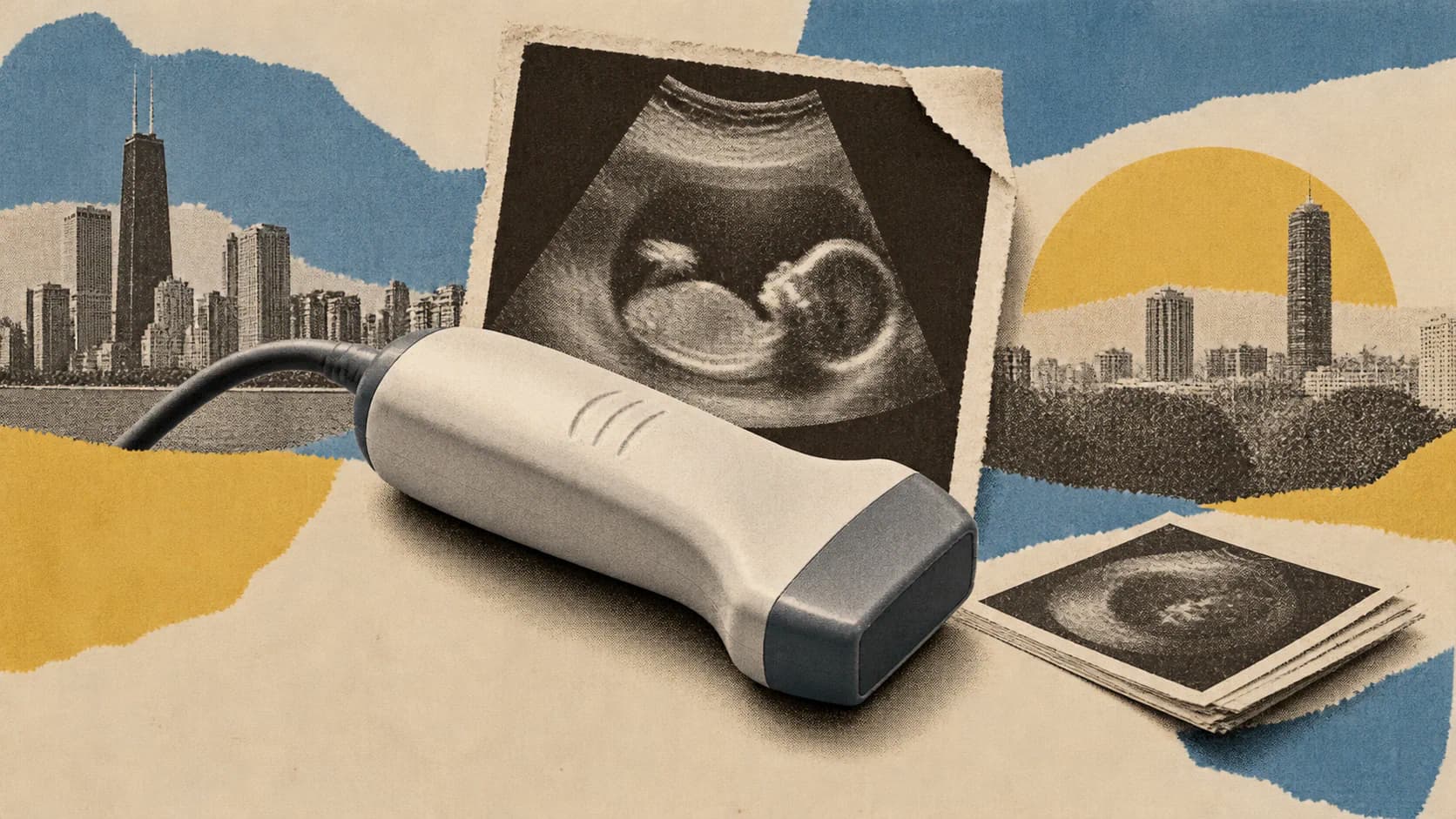
Novice operators using portable ultrasound probes collected scans that allowed a Google research AI system to estimate gestational age with accuracy comparable to expert-sonographer biometry. The prospective study covered 385 participants in Chicago and Nairobi and tested the approach in clinical workflows, beyond previously collected images.
According to Google’s study announcement, the AI’s combined mean absolute error was 4.18 days, compared with 4.48 days for the expert approach. The researchers reported that the system met the study’s non-inferiority criterion, meaning its error was not worse than the comparator beyond the study’s allowed margin.
Nairobi provided the strongest evidence for broader applicability: the model achieved a mean absolute error of 4.27 days there despite receiving no local fine-tuning.
Google described the findings on October 21, 2026, and says the study, Generalization of AI-Based Gestational Age Assessment Using Blind Sweep Ultrasonography, was published in JAMA Network Open. The findings support a specific clinical capability. The system is not a generally available diagnostic product.
Novices Collected Sweeps Instead of Targeted Measurements
Conventional ultrasound-based pregnancy dating requires an expert sonographer to identify particular views of the fetus, take anatomical measurements, and use those measurements in formulas that estimate gestational age. Both image acquisition and interpretation depend on specialized skills.
The research workflow changes the acquisition task. Operators without specialized sonography training move a portable probe across the abdomen in a standardized sequence. These “blind sweeps” collect ultrasound images without requiring the operator to find the precise anatomical cross-sections needed for conventional biometry. The AI then estimates gestational age from the collected scans.
By having non-sonographers acquire the input, the study evaluated a workflow that addresses part of the staffing constraint limiting access to ultrasound. It went beyond testing software’s ability to interpret an expert’s images.
Gestational age provides the timeline used for prenatal screening, treatment decisions, and decisions about delivery, as Google’s clinical lead explains in the announcement. Making that estimate available where a sonographer is unavailable could have practical value.
Pregnancy dating, however, is a narrower task than a complete obstetric ultrasound examination. These results do not establish that the system can replace the broader assessment performed by a trained sonographer or identify every condition that prenatal imaging is intended to investigate.