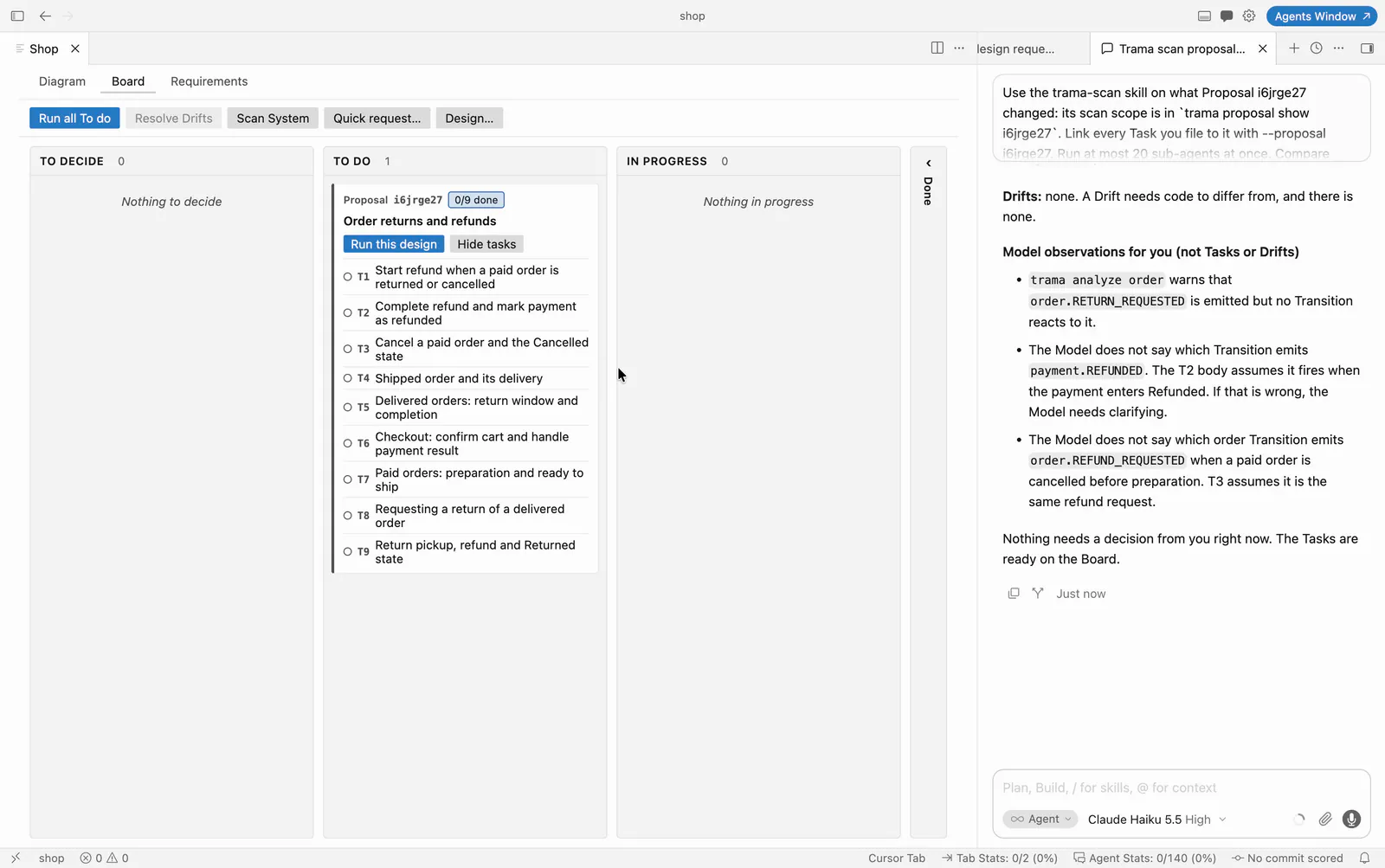
Before a coding agent changes files, Trama asks it to create or update a state-machine model of the behavior it intends to build. According to the project documentation, the agent presents those proposed changes visually and waits for approval before moving into implementation.
A code diff usually arrives after an agent has already made design decisions. Trama moves part of that review earlier: developers approve intended behavior without having to reconstruct it from generated code and a chat history.
GitHub lists Trama v0.0.1, released on October 11, as a pre-release. Developers can download its VSIX extension for VS Code or Cursor now. The model-first workflow is worth examining, though the available announcement material does not establish that its approval process or drift detection is a reliable production control system.
The Agent Proposes Behavior Before Implementation
Trama’s documented workflow begins with a feature request written in ordinary language. The agent reads the application’s existing behavioral map and asks about decisions it cannot resolve on its own.
Each question includes a suggested answer. Developers can accept the recommendation or skip the question, leaving the agent to record its recommendation as an assumption for review. Keeping that choice visible is useful: an unanswered requirement should not silently become application behavior.
Next comes a Proposal. Additions appear in blue on the diagram and removals in red. A side panel collects decisions and assumptions, while the proposal on the board lists the files it touches. The developer can approve it or reject it with a note.
Approval does not immediately send the agent off to edit everything. The documented sequence includes a scan of the affected behavior against the code, followed by preparation of implementation tasks. The developer then selects Run this design to begin execution.
The proposal and the resulting code serve separate review purposes. One answers whether the design is acceptable; the other still needs review for implementation quality. Approving a state machine cannot tell a developer whether a database query is efficient, a dependency is appropriate, or a security check is correctly implemented.
The concrete benefit is a chance to challenge significant behavioral decisions before they become a large patch.
State Machines Expose Decisions That Chat Can Hide
A state machine describes the situations a system can occupy and the events that move it between them. For an order workflow, those might include delivery, a return request, and the expiration of a return window.