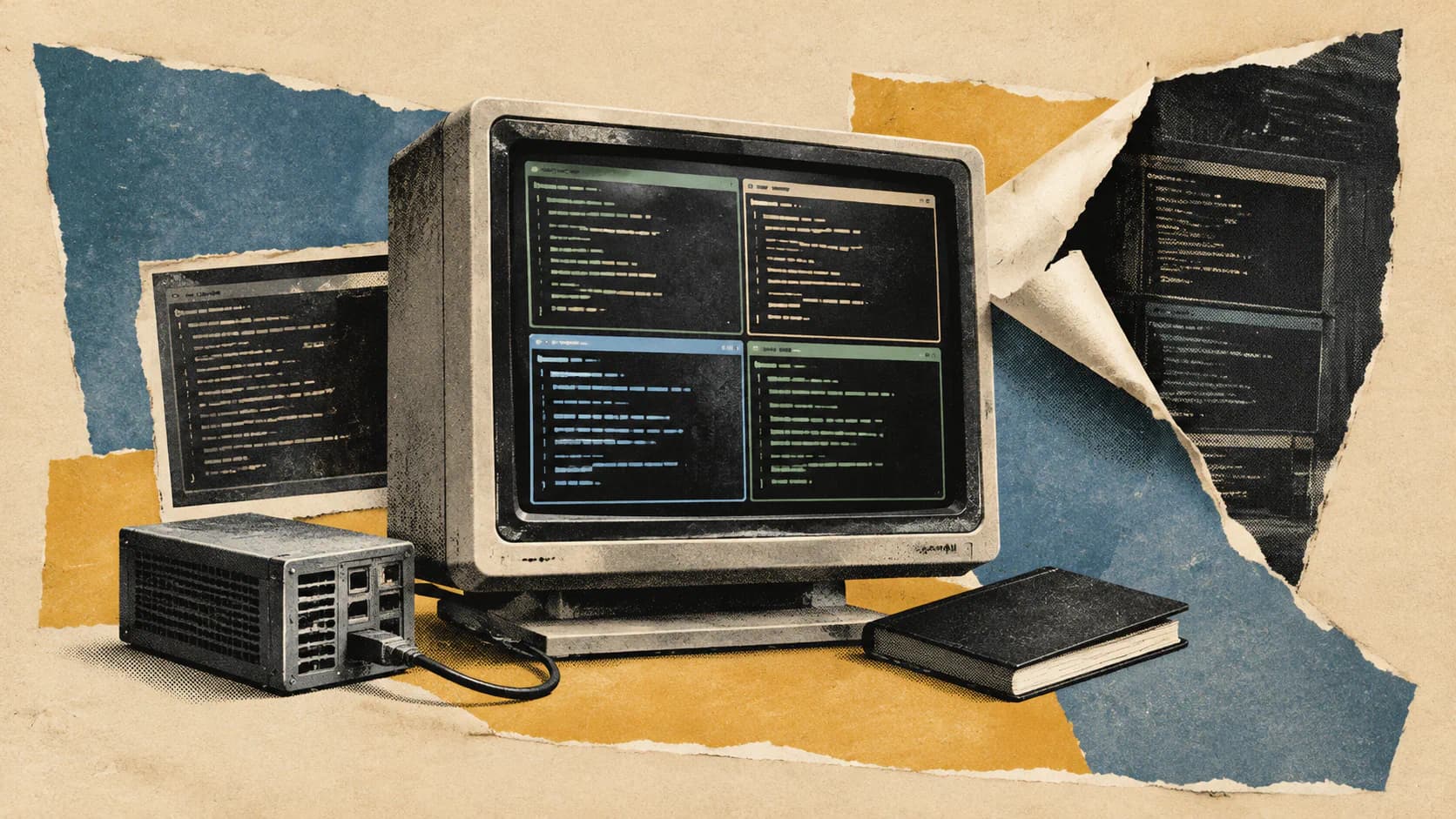
Rezoom 1.2 can pull a coding-agent session out of another Konsole window and move the running process into its own terminal pane. According to the project’s 1.2.0 release notes, that “beam-in” operation uses reptyr without restarting the agent.
Live process adoption is a stronger draw than the chat-style interface. For developers juggling Anthropic’s Claude Code, Codex and remote SSH work, Rezoom combines a searchable session list with actual terminals, stored resume commands and indicators showing which sessions need attention.
The October 11 release adds clearer Claude state indicators, agent names, SSH chats, session-health signals and optional support for multiple Claude accounts. Rezoom serves as an operations console for existing command-line tools; it does not replace the coding model.
This assessment is based on the release notes and repository documentation, not hands-on testing. The project is early, its richest features depend on Linux/KDE components, and moving live processes involves permissions that deserve attention before installation.
The Chat List Controls Real Terminals
Rezoom’s repository describes a native C++/Qt6 application that follows KDE’s desktop theme and embeds Konsole terminals. Each agent, SSH connection, tmux session or shell appears as a chat with its current state, recent output and a command for bringing it back.
Each session row opens the command-line environment where the work happens, giving it a role beyond displaying status. Chats can also float into separate tabbed windows, with the layout retained across application restarts.
Support is not equally deep for every agent:
- Claude Code: Rezoom reads Claude’s session registry and transcripts to expose live state, titles and output, with automatic discovery and optional freeze detection.
- Codex: Sessions are discovered from history and resumed with
codex resume. Rezoom also detects Codex when it starts inside a pane. - Other CLI agents: Tools such as aider, Gemini CLI and opencode can run as terminal chats, with resume behavior configured through command templates.
Running inside a real terminal does not automatically give every agent Claude-level status reporting.
Search covers names, titles, messages and folders. Running sessions expose agent names that can be used in commands such as rezoom --resume bex-6b, so developers can retrieve a particular session without remembering its window position or browsing terminal tabs.
Resuming a Session Is Not Preserving a Process
Rezoom stores the command needed to reopen each chat. The project says those records let it bring sessions back when the application starts again, including after a crash.
This does not guarantee that arbitrary processes survive a crash with their memory intact. Resuming Claude or Codex through its own command is different from retaining a running process. A stored SSH command similarly provides a route back to a host without proving that remote work continued or can recover its exact state.
The live “beam-in” feature handles a process that is already running in a terminal outside Rezoom. Version 1.2 gives sessions in other Konsole windows an adoption control that moves them into Rezoom, reusing the chat’s pane when one exists.
The release’s window-handling fixes document an important edge case. Rezoom closes the old Konsole window when it can. If that window hosts other tabs, it instead marks the adopted session “in Rezoom” with a warning to keep it open. Closing that original tab manually would end the session.
Terminal ownership and process lifetime remain connected, even when moving a session looks like a simple desktop action.
Claude’s State Indicators Separate Waiting From Trouble
Version 1.2 gives the session list clearer signals for deciding where to intervene. Working Claude sessions show Claude’s orange spinner; green means the agent has finished and it is the user’s turn; grey means an idle session whose activity has already been seen.
Two health conditions receive separate treatment. A process suspended with Ctrl+Z appears as suspended and offers a Continue action. A session marked busy whose transcript has not changed for two hours receives a “no progress” signal.
Suspension is an operating-system process state. Two hours without transcript movement is a heuristic: useful as a prompt to inspect a session, but not proof that the agent has deadlocked or stopped doing useful work.
An optional Claude Code notification hook handles usage-limit detection, letting Rezoom mark affected sessions red and display the reset time. This is separate from the transcript-based inactivity warning.
For a developer supervising several agents, these distinctions help with triage. A completed task needs input, a suspended process needs continuation, and an inactive transcript needs investigation. Collapsing all three into “not working” would conceal the action each situation requires.
SSH Chats Remember the Route Back
Remote work appears in the same session list. An SSH connection opened in a Konsole tab can appear as a chat, and an SSH command entered inside a Rezoom pane becomes that chat’s stored route back.
For remote Claude work, Rezoom reads working or waiting status from the terminal title. That signal is narrower than direct access to the local Claude session files and should not be mistaken for comprehensive remote process monitoring.
The repository also documents a “Scan remote” action that finds Claude and tmux sessions on a host and adopts them as chats. A remote Claude session can then be reopened through a command shaped like ssh -t host 'claude --resume …'.
If SSH ends inside a Rezoom pane, the application presents a Reconnect bar and leaves reconnection to the user.
A saved destination and command make remote work easier to locate while keeping the developer in control of reconnection. They do not establish that a remote session is healthy, authenticated or recoverable before the connection is made.
Linux/KDE Gets the Full Interface, With a Privilege Caveat
The installation documentation lists a Debian/Ubuntu .deb requiring KF6, an Arch PKGBUILD, and an RPM specification for Fedora/openSUSE. Packages use the distribution’s Qt/KF6 dependencies rather than bundling them.
A documented macOS build opens chats in Terminal.app windows instead of embedded Konsole panes. The project says presence, search, automatic adoption, resume commands, templates and freeze detection remain available, while beam-in and “Go to its window” require Linux-specific components, including reptyr and KWin.
Sources
- 1.2.0 release notesgithub.com
- Rezoom’s repositorygithub.com