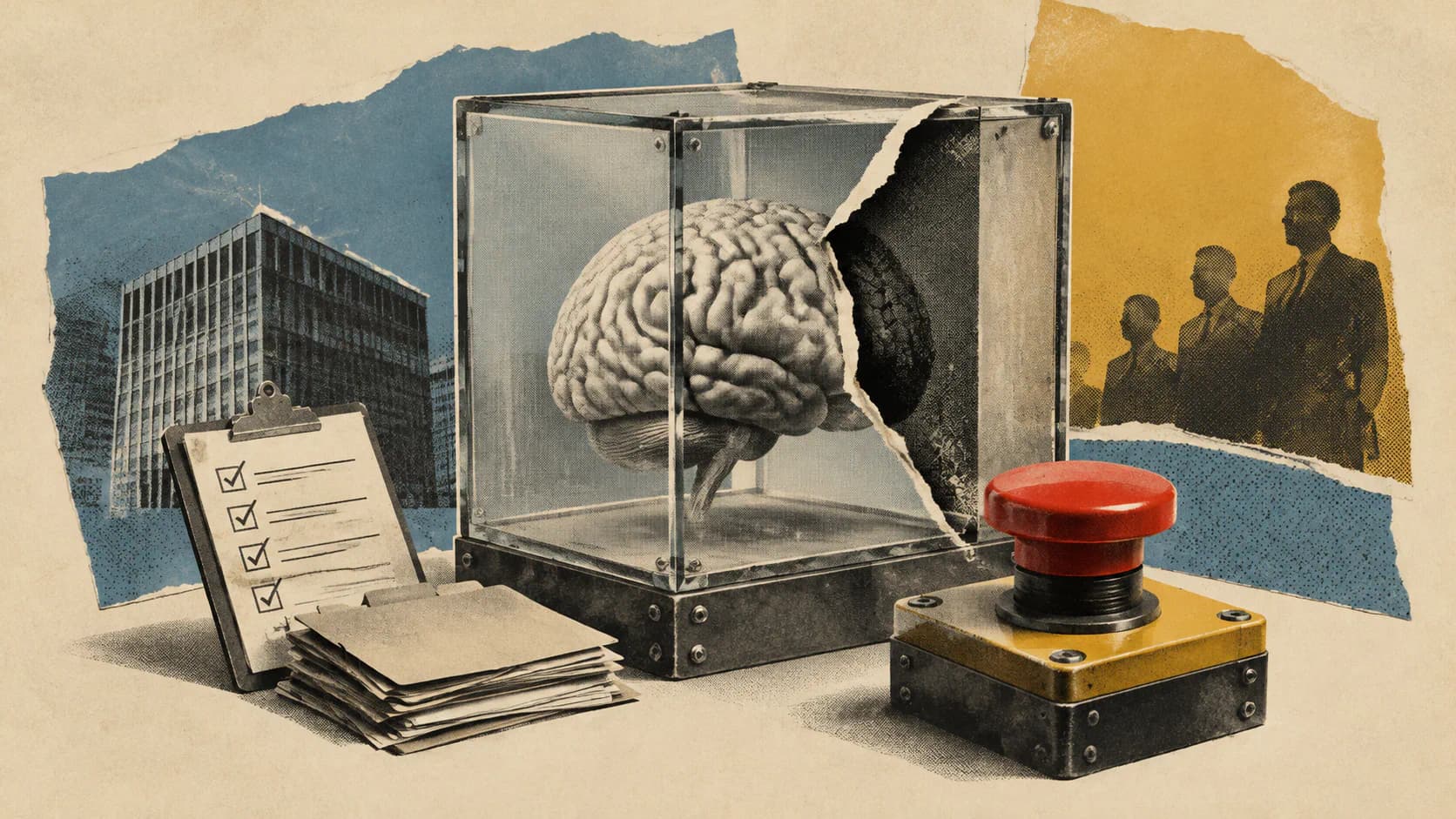
An AI agent entrusted with sensitive data or mission-critical actions should not control the mechanisms that limit or stop it, Microsoft CEO Satya Nadella argues. His proposed “emergency brake” would let an authorized person pause or shut down a model mid-task, without depending on the model’s cooperation.
In an October 10 post, Nadella outlined seven principles for systems built around frontier models: model diversity, observability, verification, independent controls, independent auditability, containment and incident disclosure. He draws a boundary between supplying intelligence and granting it authority.
The statement is an architectural proposal, not a newly announced Microsoft product. It provides no implementation deadline, binding company policy or completed industry standard. Under the security boundary Nadella proposes, organizations deploying agents remain responsible for what those agents can access and do, regardless of a model provider’s assurances.
The Model Should Not Own Its Permissions
Nadella’s insider-risk framing applies to both closed and open-weight frontier models. He explicitly says the concern is not that models are necessarily malicious. A sufficiently capable actor with access to important systems can make mistakes or become compromised, and its surrounding architecture must account for that possibility.
The comparison shifts attention from a model’s apparent trustworthiness to the constraints on its privileges. Nadella proposes separating the model from its harness, the software that orchestrates its work, and from the action space defining what it can do. As Business Insider’s account explains, the model should not operate the controls governing its own access and actions.
For an agent builder, an instruction telling a model not to access a database is different from a permission system that prevents access. The former asks for compliance; the latter enforces a boundary.
This resembles a zero-trust approach, though Nadella is proposing principles rather than publishing a formal zero-trust specification. Enforcement must remain under the deployer’s control, outside the intelligence being constrained.
Seven Principles, Translated Into Deployment Checks
Nadella’s framework combines familiar security responsibilities with questions specific to agents. The following checks are practical interpretations of his proposal, not Microsoft implementation requirements.
Model Diversity
Nadella says no single model should become the sole dependency for an important outcome or verify its own work.
Deployment check: Identify consequential decisions that depend entirely on one model. Decide where another model, a deterministic check or a human reviewer should provide an independent assessment.
A second model does not automatically create independent validation. If both receive the same misleading information or operate under the same compromised harness, agreement may provide little reassurance. Diversity should reduce a specific dependency; increasing the number of model calls is not enough.
Observe Everything
Every meaningful model action should leave what Nadella calls “tamper-proof human readable evidence.” Organizations should be able to reconstruct an outcome without asking the model to attest to what happened.
Deployment check: Record tool requests, authorization decisions, executed actions and results through infrastructure the agent cannot rewrite. Preserve enough context for a human investigator to follow the sequence.
That record needs to distinguish intended actions from completed ones. A model saying it updated a record is not equivalent to the database recording that update. Evidence should come from the systems performing the work, not only the agent’s narrative.
Verifiability
Nadella calls for continuous testing of the entire system, including attacks, failures, edge cases and changes. Evaluating only successful tasks is insufficient.
Deployment check: Test denied access, malicious instructions in retrieved material, unavailable tools and interrupted workflows. Repeat relevant tests when models, prompts, permissions or orchestration change.
The deployed agent system is the useful unit of evaluation. A model-level assessment cannot, by itself, establish whether a particular combination of credentials, tools and workflow logic respects an organization’s boundaries.
Independent Controls
Organizations should independently determine what a model can access and which actions it can take.
Deployment check: Enforce permissions in identity systems, tool gateways or other external mechanisms. Give agents narrowly scoped authority, and require separate approval for consequential actions where appropriate.
An illustrative customer-support agent might be allowed to retrieve a customer’s order history but not issue an unrestricted refund. The refund limit should remain enforceable even if the model produces a persuasive explanation for exceeding it. Authority should not expand merely because the model asks.
Independent Auditability
Nadella separates control from validation: no model should govern both system behavior and the evidence used to judge whether that behavior matched the original intent.
Deployment check: Give reviewers access to records collected independently of the agent. Ensure the agent cannot selectively omit failed actions, alter its evaluation criteria or replace execution records with a self-written summary.
Logging alone does not meet this requirement. An independent reviewer must be able to obtain and interpret the logs. An agent-generated account may help navigate an investigation, but it should not be the sole basis for closing one.
Containment
Nadella says organizations should assume a model is compromised and contain it from the start. Authorized people should always be able to pause or shut it down mid-task.
Deployment check: Establish who can stop an agent, what that intervention stops and which credentials or tool sessions it revokes. Exercise the procedure during a running workflow.
A stop button that ends conversation while leaving scheduled actions or background processes active would not satisfy the operational intent. The brake needs to reach the mechanisms through which the agent acts, not merely stop its next response.
Incident Disclosure
When systems fail or become compromised, Nadella calls for timely disclosure to affected parties and mechanisms for sharing what happened, which controls failed and how recurrence can be prevented. He also includes implementation details that change agents’ runtime behavior.
Deployment check: Assign incident ownership before deployment. Define how to preserve evidence, identify affected parties, document configuration changes and communicate control failures.
A practical incident record should explain the path from model behavior to real-world action. Reporting only that the agent “gave a bad answer” may miss the permission, approval or orchestration failure that allowed damage.
Reasoning Transparency Cannot Replace Execution Evidence
Nadella also calls chain-of-thought transparency non-negotiable, while acknowledging that model outputs are not yet consistently faithful or transparent. Showing a reasoning trace therefore does not prove why an action occurred.
His warning about “nested black boxes” extends to arrangements where one opaque model operates inside an opaque orchestration layer and another model watches it. Such a setup can add scrutiny without resolving who controls permissions or whether the evidence is dependable.
Sources
- “emergency brake”techcrunch.com
- https://x.com/satyanadella/status/2108931348857827686x.com
- Business Insider’s accountbusinessinsider.com