
Trakkr Research traced 1,285 statistics cited by ChatGPT, Perplexity, Gemini, Claude and Google’s AI Overviews and estimates that 40% reached an original study supporting the same claim. Another 8% reached research whose number or context differed from the assistant’s answer.
The audit, published October 28, 2026, asked the five systems 200 number-seeking questions and followed a random sample of their cited statistics up to five pages deep. It offers a useful distinction for anyone using AI-generated research: finding a number on a cited webpage is one check; finding the research that supports it is another.
The remaining results need careful interpretation. A source that researchers could not inspect is unresolved, not automatically wrong. And the headline 40% is a model-assisted, human-corrected estimate with substantial uncertainty, not a universal accuracy score for AI.
What Trakkr Actually Measured
Trakkr counted statistics such as shares, rates, averages, counts and costs stated as facts. It excluded prices and numerical advice, such as a recommendation to save a particular percentage of income.
Researchers followed each sampled statistic from the assistant’s citation through that page’s references. When a page named a source without linking to it, they searched for the source. The reported outcomes were:
| Outcome | Reported share | What it means |
|---|---|---|
| Matching study found | 40% | The trail reached research supporting the number and its context. |
| Number or context changed | 8% | Research was found, but the figure, population, place or time differed. |
| Could not verify | 40% | A source was identified, but was inaccessible, missing or silent on the figure. |
| No research found along the trail | 11% | Pages repeated the number without identifying a study. |
| Pages would not load | 1% | Technical access problems prevented inspection. |
These are Trakkr’s reported estimates, not independent measurements by Zeniteq.
The overall rate also has a specific denominator: sampled, cited statistics. It does not measure every factual statement in an answer, every uncited number, or the overall usefulness of an assistant. Trakkr weighted the combined result by how many cited statistics each system produced, so assistants that supplied more numbers contributed more heavily.
That weighting matters. An assistant that gives six figures creates more verification work than one that gives a single figure, even before their sourcing quality is considered.
The Human Checks Changed the Result Substantially
AI models initially judged the citation trails. A stronger model reassessed 300 trails, and people checked a random sample of 150, with an additional check where judgments disagreed.
That process made a large difference. The model-only assessment classified 23% as sourced. Humans found original research that the models had missed, and Trakkr used those checks to correct its published rates. The resulting 40% estimate has a reported 95% uncertainty range of 34% to 46%.
This is a consequential limitation: AI’s ability to find supporting evidence was itself part of the measurement problem. The published rates are adjusted estimates, not 1,285 individually confirmed human verdicts.
It would also be misleading to call 40% a strict lower bound. Unavailable sources might contain matching evidence, but the human-sample correction already attempts to account for model mistakes. The defensible reading is that Trakkr estimated a 40% matching-source rate under its method, with uncertainty.
Answers were collected through APIs with web search, so results can differ from what readers see in consumer apps. Trakkr also checked 300 statistics from AI Overviews responses to everyday searches and reported a similar 40% sourced rate. That is a useful cross-check for that Google product, though it does not remove the limits of the five-system comparison.
Trakkr publishes aggregate results and hand-checked trails in a downloadable JSON file on the study page. That makes parts of the audit inspectable; it does not make every classification independently verified.
ChatGPT Led, but This Is Not an Overall Accuracy Ranking
OpenAI’s ChatGPT had the highest reported matching-source rate and supplied the fewest statistics per answer. Anthropic’s Claude supplied the most.
| Assistant | Reported matching-source rate | Statistics per answer | Statistics traced |
|---|---|---|---|
| ChatGPT | 57% | 1.3 | 108 |
| Perplexity | 46% | 2.2 | 277 |
| Google AI Overviews | 39% | 4.8 | 300 |
| Google Gemini | 38% | 6.2 | 300 |
| Claude | 38% | 6.8 | 300 |
Trakkr says the uncertainty ranges for the four systems after ChatGPT overlap, leaving them too close to rank reliably.
I would use this table to anticipate checking effort, not to choose a universal winner. The audit compares the statistics each system elected to provide. It does not show that all five supplied equally comprehensive answers or attempted equally difficult numerical claims.
ChatGPT’s higher rate and lower output volume are worth considering together, but the study does not establish that quoting fewer numbers caused better sourcing.
How a Repeated Number Acquires Apparent Authority
Trakkr opens with this claim:
“44% of salespeople give up after just one follow-up attempt.”
All five assistants returned the figure. According to the study, only ChatGPT flagged uncertainty about its evidence.
The illustrated AI Overviews citation led to a sales company’s statistics page from 2020. Its source link led to a freelance writer’s sample article available by 2017. That article repeated the figure but did not identify a study supporting it. Trakkr reports that other routes it investigated also ended without research.
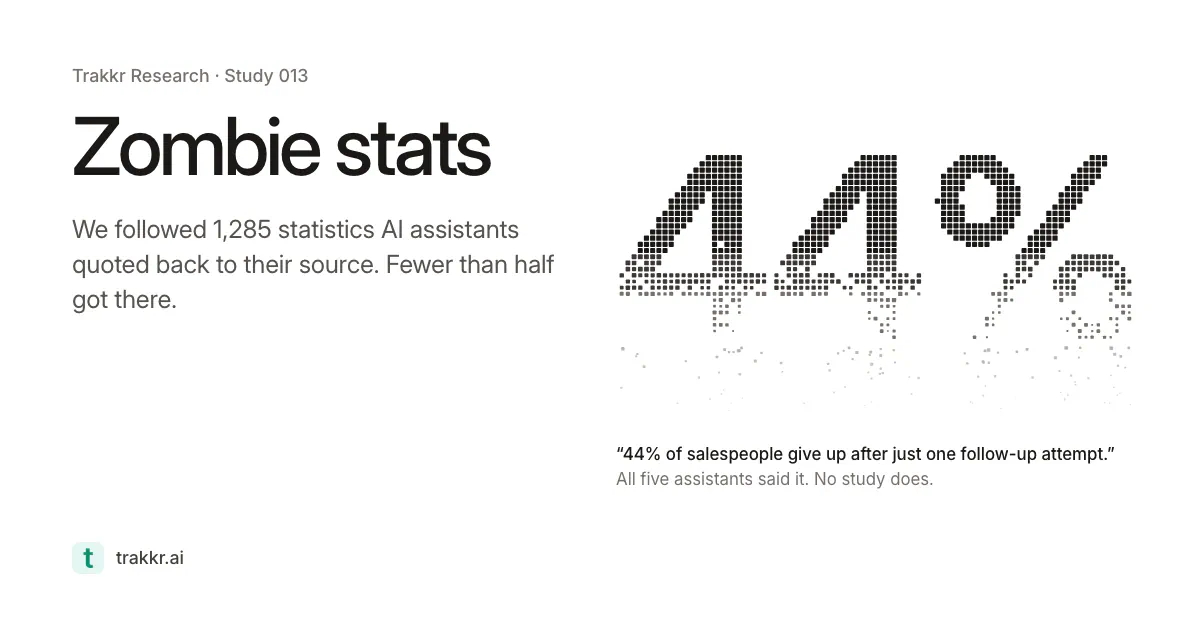
The example shows how citation chains can create apparent authority. An assistant can accurately repeat what a webpage says while leaving the underlying claim unsupported.
Agreement between assistants adds little protection in that situation. Five systems can encounter the same repeated claim online; their agreement is not five independent confirmations. The useful check is whether their evidence trails reach actual research.
A Checklist for Verifying AI-Provided Numbers
The following checklist adapts Trakkr’s trail-following method into a practical reading workflow. It is an analysis-based recommendation, not a separately tested verification tool.
Open the Citation and Locate the Claim
Search the cited page for the number, including alternate forms such as 44%, 44 percent or forty-four percent.
Check that the page makes the same claim. A page mentioning a company’s revenue does not necessarily support an assistant’s claim about its profit. A citation may support the surrounding topic while leaving the specific number unsupported.
If you cannot find the figure, record that mismatch before following more links.
Find Out Who Produced the Number
Look for a named survey, research paper, dataset, annual report or official statistical release.
Frequently Asked Questions
3 questions
1Does Trakkr’s Study Mean 60% of AI Statistics Are False?
No. Many trails could not be checked. The study separates inaccessible evidence, changed claims and trails without identified research.