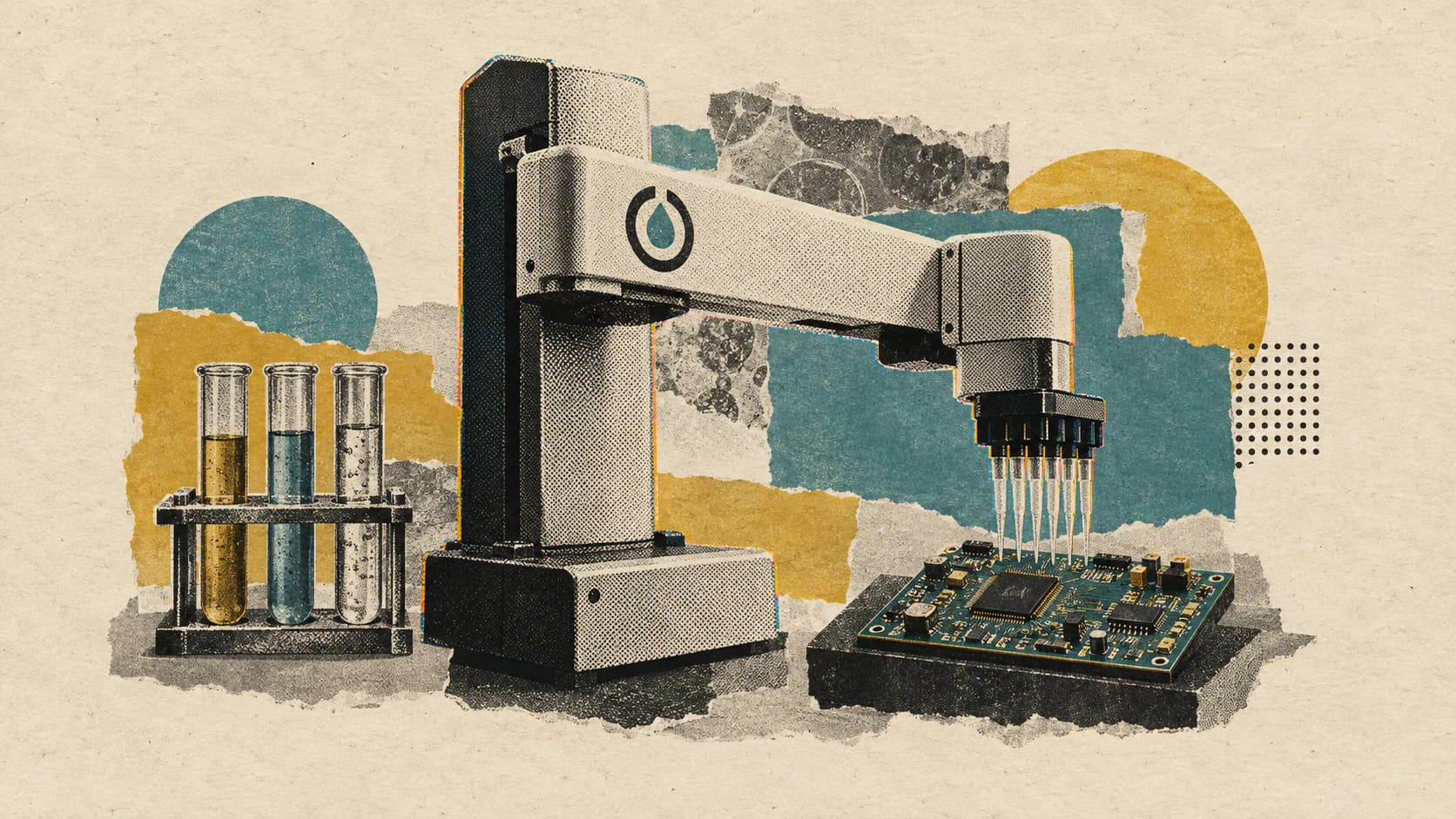
Opentrons announced a $40 million Series E on October 29, 2026, led by healthcare investor Avego with participation from BroadOak Capital Partners. The company says the money will scale its robotics, software and data infrastructure, including AI-driven experimental execution and deeper integration with other laboratory equipment. The original announcement positions that investment as a response to a physical bottleneck: AI can propose experiments faster than laboratories can carry them out.
That is a useful way to frame the financing. A model-generated experiment still needs samples, reagents, equipment and a sequence of physical actions. Improving the model alone cannot make those actions happen.
The important distinction is between automating those actions and closing the scientific learning loop. Opentrons already sells programmable liquid-handling robots. Its broader ambition is for AI and robotics to design experiments, execute them and learn from their results. The funding is intended to advance that connection, but the announcement provides much more evidence of the company’s deployment footprint than of fully autonomous experimentation.
What Opentrons Robots Already Automate
Opentrons’ Flex and OT-2 are benchtop robots that use motorized pipettes to transfer small amounts of liquid between samples. These are useful capabilities in their own right: preparing samples and repeatedly moving liquids are common parts of biological research.
According to SiliconANGLE’s coverage, Flex offers higher sample capacity and an optional robotic gripper that can move plates. The smaller, less expensive OT-2 focuses on repetitive liquid handling without Flex’s automated plate-handling capability.

| Platform | Capability described in the reporting | Practical significance |
|---|---|---|
| OT-2 | Programmable, repetitive liquid handling | Automates pipetting steps while leaving other workflow steps dependent on the lab’s setup |
| Flex | Higher-capacity liquid handling with an optional plate-moving gripper | Can reduce manual intervention between compatible steps |
| Broader AI and software layer | Tools intended to design, run and improve experiments | Aims to connect experimental planning with physical execution and subsequent learning |
The gripper distinction matters. Moving liquid within a plate and moving the plate itself are separate tasks. A workflow that needs a person to reposition materials between stages has a different level of autonomy from one that can handle those transitions automatically.
SiliconANGLE lists DNA extraction, polymerase chain reaction, protein purification and ELISA assays among the applications for which the robots can be configured. These names describe workflows, however, not a guarantee that every step of each assay runs unattended. The actual boundary depends on the selected robot, accessories, protocol and surrounding equipment.
I’d evaluate a purchase at that workflow level. “Can automate sample preparation” is useful information; “which steps still require a person?” is the question that determines how much work a particular lab can actually hand over.
What the $40 Million Is Intended to Change
The funding plan spans hardware, software and the connections between them. Opentrons identifies several priorities in its Series E announcement:
- AI-driven experimental execution: developing the systems that connect scientific goals and experimental plans to robot actions.
- Faster protocol development: using software and AI to reduce the work involved in creating executable procedures.
- Expanded automation capabilities: extending what its robots and instruments can handle.
- Deeper ecosystem integration: connecting Opentrons tools with the broader laboratory automation environment.
- Commercial expansion: entering additional markets and geographies.
Avego’s own post, dated October 29, 2026, also describes the investment as funding robotics, software and data infrastructure. It is an investor’s account of the same financing, not independent technical validation.
The distinction between protocol development and experimental execution deserves attention. A scientific procedure must become a sequence that the configured equipment can perform. Faster protocol authoring could therefore be valuable even before a lab reaches anything resembling autonomous discovery.
Integration could be equally consequential. A robot may complete its assigned liquid transfers while the overall experiment still waits for another instrument or a human operator. Connecting those stages could remove practical delays that a more capable experiment-planning model would leave untouched.
The announcement gives no spending breakdown, product-release schedule or indication of which priority comes first. Readers should therefore treat the $40 million as funding for a development and expansion program, not as a specification for a newly available autonomous product.
What 11,000 Deployed Robots Actually Demonstrate
Opentrons says it has deployed more than 11,000 robots across more than 80 countries, including installations at 90% of the top 20 global pharmaceutical companies. Its announcement also cites deployments at every top-20 U.S. research university and 14 of the top 15 global biopharma companies. These are company-supplied figures; the opened sources provide no independent verification.
Those numbers suggest substantial reach for laboratory automation. They do not reveal how much of that installed base is participating in AI-directed experimental workflows.
Several details needed to make that connection are missing:
- The split between Flex, OT-2 and other hardware generations.
- How many deployed robots remain active.
- How many use the relevant AI software.
- How often workflows run without human intervention.
- How many installations connect experimental results back to a system that selects the next experiment.
The customer-penetration figures also need careful reading. Ninety percent of 20 companies means presence at 18 organizations. It says nothing about the number of robots within each organization, the share of experimental work they perform or how broadly the software is used.
The separate “14 of the top 15” biopharma figure uses a different denominator and customer category. The release does not identify the rankings or named customer lists, so the two figures cannot usefully be combined into a larger measure of adoption. Both formulations appear in the company’s announcement.
My reading is that the installed base could give Opentrons a valuable distribution advantage: it already has equipment in laboratories where additional software and integration may find customers. That is a commercial inference. It does not tell us how much of that equipment supports the proposed AI capabilities or whether customers will adopt them.
A Robot Run Log Is Only Part of the Scientific Loop
Opentrons makes a consequential claim in the release: every experiment run on its robots generates structured, reproducible data that lays the foundation for autonomous science.
Structured execution data can be useful. A machine-readable record of a protocol can help establish what procedure was specified and connect that procedure to a particular run. But a record of execution and a scientific result serve different purposes.
Consider an illustrative DNA-preparation workflow. A liquid-handling robot could perform the specified transfers. Evaluating the experiment might then require measurements showing whether the preparation achieved its intended result. For an AI system to learn from that run, it would need the outcome associated with the correct samples, inputs and procedure.
That reasoning exposes three distinct parts of the proposed loop:
- Execution: translating an experimental plan into actions the configured equipment can perform.
Frequently Asked Questions
4 questions
1How Much Did Opentrons Raise?
Opentrons announced a $40 million Series E on October 29, 2026. Avego led the round, with participation from BroadOak Capital Partners.