
Proton CEO Andy Yen urged engineers to use more AI after an employee requested additional time to security-test new code, according to an October 29, 2026 investigation by 404 Media. The report describes a leadership push to accelerate development at the privacy-focused company, alongside employees’ concerns about testing, their ability to challenge decisions and their jobs.
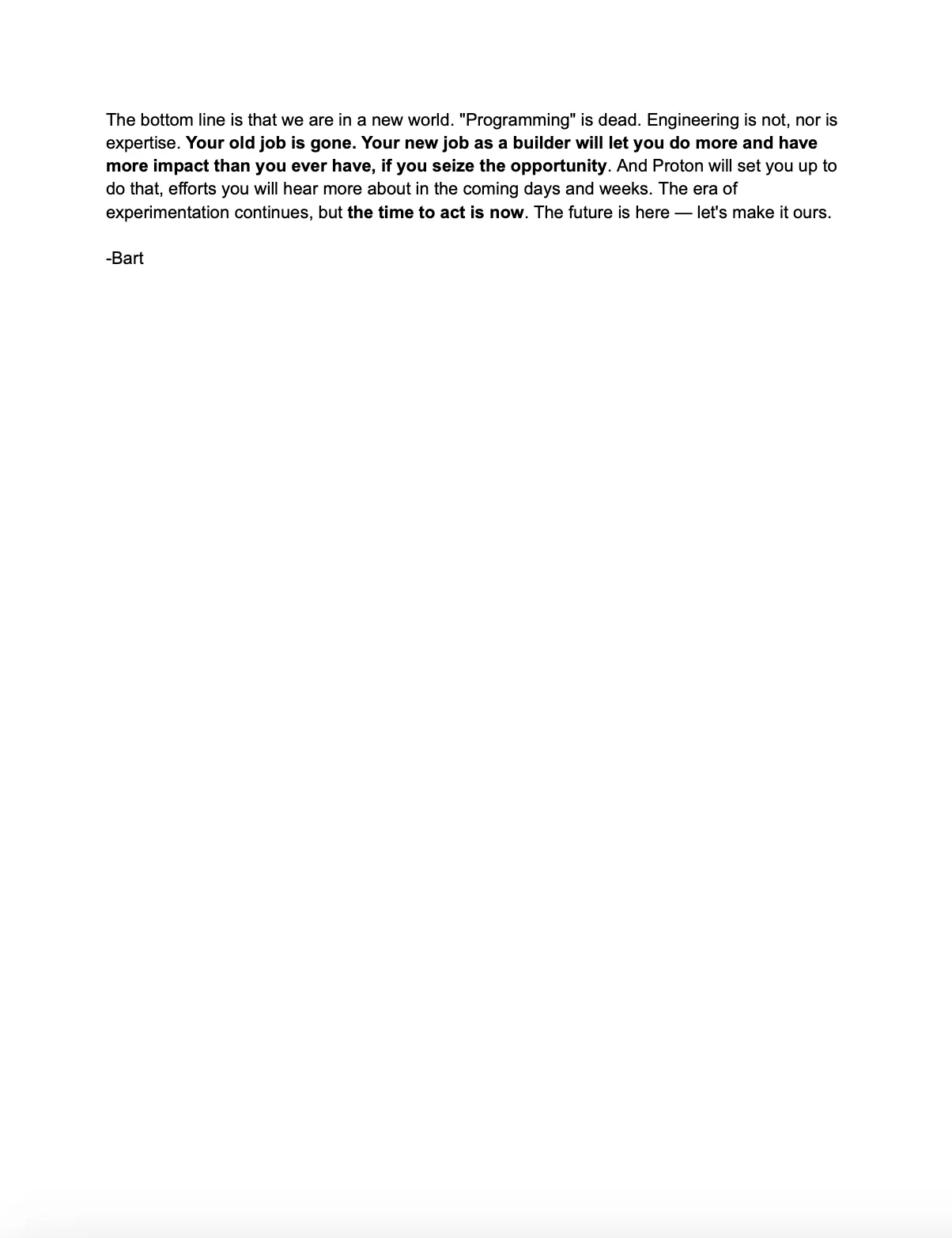
404 Media also reports that CTO Bart Butler told a meeting that AI had written 90% of Proton’s October code. That figure is an attributed internal claim, not an independently audited measure of the company’s software.
Proton’s response, delivered to 404 Media, acknowledged employee anxiety and shortcomings in how leadership communicated its plans. The dispute leaves a practical accountability question: what safeguards accompany the reported acceleration, and what evidence can customers use to assess them?
What 404 Media Reports About the Internal Push
404 Media’s Joseph Cox reports speaking with eight current Proton employees and one former employee, and reviewing Slack messages, meeting recordings and internal documents. Zeniteq has not independently reviewed those internal materials.
The investigation opens with an exchange in Proton’s security Slack channel at the end of August. According to 404 Media, an employee asked for at least a few days to penetration-test newly written code before deployment. Yen responded:
“That’s bullshit and loser thinking.”
404 Media reports that Yen said speed and security could coexist, told staff to concentrate on moving faster and urged them to use more AI instead of painstakingly writing all their code by hand.
The distinction matters. A disagreement about how long a particular test needs can be an ordinary engineering decision. The more consequential allegation here is that employees felt unable to raise technical concerns without risking a public rebuke or consequences for their employment. That account comes from 404 Media’s reporting, including its employee sources.
The outlet also reports that Proton installed software on workers’ computers to track AI-code generation and that Yen created an email address for employees to report obstacles to AI adoption.
An earlier 404 Media report, published October 26, described an internal email announcing that staff would be re-interviewed about their use of AI. The outlet reported that those interviews could affect continued employment. Together, the reports describe AI adoption as an employment and management policy, with consequences beyond the choice of coding tools.
Proton’s Response Addresses Communication and Staff Anxiety
A Proton spokesperson told 404 Media that the company was committed to retraining and reskilling staff. The spokesperson also acknowledged that some employees were unhappy with, or misunderstood, the company’s direction.
On leadership’s communication, the spokesperson said:
“we have sometimes been too blunt or too slow in explaining ourselves to our people.”
404 Media says Proton did not dispute its reporting or characterization. That description should remain attributed to the outlet; it is not independent confirmation of every internal exchange.
The response addresses a real part of the dispute: employees’ understanding of the changes and their future at Proton. It offers less help with the engineering question. An acknowledgment of blunt communication does not explain how release decisions are made, how much testing is required or who can stop a deployment when security concerns remain.
My view is that this distinction is central to the story. Better communication could reduce uncertainty for staff, but an answer about security assurance needs concrete information about review and release controls.
What the 90% AI-Written-Code Claim Actually Tells Us
Butler’s reported statement concerns code written during October, not 90% of Proton’s entire existing codebase. It should not be presented as a measurement of every Proton product or all the software the company has ever shipped.
The percentage also needs a definition before readers can make useful comparisons. A meaningful accounting would explain:
- The denominator: Whether the count covers lines, accepted suggestions, changed files or another unit.
- The scope: Which repositories, products and types of work are included, such as tests, documentation or production code.
- The treatment of edits: How code is classified when a person substantially revises AI-generated output.
- The deployment boundary: Whether the figure describes generated drafts, merged changes or code released to users.
These are questions the statistic invites, not claims about how Proton calculated it.
Even with a precise definition, AI authorship would describe how code was produced. It would not measure whether the result was correct, whether reviewers understood it or whether tests covered important failure cases. More generated code can also create more material to review; a production metric alone cannot show whether verification capacity kept pace.
The reported 90% figure is therefore evidence of the scale of leadership’s claimed adoption, not a security score. The reporting presented here does not establish that Proton products became insecure or contain a particular vulnerability.
I would give much more weight to evidence about review quality, testing and release decisions than to the percentage itself. Those measures are closer to the outcome customers care about: whether changes preserve the protections they rely on.
Proton’s October Updates Show a Narrow Disclosure Gap
Proton’s public product-update index provides a useful comparison with the reported internal push. Its October entries describe customer-facing changes across several products:
| Date in 2026 | Announcement | What the index describes |
|---|---|---|
| October 22 | Lumo creation features | Documents, code and web pages created through Lumo’s canvas |
| October 21 | Admin roles and SCIM for groups | Organizational access management |
| October 15 | Proton Pass updates | Folders, URL matching and compromised-password alerts |
| October 15 | Autumn and winter roadmaps | Planned work across Mail, Drive, Pass, VPN and Lumo |
Frequently Asked Questions
3 questions
1Is the 90% AI-Code Figure Independently Verified?
No. It is a statement attributed to CTO Bart Butler in 404 Media’s meeting reporting, not an independently audited measure of Proton’s code.


