
Mintive has raised a $7 million seed round led by Cowboy Ventures, bringing its total funding to $11 million, according to TechCrunch’s October 29, 2026 report. Other investors include Coatue, Operator Collective and Hustle Fund, alongside angels including Okta co-founder Frederic Kerrest, Jeff Dean and Andrej Karpathy.
The company sells infrastructure for a specific enterprise AI problem: an agent needs permission to do useful work, but giving it an employee’s credentials can also give it access far beyond that work. Mintive combines agent identities, a Model Context Protocol gateway, a model gateway and monitoring to put controls around those actions.
Mintive reports more than 50 customers and 2.5 million agent calls a day. Those are company-reported traction figures, not independent measurements of adoption or security effectiveness.
The technical question that matters most is what happens after an agent gets through the gateway. A system can record which agent requested a tool while the underlying application still sees only a shared, broadly privileged credential. Mintive’s identity pitch addresses that gap, but buyers need to examine the downstream authorization path as closely as the gateway dashboard.
Why Agents Need More Than an Employee Login
An employee might be allowed to read customer records, change account details and export reports. An agent assigned to summarize support cases may need only a small part of that access. Reusing the employee’s credentials makes those two permission sets difficult to separate.
Mintive describes its approach as “Treat each agent like an employee”: give it an identity, permissions and credentials that administrators can revoke independently. The useful part of that analogy is lifecycle management. An agent should have an accountable owner, a defined job and a way to lose access without disrupting everyone else.
Agents also complicate a familiar identity distinction: acting for a person versus acting as an automated workload.
An August 2026 enterprise MCP architecture paper illustrates this with an Office 365 server. An employee asking for an email summary needs access under that employee’s identity. A nightly calendar-digest job needs its own service-account authority, without the ability to impersonate individual employees. Both may use the same tool endpoint, but their authorization requirements differ.
Three concepts matter here:
- Identity: Which person or agent is making the request?
- Credentials: What token, key or other proof authenticates that caller?
- Authorization: Which resources and actions may that caller use in this context?
An API key is a credential, not a complete identity-management system. A dedicated, appropriately scoped key can identify a workload. A shared key used by several agents makes attribution and selective revocation harder.
Existing identity standards still have a substantial role. The Identity Management for Agentic AI whitepaper says existing OAuth 2.1 frameworks work well for synchronous agent operations within a single trust domain. It identifies harder cases involving cross-domain access, asynchronous work and delegation for multiple people.
My view is that “agents need identity” is most useful as an engineering requirement, not a claim that conventional IAM is obsolete. The challenge is combining familiar controls so an agent remains distinguishable from its user throughout a changing sequence of tool calls.
What Mintive Says Its Platform Controls
Mintive places its controls around two different routes: agents calling tools, and applications calling models. Those routes carry different risks.
MCP, short for Model Context Protocol, provides a common interface through which AI clients can discover and invoke tools. An MCP gateway can therefore become a central checkpoint for access to connected business systems. An LLM gateway handles model requests, with controls such as model selection and spending limits.
According to Mintive’s product site, its main components include:
| Component | Advertised controls | Practical purpose |
|---|---|---|
| MCP gateway | Approved servers, role-based tool bundles and switches for destructive actions | Limit which tools agents can reach and what operations are available |
| LLM gateway | Allowed models, routing, team budgets, token and spending visibility | Govern model use and costs |
| Agent identities | Separate identities, delegated credentials and independently revocable access | Avoid tying an agent’s entire access lifecycle to an employee’s credentials |
| Monitoring and audit | Attribution to people, agents, servers and models, with SIEM export or OTLP streaming | Make activity available for investigation and operational monitoring |
The company specifically advertises agent-identity support for Claude, ChatGPT workspace agents and Cursor background agents. Its broader gateway pitch also names clients including Copilot and Cowork. These are advertised compatibility claims; the available material does not provide a complete connector-by-connector account of downstream identity behavior.
Mintive also offers agents that work proactively in Slack and Teams, with long-term memory. That extends its scope beyond an access-control layer into running agent workloads.
CEO Jiquan Ngiam told TechCrunch that ease of deployment is a central selling point. The company promises a setup involving only a few clicks. The supplied evidence contains no independent deployment testing, so setup time and real-world effectiveness remain vendor claims.
Screening Does Not Always Mean Blocking
Mintive’s Mint Guard feature screens gateway traffic for prompt injection, secrets, personal data and harmful content. Its published policy makes an important distinction: high-confidence prompt-injection detections are blocked, while credentials, secrets, personally identifiable information and harmful content are listed as log only.
The interface also distinguishes protection being off, monitoring and enforcing. Those settings matter because detecting a sensitive value and preventing it from leaving a system are different outcomes. Mintive says customers can connect existing data-loss-prevention tools as well. Its product page documents these controls and modes.
I’d treat that policy detail as a deployment checklist item. A security team concerned about exposed API keys should verify its blocking configuration and connected DLP policy, instead of assuming that every category Mint Guard detects is automatically stopped.
The Last-Mile Test for Agent Permissions
A gateway can centralize policy without automatically solving every downstream identity problem.
In a September 1, 2026 technical article, Okta’s Alex Kemenov describes a “last-mile” problem: identity context can disappear between the gateway and the resource doing the work. The gateway may know who submitted a request, while the database, application or MCP server authorizes it using a shared service credential.
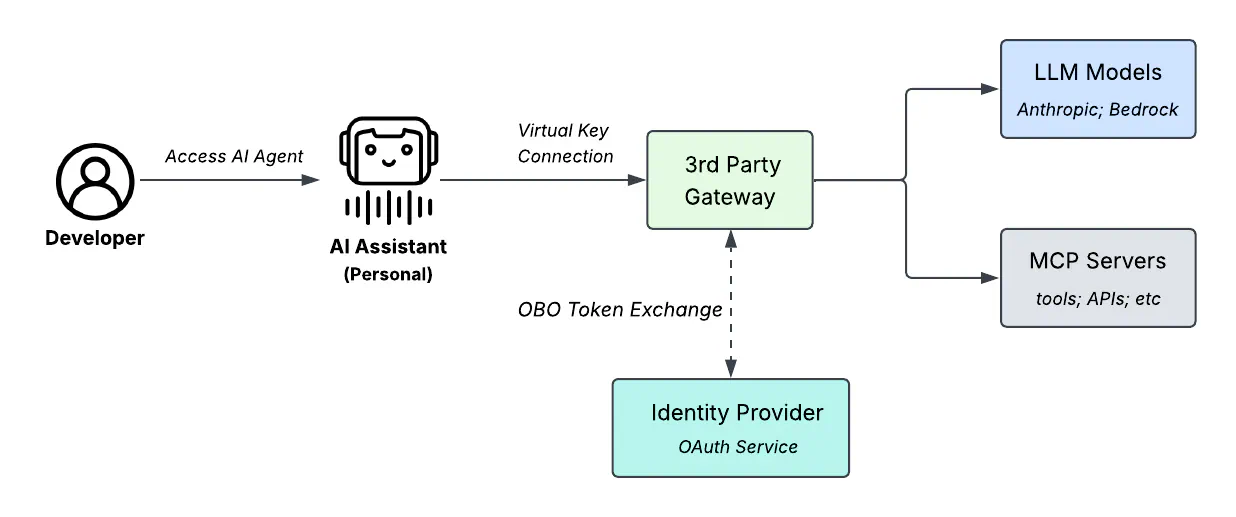
Okta sells identity products, so this is a vendor’s architectural analysis. Its specific warning is nevertheless useful: a detailed gateway log does not guarantee that the underlying resource checked the correct person’s entitlements.
The August MCP architecture paper describes a related operational problem. Its authors report a production environment with dozens of MCP servers using inconsistent authentication, including shared API keys and OAuth. They identify fragmented authorization, incompatible audit logs and difficult employee offboarding as consequences. Their proposed gateway architecture includes distinct user and non-user identity flows, plus delegated token exchange. That is evidence for the architecture pattern, not validation of Mintive’s implementation.
Together, these sources suggest a concrete test for Mintive or any competing platform: can the system preserve both the agent’s identity and the authority under which it is acting?
Consider an illustrative support-summary agent. Its human operator can access two customer accounts, but the agent’s assignment covers only one. A sound authorization decision needs to respect:
- The agent’s permitted actions and assigned scope.
- The human operator’s access, when the agent acts on that person’s behalf.
- The destination application’s resource policy.
The effective permission should not expand beyond those limits. If the gateway forwards a broadly privileged shared key, a downstream application may be unable to enforce the distinction itself. Gateway checks then carry more of the security burden.
Frequently Asked Questions
3 questions
1How Much Funding Did Mintive Raise?
Mintive raised a $7 million seed round led by Cowboy Ventures, bringing total funding to $11 million, according to TechCrunch’s October 29, 2026 report.