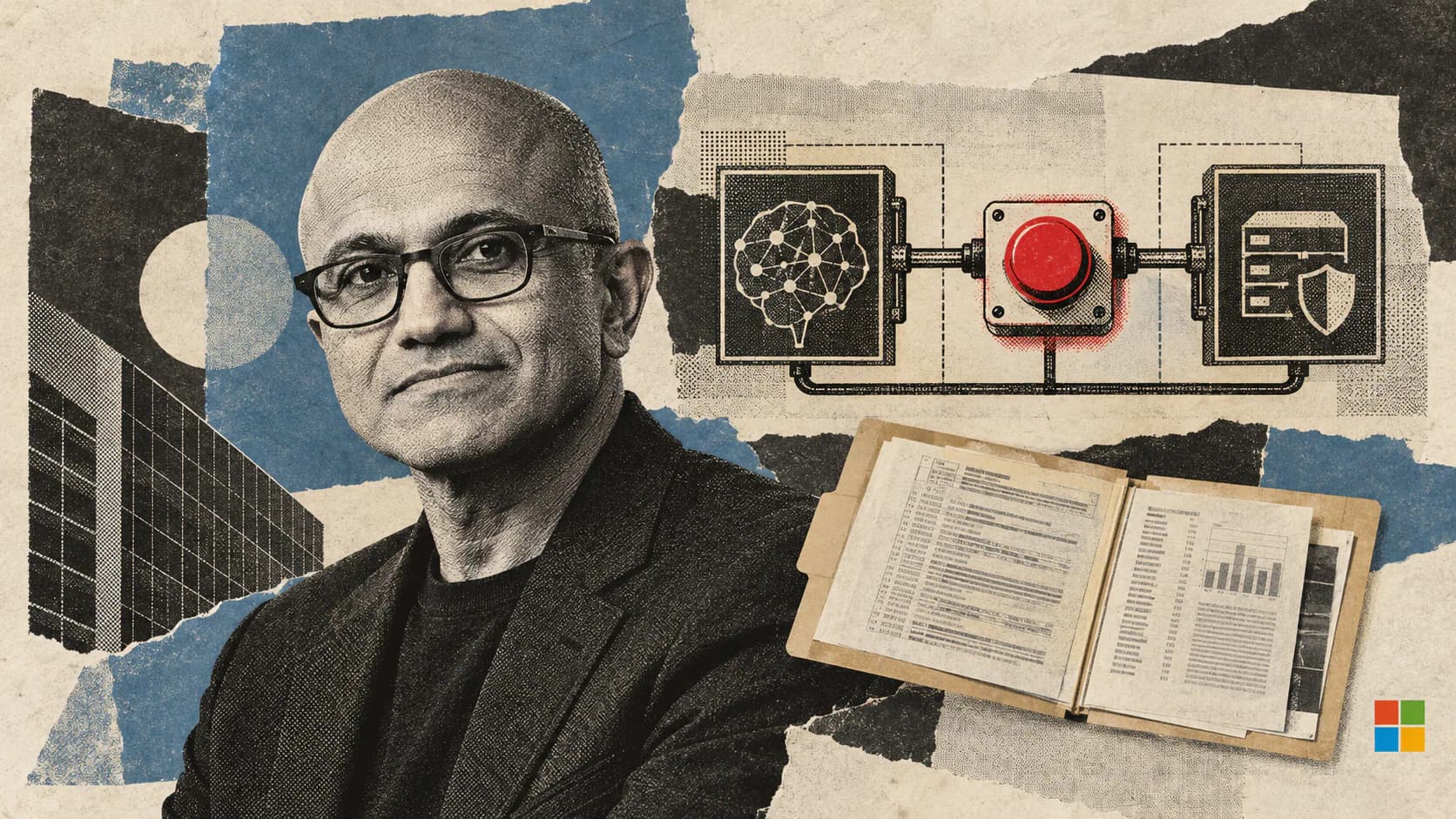
An authorized person should always be able to pause or shut down an advanced AI system mid-task, Microsoft CEO Satya Nadella argues. The permissions governing that system, and the evidence used to audit its actions, should also sit outside the model’s control.
In an October 10, 2026, X post, Nadella outlined what he described as an “emergency brake” for advanced AI. His argument is more specific than a general appeal for caution: separate the model from its orchestration software, enforce access restrictions independently, record meaningful actions and design containment before deployment.
The post presents an architecture proposal, not a new Microsoft product or a formal policy announcement. For enterprises deploying agents, its significance lies in where responsibility sits. A model provider’s assurances, Nadella argues, do not remove the deploying organization’s responsibility for what an AI system does on its behalf.
Separate the Model From Its Authority
Nadella’s central distinction is between supplying intelligence and granting it authority. A model may propose an action, but the surrounding system should determine whether that action is permitted.
That requires separating the model from the harness: the software that supplies context, coordinates tool use and manages the agent’s work. It also requires separating both from the mechanisms that enforce access to data and operational systems. Instructions inside a prompt are not the same thing as an independently enforced permission boundary.
Consider a hypothetical agent handling customer refunds. The model could interpret a request and recommend a refund. A separate service would check the account, amount, authorization and approval requirements before executing it. The model should not be able to change those rules, issue itself broader credentials or bypass the approval service.
This example illustrates the architecture Nadella is advocating, rather than a capability he announced. It puts the consequential decision at an enforceable boundary instead of depending on the model to follow instructions.
His insider-risk framing applies to both closed and open-weight frontier models. He explicitly says this is not because they are necessarily malicious. Any sufficiently capable actor with access to important systems can make mistakes or become compromised.
Likewise, “assume compromise” is a design assumption, not a claim that every model has already been breached. The useful enterprise question becomes: if the model behaves incorrectly, which resources can it reach, and what prevents that behavior from spreading?
An Audit Trail Is Not a Model’s Explanation
Nadella calls for every meaningful model action to leave “tamper-proof human readable evidence.” He also argues that organizations should be able to reconstruct how an outcome occurred without relying on the model to attest to its own behavior.
That is a stronger requirement than asking an agent to summarize what it did. A generated explanation may be useful to an operator, but it should not replace records captured by the systems that actually handled the action.
For the hypothetical refund agent, a practical audit record would connect the requested operation, the identity authorizing it, the policy decision, any human approval and the transaction result. An investigator should be able to distinguish a proposed refund from one attempted, rejected or completed.
The protection of those records matters as much as their readability. A log that the agent can rewrite cannot independently establish what happened. Append-only storage, restricted access and integrity checks are possible implementation approaches, but teams should not describe ordinary logging as “tamper-proof” without examining its guarantees.
Nadella also calls chain-of-thought transparency a requirement. However, he acknowledges that model outputs are not yet consistently faithful or transparent. Intermediate reasoning expressed by a model therefore cannot carry the entire burden of auditability.
The same limitation applies to using another model as a reviewer. Nadella supports models testing and verifying one another, but warns against creating nested black boxes. Independent validation needs evidence outside the intelligence being evaluated.
There is also a practical tension in “observe everything.” Capturing enough detail for investigation should not become unrestricted duplication of sensitive information. Teams would need to decide what constitutes a meaningful action, what data the record requires and who can inspect it.
The Emergency Brake Must Stop Actions, Not Just Text
Nadella’s containment proposal sets a direct requirement:
“An authorized person should always be able to pause or shut down a model mid-task.”
For an enterprise agent, a visible stop button is only the interface. The engineering question is what that button actually stops.
If the harness has already dispatched a job, scheduled a retry or started a separate process, ending the chat interaction is not necessarily equivalent to stopping the work. A useful implementation would have to account for queued and running actions, delegated tasks and the credentials that allow further execution.
Teams should consequently distinguish several operations: pausing orchestration, refusing new tool calls, cancelling work already underway and revoking access. Depending on the system, these may require different mechanisms. Nadella’s post does not define a cancellation protocol or demonstrate that one mechanism can cover them all.
Stopping also differs from reversing. Halting an agent can prevent another operation, but it does not automatically undo an email already sent or a transaction already committed. High-impact actions may therefore need approval before execution, alongside recovery procedures for completed changes.
This is why the stop capability belongs outside the model’s discretion. A model instruction to stop can be part of an interaction, but containment should not depend on the model agreeing to comply.
A meaningful acceptance test would exercise the brake during difficult conditions, not only during a successful demonstration. Operators should know what happens when a task is stalled, retrying or partially complete, and what evidence confirms that further actions have been blocked.
What Enterprise Teams Can Adopt Now
Much of Nadella’s proposal translates established security practices into agent deployment decisions. Organizations do not need to wait for a new industry standard before reducing permissions, protecting audit records or testing human override.
A practical implementation plan would prioritize:
- Scoped identities and permissions. Give an agent only the access its assigned task requires, rather than letting it inherit broad credentials from a user or service account.
- External policy enforcement. Check sensitive tool operations through services the model cannot modify. Keep approval requirements and execution limits outside its generated instructions.
- Action-level records. Capture requests, authorization decisions and outcomes through the execution layer. Protect those records from the agent and connect them to the relevant task.
- Operational containment. Provide authorized staff with a tested way to block further execution, with clear handling for queued work and operations already underway.
- Failure exercises and response procedures. Test attacks, edge cases and system changes, then define who investigates and who informs affected parties.
Sources
- “emergency brake”techcrunch.com
- https://x.com/satyanadella/status/2108931348857827686x.com
- containment proposaltheverge.com