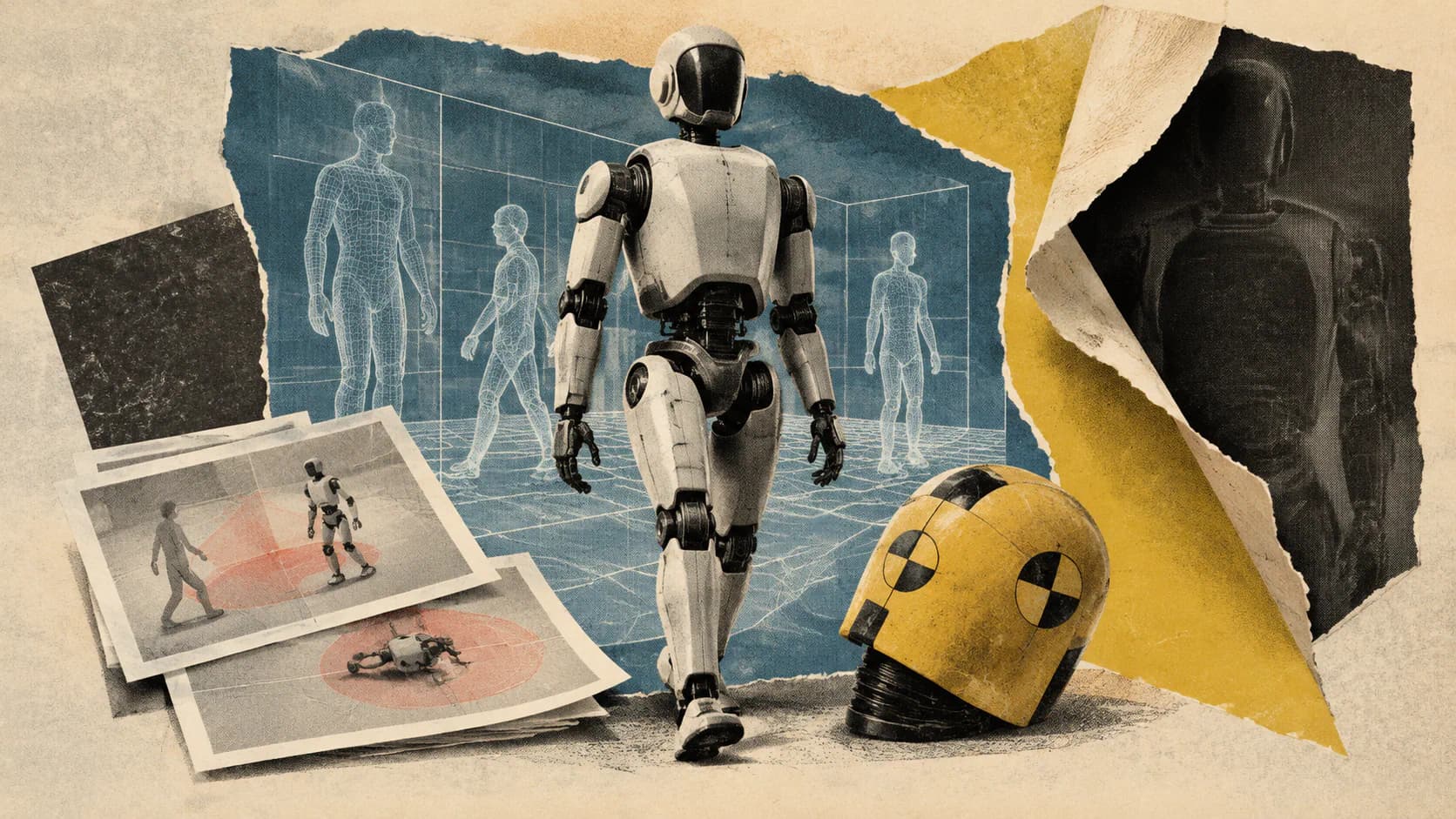
Testing whether a robot responds safely to someone falling into its path presents an obvious problem: recreating the encounter physically could put a person at risk. Safeworld is proposing a simulation-based workflow for exploring those situations before deployment.
The company emerged from stealth on October 5, 2026, according to TechCrunch’s launch report. Its website now offers a waitlist for a robot-safety testing platform that Safeworld says can generate possible interaction paths, predict risk, and preserve evaluation evidence.
The launch materials do not establish that Safeworld reduces real-world injuries, provides complete hazard coverage, or satisfies a particular certification standard. For robotics teams evaluating new AI products, the practical questions are what the proposed tests examine, how their results inform engineering decisions, and what is accessible today.
Safeworld Wants to Test Robots Against Human Behavior
Safeworld’s platform description focuses on robots working around people. The company argues that unpredictable human behavior, changing environments, and software updates create risks that existing testing practices struggle to cover.
Its proposed workflow has three parts: generate possible paths, predict interaction risk, and preserve the evidence. The idea is to go beyond a single successful demonstration, exploring different ways an encounter could unfold and retaining records that engineering, safety, and operations teams can review.
TechCrunch describes an evaluation process in which a simulated robot runs its actual control software inside a digital environment populated with realistic human models. A team could recreate a factory’s blind corner, then vary how people encounter the robot. Does it detect someone carrying boxes that partly obscure their body? Does it respond differently to someone crouching or falling? Is its speed appropriate for the available stopping distance?
The founders told TechCrunch that the workflow would run thousands of scenarios. That is their intended testing approach; no published benchmark shows how many meaningful scenarios the platform has successfully evaluated.
The human models deserve particular scrutiny. A predefined walking path can test one encounter, but it cannot establish how a person would react when a robot changes direction. A model that responds to the robot introduces another set of assumptions. Safeworld’s usefulness will depend partly on how well those assumptions represent the people and operating conditions a customer actually expects.
Simulation Could Expand Testing Without Replacing It
Safeworld’s argument against physical-only testing is practical: dangerous encounters are difficult to recreate safely, and repeatedly arranging people, equipment, and environmental conditions can be expensive.
The website claims teams can test dangerous and unexpected situations “in minutes” without putting people at risk. The supplied evidence includes no independent timing comparison or measured reduction in testing costs to support that vendor claim.
Simulation nevertheless offers a clear engineering rationale. A team can hold some conditions fixed while changing others, making it easier to investigate why a failure occurred. An obstructed crossing can become a repeatable test case instead of an incident someone must reconstruct from memory.
That approach could also help evaluate a software update. If a previous version struggled with a particular encounter, rerunning the same case would let engineers check whether the change addressed it. Related cases could reveal whether the fix introduced a different problem. Safeworld’s public guidance recommends this kind of retesting, though it does not demonstrate the platform’s regression-testing performance.
Physical testing answers questions that a simulated result cannot settle by itself. The simulation must adequately represent the sensors, response delays, motion, and other physical behavior relevant to the test. A robot that stops safely in an inaccurate model may not do so on the floor.
Safeworld’s own guidance acknowledges that physical validation remains necessary where required by the application and applicable standards. Simulation can defensibly help identify and investigate problems, then support validation. It cannot replace the evidence needed from the real system.
A Warehouse Example Shows What a Useful Test Requires
Safeworld’s robot risk-assessment example explains its proposed workflow more concretely than the homepage’s broad safety language.
The guide describes an illustrative mobile robot carrying a load through a warehouse aisle. A worker approaches a crossing behind a loaded cart, which partly blocks the camera’s view. This is a test-planning example, not a measured platform result.
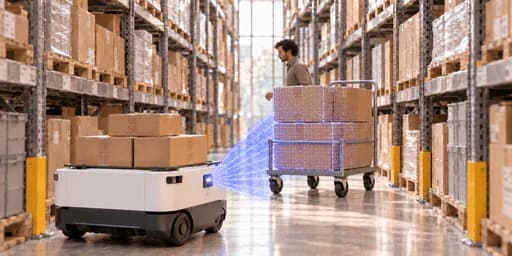
The starting hazard is a person entering space occupied by the robot or its load. Partial visibility is one condition that might contribute to a problem; it does not fully explain every possible collision or injury.
The guide connects that hazard to an engineering record:
- Requirement: Identify what the system must do and the source of that requirement.
- Scenario: Record the robot, sensor placement, load, environment, and human movement.
- Measurement: Define the outputs being assessed, such as missed detections or time to a valid detection.
- Acceptance rule: Establish approved limits before running the evaluation.
- Evidence: Preserve inputs, timestamps, configurations, outputs, and the result for review.
Detection and stopping need separate attention. A detector can correctly identify a person while another component responds too late. The example therefore limits its perception test to sensor input and detector output. Braking requires a separate evaluation covering the complete protective function.
A team should also know its acceptance rule before it sees the result. The guide says a test without approved limits cannot receive a pass verdict. Choosing a convenient threshold afterward would make the result difficult to defend.
To be useful beyond producing plausible-looking scenes, a simulation workflow needs to connect a specific requirement to a specific measurement under recorded conditions. More scenarios are valuable only if they answer relevant safety questions.
The guide also calls for documenting excluded conditions and model limitations. A successful test at one crossing does not establish performance across every aisle, load, posture, or approach direction.
Access Begins With a Waitlist, Not a Public Release
Robotics teams can currently request access through Safeworld’s website and read its public assessment guidance. The access form asks for a name, work email, and company. Developers cannot treat that as an openly available product they can immediately integrate and benchmark.
Frequently Asked Questions
4 questions
1What is Safeworld’s robot-safety platform?
Safeworld describes its platform as a simulation and evaluation system for robots operating around people. The company says it generates possible interaction paths, predicts risk, and preserves testing evidence. TechCrunch reports that the proposed workflow evaluates robot control software in simulated environments with realistic human models. These launch claims have not independently demonstrated safety outcomes.
2
Sources
- TechCrunch’s launch reporttechcrunch.com
- Safeworld’s platform descriptionsafeworld.ai
- robot risk-assessment examplesafeworld.ai