

AWS introduced the general availability of Amazon Bedrock’s Trusted Access API on November 23, 2026, giving teams one workflow for discovering model-provider programs, checking eligibility, requesting approval, and managing enrollment.
The first offerings, Anthropic’s Enterprise Frontier Safeguards (EFS) and Enterprise Data Controls (EDC), are public previews, not generally available services. Both put flagged safety cases in the customer’s hands, but they use different storage arrangements.
Retention is the immediate planning issue. Joining the preview turns off zero data retention for the accounts or projects added. AWS also instructs participants to use a test account, send only test traffic, and exclude regulated data such as personally identifiable information or protected health information.
What Is Generally Available and What Is in Preview?
Amazon Bedrock’s Trusted Access API is generally available; Anthropic EFS and EDC remain public previews requiring eligibility and an AWS account-team request.
| Component | Release status | What it provides |
|---|---|---|
| Amazon Bedrock Trusted Access API | Generally available | Program discovery, eligibility checks, approval requests, and enrollment management |
| Anthropic EFS | Public preview | Retained content in customer-controlled S3 storage, encrypted with the customer’s KMS key |
| Anthropic EDC | Public preview | Retained content in Amazon-managed storage, with AWS-managed encryption |
The distinction matters for deployment planning. A generally available administration API can expose programs whose own terms, implementation, and availability remain provisional. AWS warns that the EFS/EDC preview’s APIs, IAM action names, and endpoints may change before general availability.
Covered models include Anthropic’s Claude Fable and Claude Mythos, plus Claude Opus 5.5 and Claude Sonnet 5.5 used through the Cyber Verification Program (CVP). Teams following Anthropic’s tiered Claude cyber-access programs should treat trusted-access enrollment as an additional governance step, with its own approval and data-handling settings.
How Enrollment, Scope, and IAM Governance Work
Amazon Bedrock’s Trusted Access API separates approval from enrollment: eligibility means a provider or AWS has approved participation, while enrollment determines whether the program takes effect.
The trusted-access documentation describes five computed statuses:
| Status | Meaning | Next action |
|---|---|---|
requestable | No approval covers the scope, or a request was declined | Follow statusReason to request approval |
eligible | Approval exists, but participation is not enabled | Opt in |
enabled | Approval exists and participation is enabled | Program applies to requests |
disabled | Approval exists, but participation is disabled | Opt in again if needed |
revoked | AWS or the provider withdrew approval | Contact the AWS account team |
A revoked program retains its enrollment setting. If approval is restored, that saved setting takes effect again. Administrators should account for that behavior when reviewing whether a previously suspended program could resume.
Enrollment supports three scopes:
- Organization: Covers current and future member accounts. Only the management account or an account registered as a delegated administrator for Amazon Bedrock can request approval, opt in, or view organization enrollment.
- Account: Applies at the individual AWS account level.
- Project: Covers one named Bedrock project in the Region where it was created. The account’s default project cannot receive a project-specific setting.
Requests without a named project use account and organization settings. IAM policies and service control policies (SCPs) govern who can enroll, allowing central administrators to restrict who accepts provider terms.
Project targeting also has an application-side detail. The AWS C++ SDK 1.11.934 changelog, dated November 20, lists an optional projectIdentifier parameter for InvokeModel, InvokeModelWithResponseStream, Converse, and ConverseStream. It accepts a project ID or ARN.
For the EFS/EDC preview, teams still need their AWS account representatives to submit the requested scope and identifiers. The common API standardizes administration; provider approval remains a prerequisite.
EFS vs. EDC: Storage, Encryption, and Safety Reviews
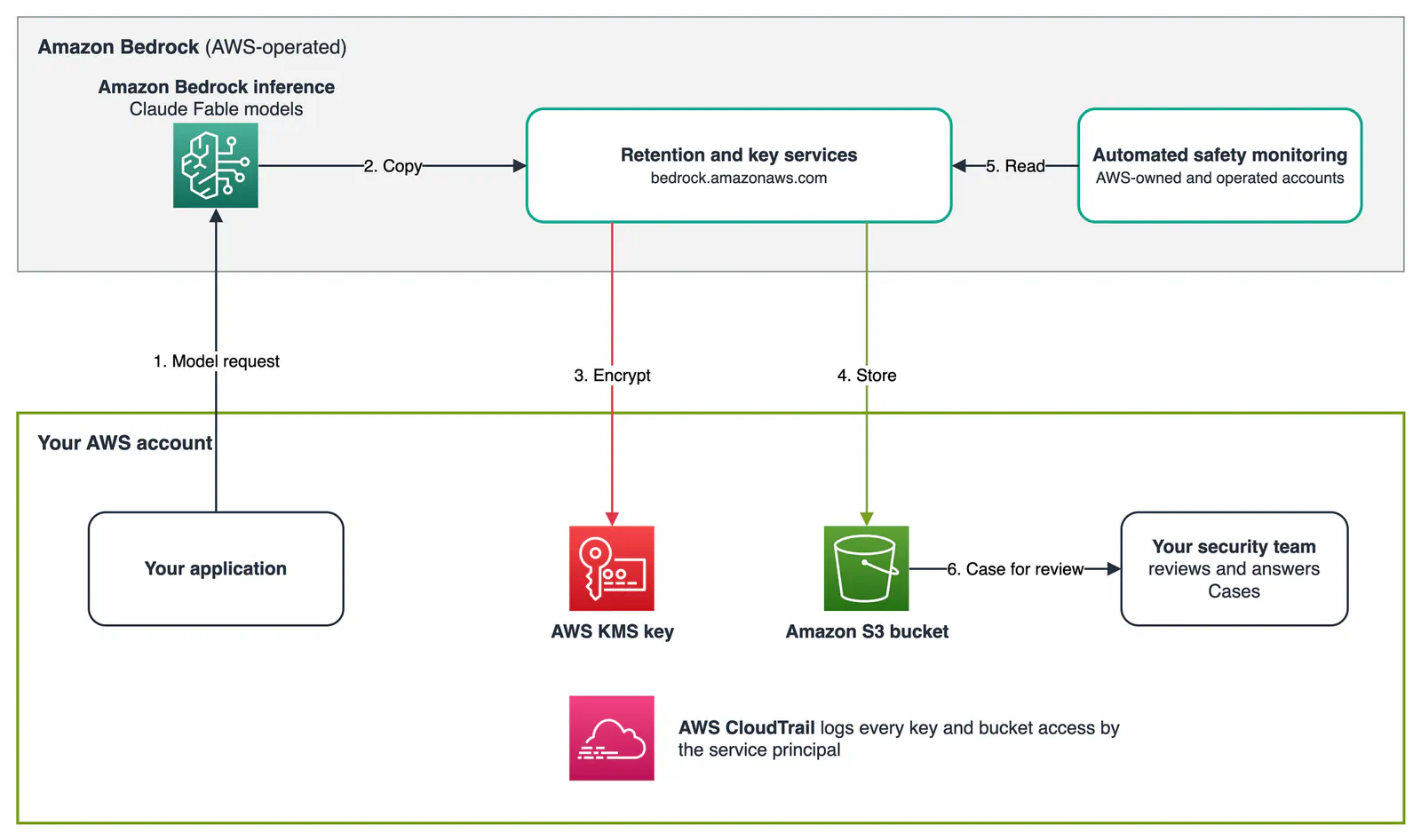
Anthropic’s EFS and EDC public previews differ chiefly in who controls retained storage and encryption, while both leave flagged safety-case review with the customer’s team.
AWS’s EFS/EDC storage comparison sets out the operational differences:
| Detail | EFS: Customer Storage | EDC: Amazon-Managed Storage |
|---|---|---|
| Storage location | S3 bucket in the customer’s account | Storage operated by AWS |
| Encryption | Customer’s AWS KMS key | AWS-managed encryption; customer key is not used |
| Storage access | Bedrock service principal and identities permitted by customer policies | AWS |
| Storage visibility in customer CloudTrail | Key use; bucket access when S3 data events are enabled | No storage activity in the customer’s account |
| Retention period | Customer’s bucket lifecycle rules | Content deleted after 30 days |
| Operational responsibility | Bucket, key, policies, lifecycle, and case review | Case review |
Automated monitoring looks for patterns across requests, including deliberate misuse and agents exceeding their intended authority. Flagged activity creates a safety case for the customer to investigate and answer.
For EFS specifically, AWS says neither AWS nor Anthropic human reviewers access retained inputs and outputs, and those inputs and outputs are never used for training. The retained content supports automated monitoring within AWS.
EFS is the more suitable option when ownership of the bucket, key, and storage audit trail is a requirement. That conclusion follows from the documented controls, but it also carries operational responsibility. EDC removes customer management of the storage infrastructure while leaving the safety-review workload intact.
EFS buckets also contain two different record types: readable inputs and outputs under transcripts/, and encrypted safety-review records under prefixes including slab/. Customer ownership of the bucket does not make every stored object human-readable.
Preview Enrollment Changes Zero Data Retention
Anthropic’s EFS/EDC public preview turns zero data retention off for the accounts or projects added, so covered content is retained in the configured destination. Other accounts keep their existing ZDR treatment.
AWS describes the preview as intended for customers already enrolled in EFS ZDR. Participants therefore need to review a concrete change in handling: EFS stores retained content in their S3 bucket, while EDC uses Amazon-managed storage.
The documentation also identifies aws_review as the data-retention mode used by EFS and EDC accounts. That setting’s name should not be read as a promise of AWS human review; AWS separately describes the EFS process as automated monitoring with customer-led case review.
The practical sequence is to approve the retention change internally, establish the storage destination, and then enroll the intended test scope. Organization-wide participation warrants particular care because its reach includes future member accounts.
AWS’s preview instructions explicitly exclude regulated test traffic. The GA label on the surrounding API is therefore insufficient grounds to send production PII or PHI into these previews.
Regional Storage and the 24-Hour Access Risk
Anthropic’s EFS/EDC public preview uses per-Region storage configurations, with the most specific configuration taking precedence: project, then account, then organization.
Frequently Asked Questions
3 questions
1What Is the Difference Between EFS and EDC?
EFS retains covered content in an S3 bucket in the customer’s account, encrypted with the customer’s KMS key. EDC uses Amazon-managed storage and encryption. Both require the customer’s team to review flagged safety cases, but EFS additionally requires the customer to manage storage policies, lifecycle rules, and key access.


