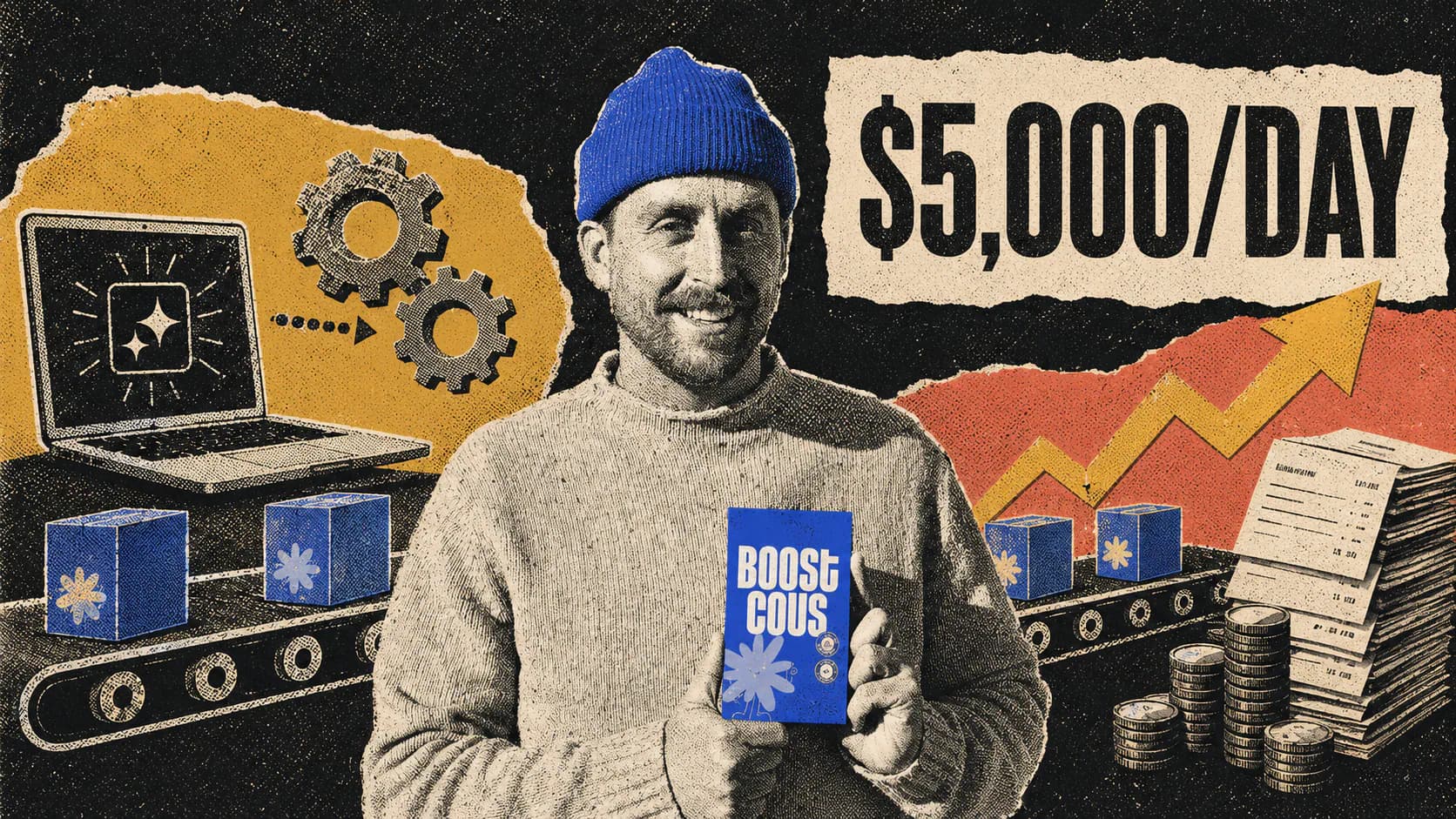
The most revealing part of the Boostcous story is not that an AI tool helped run the business. It is that the founders’ original 10-hour workweek did not survive the company’s growth.
According to Entrepreneur’s March 13, 2026 profile, Bar Bruhis and Brian Gallagher launched Boostcous in December 2025. Within months, the high-protein couscous startup was generating more than $5,000 in daily sales and forecasting roughly $3 million in 2026 revenue. Bruhis credited an AI agent with handling advertising, email, invoices, and other operational work.
That sounds like a blueprint for an unusually easy side hustle. A closer look reveals something more useful: a two-year product-development process, $30,000 in founder capital, credit-card financing, manufacturing problems, paid advertising, industry connections, and a workload that eventually exceeded 40 hours per week.
From Kitchen Experiment to a $30,000 Launch

Bruhis’ idea came from a familiar food. He grew up eating couscous in Israel but found that traditional varieties no longer fit his nutrition goals. He and Gallagher spent about two years formulating an alternative before launching Boostcous, which the company makes from chickpea, lentil, and pea flour. Its website advertises 18 grams of protein and 11 grams of fiber per serving, with a cooking time of five to seven minutes.
The co-founders invested $15,000 each and supplemented that $30,000 with 12-month, interest-free credit cards, primarily to fund marketing. They secured the brand’s domain and social accounts, then worked through formulation, ingredient sourcing, manufacturing, packing, and food-safety requirements. This was a physical consumer product, so an attractive website and clever AI-generated copy could not replace supply-chain work.
Boostcous made about $10,000 during its first two weeks after receiving media attention. Sales then declined, forcing the founders to learn paid acquisition. Bruhis said it took roughly two months to generate consistent revenue. The first 12,000-box production run also carried an incorrectly calculated nutrition label, which the company acknowledged and corrected on its website and subsequent packaging.
The 10-Hour Workweek Did Not Last
The “10 hours per week” claim describes Boostcous’ early stage, not the workload required once sales accelerated. Bruhis said he initially spent 10 to 15 hours per week on the business. By the time of the March profile, that commitment had grown beyond 40 hours, and he planned to leave his day job on April 1 to run the startup full-time.
He also entered the business with relevant advantages. Bruhis was general manager of KnoCommerce, a post-purchase survey company that he said served 6,500 Shopify brands. That position gave him access to experienced direct-to-consumer operators and mentors. He also relied on consumer packaged goods communities and hundreds, potentially thousands, of hours of YouTube instruction covering websites, advertising, branding, and email marketing.
None of that diminishes the result. It does change the lesson. The business began as a side hustle, but it was not a push-button startup created by a novice in a few spare evenings. The founders combined product knowledge, industry relationships, financing, sustained learning, and increasingly substantial labor.
OpenClaw Became an AI Operations Layer
Bruhis said he uses OpenClaw, an open-source personal AI assistant, to build ads, design and distribute email campaigns, process invoices, and complete other recurring tasks. That gives the founder something closer to a configurable operations assistant than a standard chatbot.
OpenClaw runs on a user-controlled machine and can connect with communication channels such as WhatsApp, Telegram, Discord, and Slack. Depending on its configuration, it can browse websites, manage files, execute scripts, access calendars, and send messages. Its installation process is accessible to technically curious users, although it still involves command-line tools, model configuration, integrations, and ongoing maintenance.
Those capabilities explain why the software can reduce hiring pressure. A startup might use an agent to prepare campaign drafts, organize operational data, create reports, or move information between systems. The founder can then review the work instead of completing every step manually.
The same access creates risk. OpenClaw’s official security guidance recommends restricting inbound messages, limiting high-risk tools, using allowlists, isolating untrusted content, and running sensitive execution inside a sandbox. The documentation warns that emails, webpages, files, and attachments can carry prompt-injection instructions. Giving an AI agent access to invoices, customer information, email, and a local computer requires more care than opening a browser-based chatbot.
Most importantly, OpenClaw did not discover the customer problem, formulate the food, select the ingredients, navigate food-safety rules, or find a manufacturer. It helped automate repeatable digital work around a product the founders had already spent two years developing.
The $5,000-a-Day Figure Is Revenue, Not Profit
Boostcous’ reported sales pace is impressive for a young startup, but the headline number needs context. The company disclosed daily sales, not net income. The founders did not reveal gross margin, ingredient costs, manufacturing expenses, fulfillment fees, payment-processing charges, advertising costs, refunds, salaries, or debt repayments.
A business generating $5,000 per day at a flat pace would record approximately $1.825 million over 365 days. Reaching $3 million in 2026 requires average daily revenue of about $8,219 across the full year. Boostcous’ forecast therefore assumed continued growth, stronger sales later in the year, or both.
The difference does not make the projection implausible. Bruhis said the business had already moved from launch-driven publicity to consistent paid acquisition. It does mean that “on track for $3 million” should be read as a founder-supplied forecast, not a completed or independently audited result. As of August 24, 2026, the year is still in progress.
What Other Startup Founders Can Copy
The transferable parts of the Boostcous story are less dramatic than the revenue headline, but considerably more practical.
- Start with a specific customer problem. Bruhis wanted the convenience of couscous with more protein and fiber. The product addressed a clear use case instead of beginning with an AI tool in search of a business.
- Expect physical products to move slowly. Formulation and manufacturing took approximately two years. Food labels, suppliers, packers, inventory, and regulations do not operate at software speed.
- Apply AI to defined workflows. Ads, emails, invoice processing, research, and reporting have recognizable inputs and outputs. These tasks are safer automation targets than vague instructions to “run the business.”
- Buy expertise when learning has poor returns. Bruhis recalled wasting hours trying to design email templates before finding a designer who charged about $30 per email. AI does not eliminate the value of capable specialists.
- Treat early attention as validation, not stability. Boostcous’ viral launch produced $10,000 in two weeks, but sales subsequently fell. The founders still had to build a repeatable paid-marketing system.
There is also a broader lesson for AI-enabled business owners: automation works best after someone understands the underlying process. A poorly defined workflow does not become reliable because an agent completes it faster. Founders still need review procedures, spending limits, secure permissions, and clear points where a human must approve an action.
Final Thoughts
Boostcous is better understood as an AI-assisted consumer startup than an AI-created side hustle. OpenClaw appears to have helped a small team delay some hiring and operate with greater speed, but the agent sat on top of years of formulation, founder capital, manufacturing work, industry mentorship, and paid customer acquisition.
The transition from 10 to 15 hours per week to more than 40 is not a contradiction in the company’s success story. It is evidence that automation has limits. AI can give a founder more operating capacity, but when a physical business starts generating thousands of dollars in daily sales, the work does not disappear. It changes from launching a side hustle to building a company.
Frequently Asked Questions
4 questions
1How did Boostcous reach $5,000 per day in sales?
Boostcous reached more than $5,000 in daily sales after combining launch publicity with paid advertising. The company made approximately $10,000 during its first two weeks, but that initial momentum faded. The founders then spent about two months learning how to generate consistent revenue through paid customer acquisition.