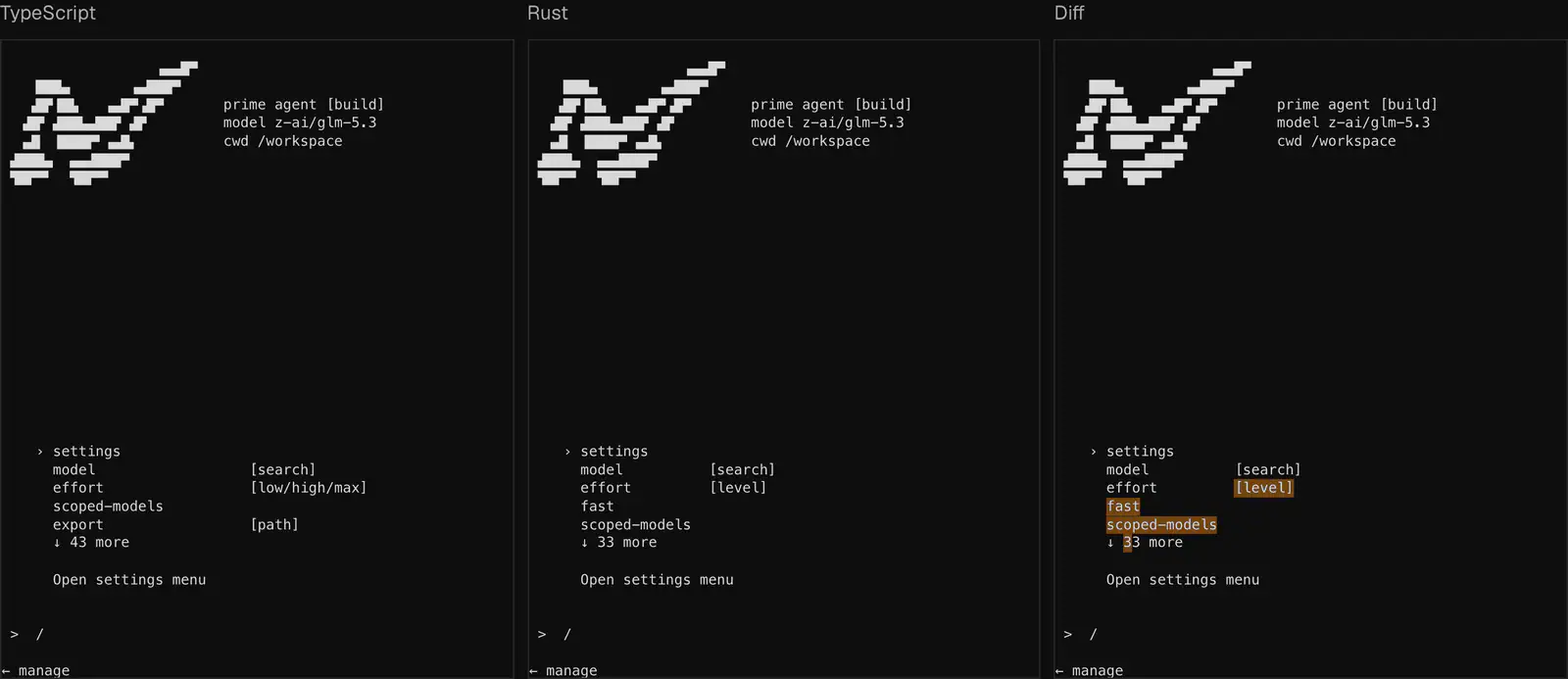
Prime Agent’s Rust rewrite puts each coding session in its own worker process, allowing a session to fail without taking the others down. It also brings native Windows support in beta and simpler installation. These practical changes are separate from the announcement’s bigger claim about how the software was built.
In its October 9, 2026 Rust rewrite announcement, Prime Intellect says more than 2,000 agents worked across over 10,000 Prime Sandboxes, consuming more than 200 billion tokens to rebuild and optimize the tool.
The release is available as open-source software. The swarm totals, engineering timeline and performance findings are Prime Intellect’s own account, not independently verified results. The useful questions are what the shipped design changes and what the company’s documented workflow demonstrates about agent-written infrastructure.
Prime Agent’s worker processes provide crash isolation, not a security boundary. The repository explicitly warns that model-generated code runs with the user’s permissions.
Nine Rust Crates Replace the TypeScript Architecture
Prime Intellect describes the rewrite as an architectural reworking, not a direct language translation. The new code is split into nine Rust crates, with a one-way dependency graph and a shared types crate that defines messages used by clients, the daemon and workers.
That shared protocol definition addresses a common maintenance problem in multi-process software. If one component changes a message type, the compiler can flag incompatible uses elsewhere. It doesn't establish that a message’s meaning is correct, but it makes incompatible definitions harder to ship unnoticed.
The daemon coordinates attached clients, model streams, tool calls and messages between agents. Each session runs in a separate worker under a small supervisor. Prime Intellect says sessions persist on disk, letting clients reattach after a restart.
For long-running coding tasks, a terminal disconnect should not have to end the work, and one failed session should not disrupt unrelated sessions. The Prime Agent repository documents background execution, session attachment and service-management commands.
Platform-specific transport, process control and file locking now sit behind interfaces. According to Prime Intellect, that made Windows support a matter of implementing those interfaces instead of restructuring the daemon again.
The company attributes much of the memory and startup improvement to native code without a JavaScript runtime and garbage collector for each process. It also points to Rust’s compile-time checks for ownership, exhaustive enums and cross-thread data sharing.