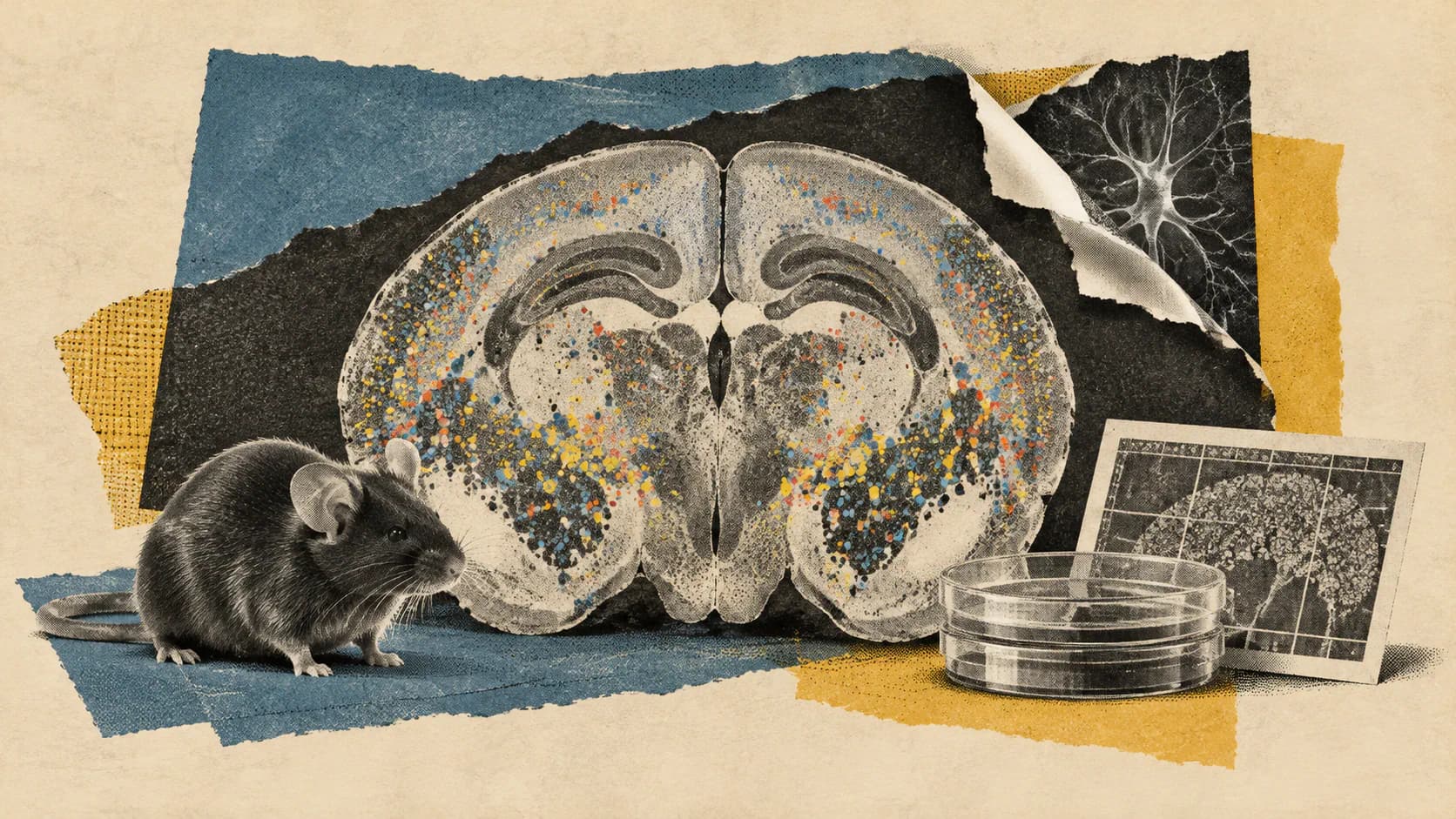
OpenAI says thousands of GPT-Rosalind-powered agents analyzed a mouse brain dataset covering millions of cells in 32 minutes, producing research leads involving gene disruption and neurodegeneration. The output consisted of biological interpretations and proposed mechanisms, none of which were confirmed in the laboratory.
The collaboration between OpenAI, PerturbAI and Scripps Research addresses a specific research bottleneck: interpreting large experiments that measure how cells respond when genes are disrupted. Running agents in parallel allowed the team to examine more perturbations and consult substantially more literature than a single-agent approach, according to OpenAI’s account.
The accompanying manuscript is a bioRxiv preprint that has not been peer-reviewed. Its biological connections remain hypotheses, and the reported timing and evaluation results are the research team’s own measurements.
For researchers, the most useful release may be the Distributed Agents repository. It provides the framework, corpus tooling, saved reports and manuscript notebooks needed to inspect the work beyond the announcement.
Parallel Agents Interpreted an Existing CRISPR Atlas
The system worked on a whole-brain, in vivo CRISPR Perturb-seq atlas. In this type of experiment, researchers disrupt genes and measure changes in gene expression across cells. Responses can differ by cell type, leaving a substantial interpretation task after the experimental data have been collected.
According to the repository, the framework assigns independent AI agents to individual perturbations. Each agent combines cell-type-resolved expression data with scientific literature and produces both narrative and structured reports. The system then synthesizes those narrower investigations to identify relationships between perturbations and prioritize hypotheses for follow-up, instead of asking one agent to interpret the entire dataset.
OpenAI describes the combined output as a reasoning atlas linking disrupted genes, cellular effects, publications and possible mechanisms. It adds an interpretation layer to the experimental measurements without replacing them.
The reported 32 minutes covers only the computational analysis. It excludes collecting millions of cells, conducting the CRISPR experiments and validating the resulting hypotheses. That boundary separates a fast interpretation workflow from an automated experimental discovery process.
Broader Literature Coverage Is the Clearest Reported Gain
OpenAI reports that, at the largest workload, the distributed agents cited more than 700 references, compared with 11 for a single agent. The company also says blinded human experts preferred the distributed-agent reports 75% of the time.
The clearest gains were broader literature coverage and reports that evaluators more often preferred. Those results do not establish that multiple agents automatically produce better science.
Reference counts alone cannot establish scientific accuracy. A report can cite many papers while misreading a result, overlooking contradictory evidence or connecting findings that arose under incompatible experimental conditions. More references create more opportunities to find relevant biology, along with more material that needs checking.
Reviewers, meanwhile, may favor a report because it is more complete, better organized or more persuasive. Their preference does not establish that every proposed mechanism is correct.
Readers assessing the evaluation should distinguish three questions:
- Did the agents cover more relevant evidence?
- Did they interpret that evidence accurately?
- Did the resulting hypotheses predict outcomes in new experiments?
The reported citation and preference results bear most directly on the first two questions. They do not, by themselves, answer the third. The figures also remain team-reported results that have not been independently reproduced.
Tsc1, Tsc2 and DCTN1 Are Follow-Up Leads
OpenAI highlights hypotheses involving differences between Tsc1 and Tsc2 disruptions, alongside a possible connection between DCTN1 disruption, cholesterol regulation and neurodegeneration.
These examples show how the system is intended to work: identify patterns in a large dataset, connect them to existing research and suggest where an investigator should look next. They are not confirmed explanations of disease.
A difference between two perturbations can provide a useful starting point for follow-up. Establishing its biological meaning still requires researchers to examine the relevant cell populations, the underlying measurements and alternative explanations. The agent’s narrative is an argument built from evidence, not an additional experimental observation.
For DCTN1, the proposed connection among gene disruption, cholesterol regulation and neurodegeneration does not show that changing cholesterol will treat a neurological condition. Even a well-supported relationship in mouse cells would leave questions about mechanism and relevance to human disease.
The practical output is a research priority: which connection deserves closer inspection, which measurements would distinguish competing explanations and which experiment could disprove the proposed mechanism.
That is valuable assistance when an atlas contains more signals than a research team can investigate immediately. Its value depends on whether the prioritization leads to informative experiments, including those that reject the AI-generated explanation.
Researchers Can Inspect the Corpus and Reproduce Saved Analyses
The public repository supports several kinds of inspection, each with different requirements.
Researchers can browse the hosted corpus without installing the repository or downloading local data. The documentation also describes read-only access through Model Context Protocol, or MCP, for compatible AI assistants. Those interfaces expose findings, claims and supporting evidence.
The hosted MCP server does not include the raw dataset files, so it cannot perform operations that require direct access to those files or recomputation of statistics from them.
For that work, researchers need the local repository and data. The documentation explains how to retrieve large files with Git LFS and prepare the tables used by the manuscript notebooks. The repository includes saved predictions, reports, prompts, run measurements, reference inputs and figure notebooks.
The authors say reproducing the . Researchers can therefore inspect how the released outputs feed into the reported analyses without first paying to regenerate them.
Sources
- Distributed Agents repositorygithub.com