
NVIDIA introduced GR00T 2 on November 9, 2026, as an open world-action foundation model built on NVIDIA Cosmos. Its defining feature is joint prediction: the model generates future video and robot actions together, connecting an estimate of how a scene will change with the movements needed to change it. NVIDIA announced the model at the Conference on Robot Learning alongside Isaac Lab 3.0. (NVIDIA announcement)
NVIDIA reports that GR00T 2 transfers skills across robot bodies and adapts to unfamiliar tasks with a handful of demonstrations. The headline result is 40% zero-shot success across 50 tasks unseen on the target robot, rising to 95% with five demonstrations per task and fine-tuning. The research page also sets an important release boundary: code availability was announced for December, so the model announcement preceded its code release. (GR00T 2 research page)
GR00T 2 Is the Model, Isaac Lab 3.0 Is the Framework
GR00T 2 and Isaac Lab 3.0 address different parts of robot development. GR00T 2 learns a policy for turning observations and instructions into actions. Isaac Lab provides simulation and robot-learning infrastructure used to train, refine and evaluate policies.
NVIDIA’s accompanying announcement describes Isaac Lab 3.0 features such as switching between PhysX and Newton physics solvers, selecting renderers and applying reinforcement post-training to foundation models. Those tools can support GR00T development, but they are separate from the model’s joint video-action architecture. (NVIDIA announcement)
For a robotics team, that distinction changes the evaluation plan. A simulation framework upgrade raises questions about physics, assets and training throughput. GR00T 2 raises questions about transferable skills, robot-specific controls, adaptation data and execution reliability.
How Joint Video-Action Prediction Works
GR00T 2 uses one diffusion transformer to denoise future video and robot actions together. In this process, the network progressively refines noisy representations into predicted observations and an action sequence.
NVIDIA’s illustrated setup supplies three kinds of input:
- Recent camera observations: 0.8 seconds of history from a head camera and two wrist cameras.
- A language instruction: the task the robot should perform.
- Robot state: current arm and hand joint information.
The model produces future video alongside an action chunk, a sequence of arm and hand joint targets. Small robot-specific heads translate the shared model’s output into controls for the relevant body. The robot executes a chunk, receives new observations and repeats the cycle. Action generation can attend to both past observations and the future video being predicted. (GR00T 2 architecture)
This design gives human footage a useful training role even when it contains no robot motor commands. A person placing filter paper into a funnel demonstrates how objects move and make contact. Robot demonstrations provide examples of controls that produce physical changes. Joint prediction links those two types of information.
That is the practical appeal of the architecture: much of the visible outcome can be shared across bodies, while joint commands remain body-specific. A five-fingered hand and a parallel gripper may both move an object into place, but they need different control outputs.
I would read the robot-specific heads as an important qualification to the transfer claim. Shared knowledge can reduce task-specific training, while integration still needs to account for the target robot’s state and action interface. Cross-embodiment learning is not a promise that any robot can use the model unchanged.
Human Video Supplies Most of the Training Hours
NVIDIA describes a pretraining mixture spanning human activity, handheld-gripper demonstrations and robot teleoperation:
| Data source | Reported scale | What it contributes |
|---|---|---|
| Egocentric human video | 402,730 hours | First-person views of people performing work |
| Handheld UMI gripper demonstrations | 10,184 hours across 2,897 tasks | Manipulation demonstrations collected with a handheld device |
| Robot teleoperation | 23,500 hours | Robot-specific observations and actions across multiple bodies |
The robot data includes YAM and Franka parallel-gripper arms, Sharpa and Wuji dexterous hands, and the Unitree G1 humanoid. (GR00T 2 training data)
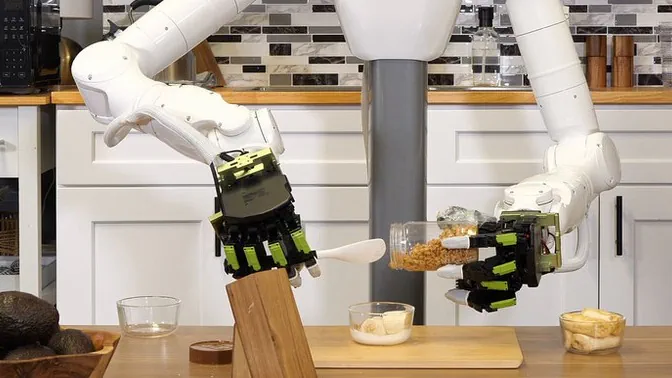
NVIDIA says 100,000 hours of human footage are openly available as Human-1M-100K on Hugging Face. That is roughly one-quarter of the 402,730 hours of human video listed in the pretraining mixture. It is a substantial public subset, but it is not the entire human-video corpus or the complete multimodal training mixture. (GR00T 2 research page)
This distinction matters for reproducibility. Access to Human-1M-100K gives researchers data to inspect and incorporate into experiments; it does not, by itself, supply everything used to train GR00T 2.
What Cross-Embodiment Transfer Means Here
NVIDIA reports a 65% success rate for a two-handed robot lining a laboratory funnel with filter paper and wetting it with a wash bottle, after seeing that task demonstrated only by humans.
In another example, a YAM arm assembled a toy dump truck with 60% success after task demonstrations collected using a handheld UMI gripper different from the robot’s own gripper. NVIDIA says the assembly can take up to four minutes. (GR00T 2 transfer results)
“Only by humans” describes the task demonstrations, not the model’s entire training history. GR00T 2 still received substantial robot training data. The useful finding is narrower: task knowledge learned from another body can transfer to a target robot without demonstrations of that task on that robot.
Reading the Adaptation Results Correctly
NVIDIA publishes several figures for the 50-task evaluation. They measure different things:
| Evaluation condition | NVIDIA-reported result | Meaning |
|---|---|---|
| Zero-shot evaluation | 40% success | Reported success across tasks unseen on the target robot |
| Zero-shot task coverage | 40 of 50 tasks completed at least once | Breadth of tasks with at least one successful attempt |
| One demonstration per task | 71% average success | Adaptation with a single target-task example |
| Five demonstrations per task | 95% success | Adaptation after additional demonstrations and fine-tuning |
The research page gives the 40% and 95% figures and specifies a 30-minute fine-tune on one RTX 5090 for the five-demonstration result. The announcement adds the one-demonstration result and the 40-of-50 task-coverage figure. These are NVIDIA’s own research results; the supplied evidence contains no independent replication. (Research results, announcement)
The difference between 40% success and 40 of 50 tasks is especially consequential. Completing 40 tasks at least once indicates coverage of 80% of the task set. It says nothing on its own about how consistently the robot completed each task. Both figures can be true without describing the same level of reliability.
Frequently Asked Questions
4 questions
1What Is NVIDIA GR00T 2?
GR00T 2 is a robot foundation world-action model that jointly predicts future video and robot actions. NVIDIA designed it to learn from human footage, handheld demonstrations and robot data.


