
Google announced Gemini 4 Hydrogen on November 12, 2026, positioning it as the fast, broadly available model for everyday coding and agent workflows. It is rolling out across developer tools, business products, the Gemini app and Search, with paid access in Antigravity.
The headline specifications are a 1 million-token context window, four thinking levels, and flat API prices of $1.50 per million input tokens and $7.50 per million output tokens. Google describes Hydrogen as an execution-focused companion to Gemini 4 Carbon and Argon, which target deeper, longer-running reasoning. (Google announcement)
For teams using Gemini 3.8 Flash, the practical question is whether Hydrogen improves successful task completion at an acceptable cost. Independent measurements offer useful context, especially because they cover Hydrogen’s highest thinking setting, while Google’s headline speed comparison uses its default.
Where Gemini 4 Hydrogen Is Available
Google lists Hydrogen across all tiers of AI Studio, the Gemini API, Gemini for business, the Gemini app and Google Search. In Google Antigravity, access is for paid Google AI Pro and Ultra subscribers. Availability can vary by product, account and region. (Google)
The consumer positioning is clearer than the elemental names suggest. TPS reports that the Gemini app labels Hydrogen “Everyday help,” with Argon assigned to code and analysis and Carbon to the most complex work. Free app users receive Hydrogen through automatic model selection when appropriate.
I’d read this as a broad-access workhorse launch. Google is putting the model where routine work already happens, while keeping more expensive reasoning options available for difficult steps. App access, however, should not be confused with an API entitlement or identical controls across every surface.
Flat Token Pricing Still Leaves a Thinking Tradeoff
Google says Hydrogen’s input and output rates remain flat across its entire million-token context window. That removes a context-length pricing step from the published rate structure. It does not make a large request cost the same as a small one. (Google)
At the listed rates:
- 100,000 input tokens cost $0.15.
- 10,000 output tokens cost $0.075.
- Together, that illustrative request costs $0.225, before caching adjustments or other applicable charges.
The million-token window gives teams room to supply substantial repository content, documents or multimodal material. Whether loading more context improves an answer remains a workload-specific question.
Hydrogen also has four thinking levels. Google identifies high as the default and xhigh as the highest setting. Thinking effort is a separate choice from context size: supplying more material and allowing more reasoning address different problems.
My practical preference would be to start migration testing at the default. A higher intelligence score is useful only when its extra reasoning improves the outcome enough to justify the time and token consumption.
Google’s Speed Claim and Independent Timing Measure Different Things
Google reports that Hydrogen scores 51 on the Artificial Analysis Intelligence Index at default high thinking and 54 at xhigh. It also says the default setting finishes tasks 2.5 times faster than Gemini 3.8 Flash. (Google)
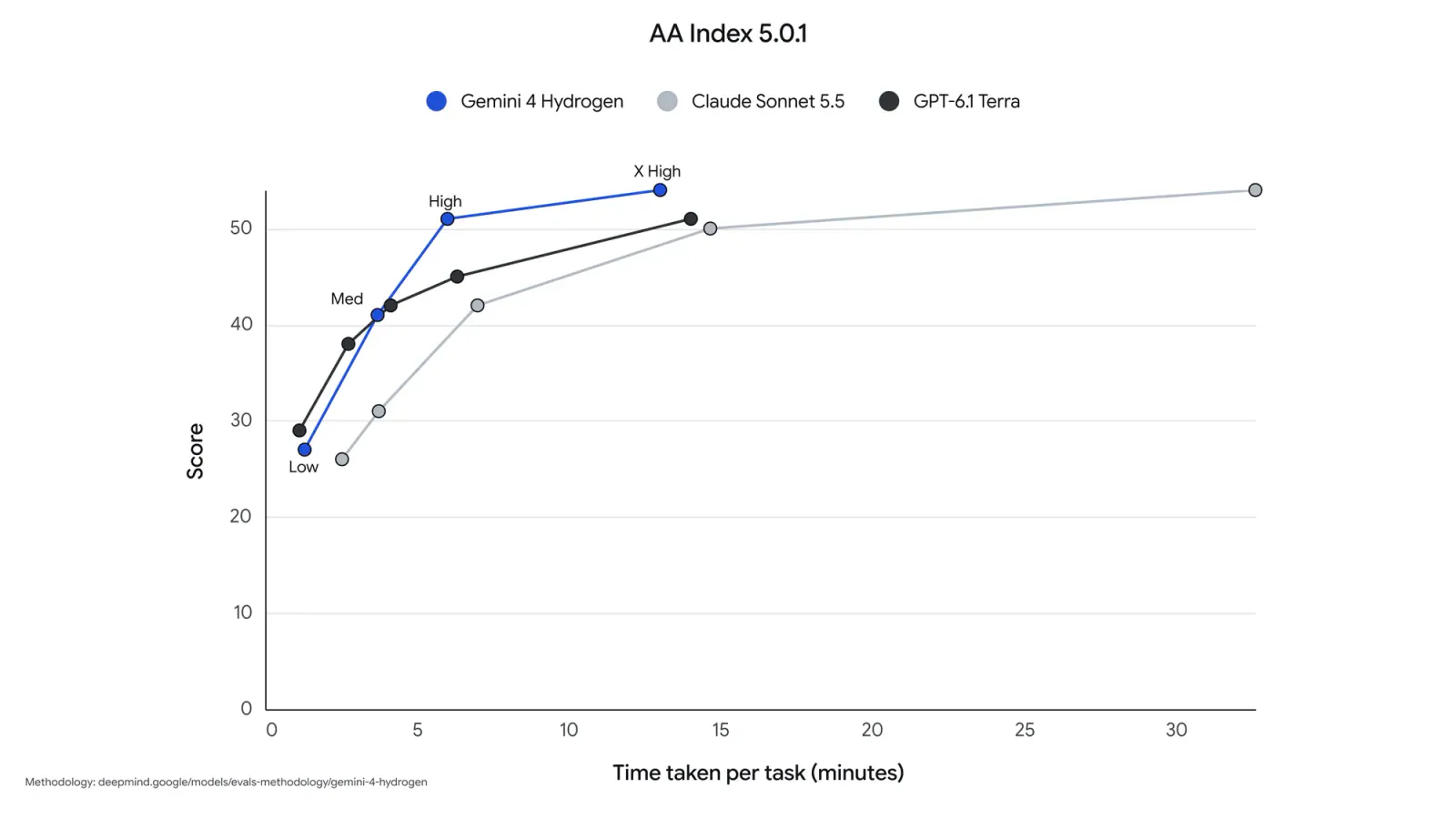
Artificial Analysis independently lists the xhigh variant at 54, alongside these measurements:
| Measurement | Published result | What it tells teams |
|---|---|---|
| Intelligence Index | 54 at xhigh | Corroborates Google’s reported highest-setting score |
| Time to first answer token | 41.11 seconds | Fast output generation can still follow a substantial initial wait |
| Output speed | 198 tokens per second | Measures generation speed, not complete task duration |
| Time per Intelligence Index task | 13.0 minutes; comparison median 12.9 | Xhigh is effectively near the comparison median on this measure |
| Cost per Intelligence Index task | $3.16 | Benchmark task cost can be much larger than a small-request pricing example |
Artificial Analysis describes the variant as “slower than average per task and very verbose.” Its evaluation generated 304 million output tokens, compared with a reported median of 72.8 million.
These findings neither reproduce nor contradict Google’s 2.5-times-faster claim: the thinking settings, task sets and comparison baselines differ. Artificial Analysis measures xhigh on its Intelligence Index tasks; Google compares default high with 3.8 Flash.
The consequential pricing detail is the gap between token rates and completed-task cost. Artificial Analysis calculates its weighted task cost using input, cache, reasoning and answer-token prices. Its $3.16 figure is an evaluation result, not a forecast for a support bot or repository fix. Still, it demonstrates why a cheap-looking rate card cannot settle a migration decision.
Reliability Claims Need Their Own Checks
Google reports 57% on Terminal-Bench 4.1, versus 18.2% for Gemini 3.8 Flash, and claims more than a fivefold reduction in fabricated claims. It also describes better recovery when tool calls fail or searches return nothing. These are Google-reported results. The independent measurements above cover capability, timing and cost, not validation of those reliability or broader safety claims. (Google)
Antigravity Orchestrator Routes Between Carbon and Hydrogen
Frequently Asked Questions
3 questions
1Is Gemini 4 Hydrogen available to free users?
Google includes all tiers of AI Studio and the Gemini app in its rollout. TPS reports that free app users receive Hydrogen through automatic selection. Antigravity requires Google AI Pro or Ultra.


