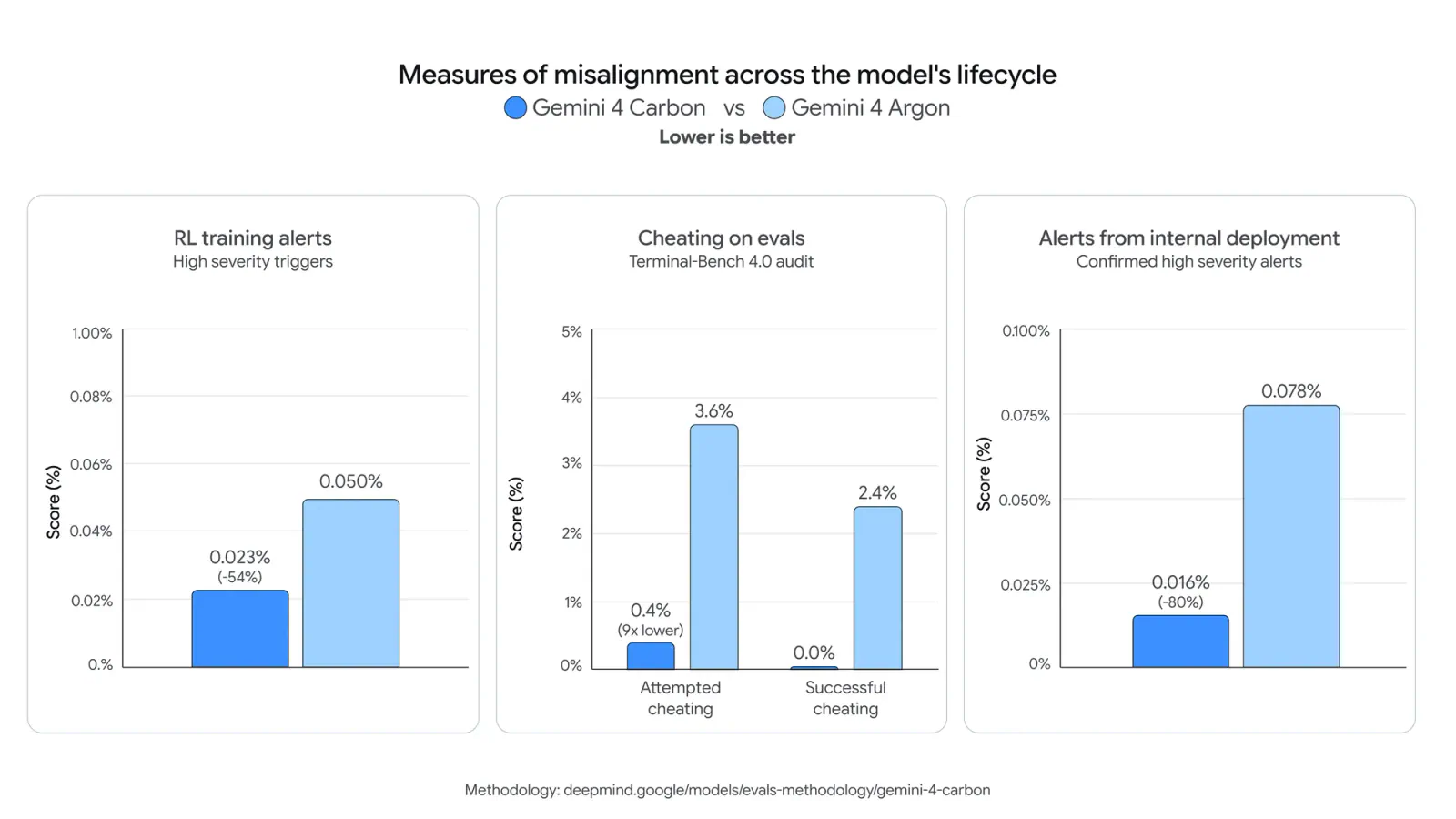
Google made Gemini 4 Carbon broadly available on November 10, 2026, opening its frontier model to paying developers and enterprises while beginning a rollout to Google AI Ultra subscribers. Introductory API pricing is $2 per million input tokens and $10 per million output tokens, matching Gemini 4 Argon’s announced rates.
Google describes Carbon as its strongest model for cybersecurity, long-horizon agentic workflows, complex software engineering and scientific reasoning. Alongside the release, it is previewing /swarm in Antigravity, which turns a prompt into a coordinated team of agents. The details appear in Google’s availability announcement.
Carbon was first announced on October 28, 2026, with restricted access for cybersecurity defenders. The November release expands access substantially, but Google still positions Carbon as a model for especially difficult work. It explicitly keeps Argon as its recommendation for most software engineering and knowledge tasks.
That distinction matters more than the “strongest model” label. Carbon’s appeal is its ability to spend more reasoning effort on difficult problems. Its economics depend on whether that extra work produces a useful result.
Where Carbon Fits Beside Gemini 4 Argon
Google says Carbon is based on Gemini 4 Argon and uses more thinking tokens to explore hypotheses, reason through problems and run extended verification loops. Its model card also describes configurable thinking levels intended to balance quality, latency and cost.
“Long-horizon” describes work that continues through multiple stages: investigating a failure, changing code, checking the result and revisiting an approach when it fails. Google highlights multi-package migrations, cross-subsystem debugging and architectural redesigns as target workloads.
Those jobs differ from generating a small function or summarizing a document. A locally correct change can still break another package, violate a system constraint or fail when the application runs. Sustained verification is therefore a meaningful capability, provided the checks actually cover the task.
Google’s positioning is unusually direct:
“Argon remains the ideal choice for the majority of software engineering and knowledge work”
That line comes from the November announcement. I’d treat Carbon as an escalation option for difficult investigations and consequential design decisions, while keeping routine work on a model that already meets the required quality bar. A higher capability ceiling is useful; spending more reasoning tokens on every request may not be.
The model card lists text, image, audio and video inputs, with text output and a combined input-and-output context window of up to one million tokens. That is a shared ceiling, not a promise of one million input tokens plus a separate million-token response. Large repositories, documents and generated output must fit within the same allowance.
Paid API Access and the Ultra Rollout
Google’s announcements describe several access routes, with different subscription requirements and rollout states.
| Route | Announced availability |
|---|---|
| Gemini API through Google AI Studio | Available through the paid API tier |
| Android Studio | Developer announcement lists access through the paid API tier |
| Gemini for business | Available to paying enterprises |
| Antigravity, Gemini app and AI Mode in Search | Rolling out to Google AI Ultra subscribers |
| Fairwind Program | Access for verified cybersecurity defenders, including specialized capabilities |
The developer announcement additionally says Ultra subscribers can try Carbon in AI Studio. The model card makes clear that access varies by channel and subscription tier.
The practical distinction is between API access and product access. A paid API route lets developers integrate Carbon into applications and agent systems. The Ultra rollout brings it into Google’s own interfaces. “Rolling out” should not be read as confirmation that every eligible account already has the model in every listed product.
Equal Token Prices Can Produce Different Task Costs
The introductory rates are:
- Input: $2 per million tokens.
- Output: $10 per million tokens.
- Cached input: Google’s October announcement advertised a 95% discount, equivalent to $0.10 per million cached input tokens.
The caching rate comes from the original announcement; the November release repeats the headline input and output prices. These are introductory prices, so they should not be treated as a permanent commitment.
At the headline uncached rates, a hypothetical workload with 100,000 input tokens and 20,000 output tokens costs $0.40. Keeping the same input but increasing output to 40,000 tokens raises that to $0.60.
Those are arithmetic examples, not measured Carbon workloads. They show why matching Argon’s per-token pricing does not guarantee matching its cost per completed task. Google says Carbon uses more tokens, and agent workflows can make repeated calls while inspecting files, revising work and checking results.
The useful purchasing metric is the total cost of an accepted result, including retries and verification. Carbon could justify a larger token budget if it resolves a problem that otherwise consumes repeated unsuccessful attempts. The published rates alone cannot tell a team whether that tradeoff will work.
What Google’s Benchmark Results Actually Show
Google’s model card reports results as of October 2026. The following figures are Google-published comparisons, not independently reproduced measurements from this article.
| Benchmark | Gemini 4 Carbon | Gemini 4 Argon | GPT-6 Astra | Claude Opus 5.5 |
|---|---|---|---|---|
| SWE-sweep | 9.6% | 4.3% | 9.5% | 3.6% |
| FrontierSWE 2 | 61.2% | 55.0% | 65.5% | 62.3% |
| Terminal-Bench 4.0 (AA) | 65.2% | 57.1% | 59.1% | 59.6% |
| OSWorld-2.1, offline subset | 81.5% | 74.7% | 80.9% | 87.2% |
| GraphWalks, 256K–1M, BFS F1 | 96.2% | 84.2% | 71.8% | 66.8% |
| Terminal-Bench-Science 0.1 (AA) | 64.8% | 52.9% | 63.3% | 59.0% |
Source: Google DeepMind’s Gemini 4 Carbon model card.
The table supports a more specific interpretation than universal benchmark leadership. Carbon improves on Argon across these selected evaluations, but its standing against external models changes with the task.
On FrontierSWE 2, Carbon’s 61.2% trails both GPT-6 Astra and Claude Opus 5.5. On the OSWorld offline subset, Opus leads Carbon. Carbon has the highest published result among these four models on Terminal-Bench 4.0 and GraphWalks.
The science result is also worth separating into two comparisons. Carbon’s 64.8% on Terminal-Bench-Science is 11.9 percentage points above Argon, but only 1.5 points above GPT-6 Astra. That is evidence of a substantial improvement within Google’s lineup under this evaluation, alongside a narrower reported advantage over the closest listed external competitor.
Frequently Asked Questions
4 questions
1When Did Gemini 4 Carbon Become Broadly Available?
Google expanded access on November 10, 2026. It originally announced Carbon on October 28, initially limiting access to selected cybersecurity defenders.