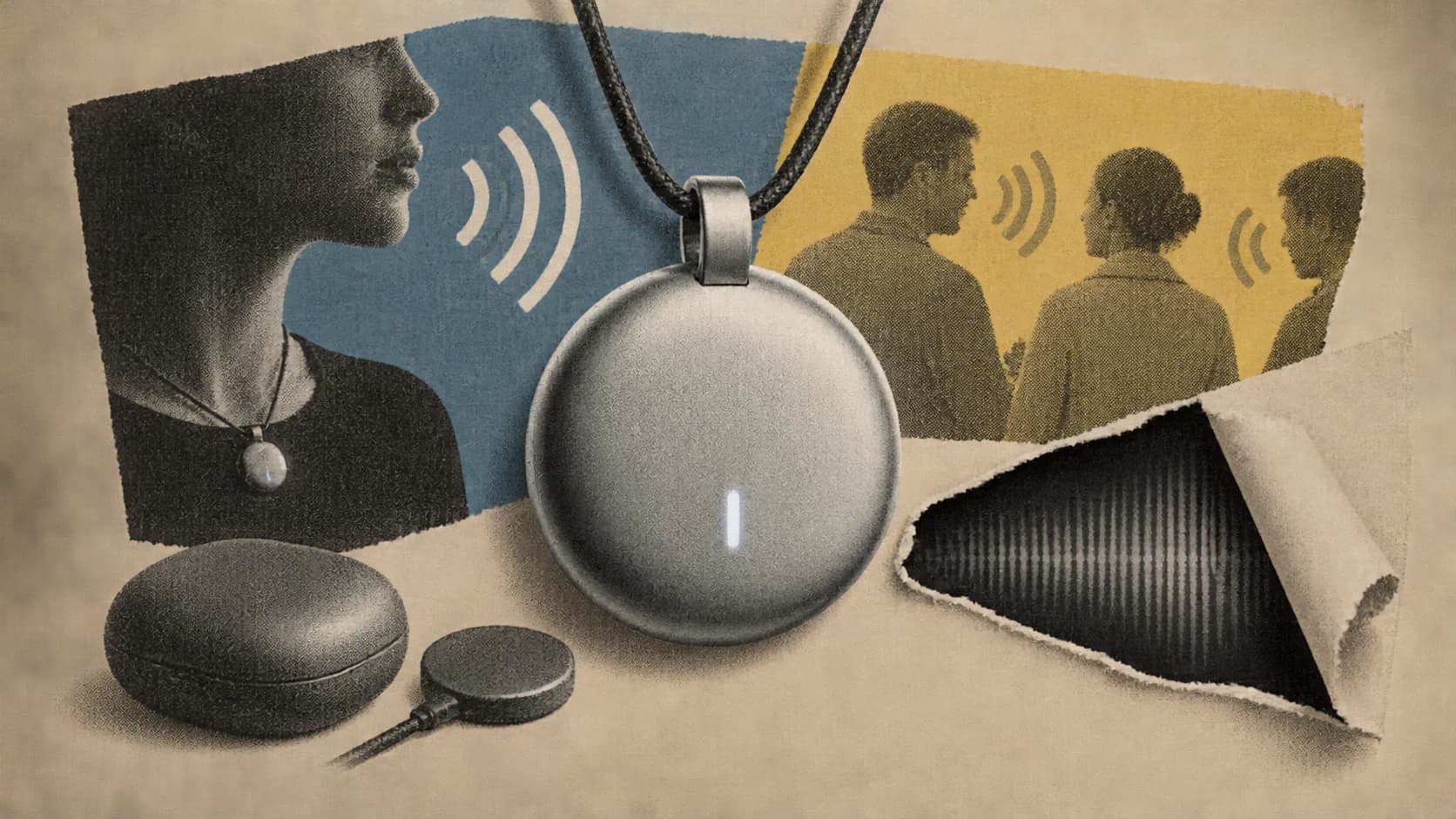
Nirva announced a $25 million pre-Series A round on October 22, 2026, bringing its disclosed funding to $33 million. Its next step is a $249 AI pendant that the company says can listen throughout the day while filtering out everyone except its wearer.
Orders are planned for November 2026, with shipments to early users targeted before year-end, according to TechCrunch’s report. Those are launch targets, not immediate availability.
The privacy pitch has two parts: identify the wearer’s voice, then discard audio and transcripts after processing by default. Meanwhile, the companion app turns speech into reminders, journal entries and personal insights. That creates an important distinction for buyers: deleting a recording and deleting what an AI learned from it are separate questions.
What Nirva Plans to Sell for $249
Nirva’s pendant can also be worn as a bracelet. The October report describes an approximately eight-gram device with battery life of up to three days on a charge, available in silver, brushed silver, black and gold. Those weight and battery figures are company claims, not independently measured results.
The app is intended to identify patterns in the wearer’s life, including emotions, communication style, social relationships and daily activities. It can also surface reminders and action items. CEO Wei Lyu gave TechCrunch an example of the app prompting her to thank her mother after she had forgotten.
That positions Nirva closer to an automated personal journal with coaching features than a conventional meeting recorder. Its official website describes automatic journaling, mood tracking, social relationship mapping and everyday guidance.
The site offers an email list for preorder information. Because the page is undated, it cannot establish a precise ordering timeline or confirm that checkout is live. The clearest dated schedule in the supplied reporting remains November orders and targeted early-user shipping by the end of 2026.
How Wearer-Only Voice Filtering Is Supposed to Work
Nirva asks users to record short samples of their voice during onboarding. According to TechCrunch, the company uses those samples to build a model that distinguishes the wearer from other people. During use, it says the system filters out speech and data captured from surrounding speakers.
Voice enrollment is therefore central to the product’s privacy claim. The pendant needs to recognize who is speaking, beyond identifying the words being spoken.
Filtering surrounding speech is different from never capturing it. The published description leaves unanswered where that filtering happens, whether incidental speech leaves the device before being rejected, and how the system handles overlapping voices. The supplied evidence includes no independent measurements of filtering accuracy, battery life, emotion inference or deletion behavior.
I’d treat speaker filtering as the first feature to verify, because much of Nirva’s appeal depends on it. A useful evaluation would show both how often someone else’s speech gets through and how often the wearer’s own words are mistakenly excluded. A quiet-room demonstration would leave open the harder cases, such as a busy restaurant or two people speaking simultaneously.
Wearer-only listening also creates a practical tradeoff. If the system excludes another person’s words, its account of a conversation necessarily has less context. That may be sufficient for remembering something the wearer promised to do. It is a more consequential constraint when generating advice about a relationship or communication style.
Deleting Audio Leaves a Separate Question About Insights
Nirva says it does not retain audio or transcripts after processing by default. Before discarding audio, however, it analyzes characteristics including tone, pitch, volume and speaking speed to produce emotion-related insights, according to the October report.
Three categories of information matter here:
- Audio: the captured sound, including vocal characteristics.
- Transcripts: a written representation of speech.
- Derived records: journal entries, reminders, emotional interpretations, relationship patterns and other information generated from that speech.
The stated deletion policy covers the first two categories after processing. It leaves a separate retention question for the third, which is also where much of the product’s usefulness resides.
An app needs access to some history to show patterns over time. Yet an inference about stress, relationships or recurring behavior can remain sensitive after the original recording disappears. Removing the source material does not automatically remove those records.
Nirva’s January announcement said users could delete their data at any time. The published material does not explain how that control applies to generated insights, longer-term profiles or backups.
I’d want the ability to inspect, correct and erase individual insights, alongside a whole-account deletion option. The reason is practical: interpreting someone’s mood from speech is an inference, and a mistaken interpretation should not quietly become the basis for future guidance.
The useful privacy question is therefore broader than how quickly recordings disappear. Buyers also need to know which information survives processing, how long it stays and what control they have over it.
January and October Tell Different Launch Stories
Nirva first previewed the jewelry at CES in a January 5, 2026 company announcement. That release described a substantially earlier ordering and shipping schedule than the October report.
| Published detail | January 5 company announcement | October 22 TechCrunch report |
|---|---|---|
| Ordering target | Preorders the following month, meaning February 2026 | Orders in November 2026 |
| Shipping target | First half of 2026 | Early-user shipments by year-end |
| Weight | 10 grams | About 8 grams |
| Battery life | Two days | Up to three days |
| Price | Not stated in the release | $249 |
Sources: Nirva’s January release and TechCrunch’s October report.
The October delivery target is later than the schedule Nirva originally published. The evidence does not explain the change or establish what, if anything, shipped under the earlier plan.
Frequently Asked Questions
3 questions
1Can Nirva Be Worn as a Bracelet?
Yes. Nirva describes the device as jewelry that can be worn either as a pendant or a bracelet.